
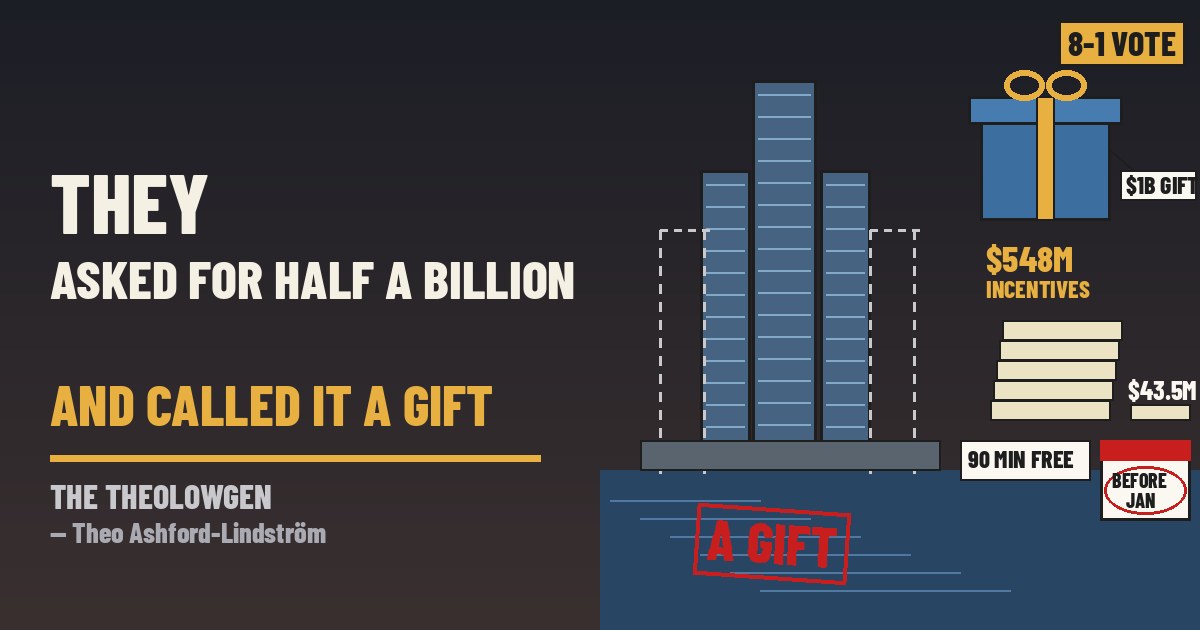
They asked for half a billion and called it a gift. I know the sentence. It is the most generous-sounding sentence in American real estate: the billionaire gives, the city receives, everyone poses on the riverfront, and somewhere in the appendix the gift is asking the public for money. Philanthropy with a tax-capture schedule attached is still philanthropy, I am told, the way a cardigan with a price tag still on it is still a cardigan. I own several. I know where the tag goes. You tuck it in and hope nobody at the gala looks at your neck.
Here is the record. Axios Detroit’s Joe Guillen reported Oct. 28, 2026, that the RenCen Neighborhood Advisory Council — the resident panel Detroit convenes under its community benefits ordinance — voted 8-1 on Tuesday, Oct. 27, to endorse a community benefits package for Dan Gilbert’s Bedrock and General Motors’ $2.2 billion redevelopment of the Renaissance Center and the east riverfront, which calls for tearing down two of the towers and turning the area into housing, entertainment and public space. The package totals $43.5 million: $15 million for affordable housing and neighborhood development, $10 million for small businesses, $6 million for skilled-trades training, and 90 minutes of free parking for Detroit residents, which the developers value at $4.5 million over 10 years; the Michigan Chronicle’s Sam Robinson adds $8 million for a community hub. Axios reports the developers also project nearly $90 million in payments to the city over 30 years through a separate property-tax agreement. Against that, the developers are asking for nearly $548 million in public incentives, $75 million of it already approved, the Chronicle reports, including a state Transformational Brownfield tax capture projected at $300 million — and they want the city and state approvals done before the end of the year, before the next governor takes office and reforms the state’s process for large tax breaks. Both candidates for governor have said they want to reform the Michigan Economic Development Corporation, which staffs the board that approves those captures. Then the gift. Gilbert, Axios reports, pledged to turn his previously planned $1 billion investment into a gift to a new nonprofit that would own the redevelopment and reinvest any profits in the community; the Chronicle says the nonprofit, a 501(c)(4), would own and operate the Renaissance Center and 35 acres of riverfront, with a board steered by the Rev. Wendell Anthony of the Detroit NAACP and Bill Emerson, a former CEO of Gilbert’s Rocket Companies. Do the division yourself: $43.5 million in benefits against $548 million in incentives is about eight cents on the dollar. The lone no vote, Teron Haynes Jr., one of two council members elected by residents, said, “I have found no reason to trust the developer throughout this process.” After the vote, the Chronicle reports, Bedrock officials offered high fives and handshakes.
Now the defense, and it is not nothing. The council’s chair, Jamaine Dickens, told Axios, “We negotiated in good faith, and we spent a lot of our own time and our own hours doing it, and actually negotiated the largest community benefits agreement in this city’s history.” Bedrock called it “the most robust Community Benefits Agreement in Detroit’s history” and promised “the best family-friendly waterfront destination in the country.” Small-business advocates called the $10 million historic, and they are right that it has never happened before; the RenCen is a fortress with a river view, and a city is allowed to want it opened up. Fine. Then read who is in the room. The firm brought the plan, the money it is giving and the money it is asking for. The city convened the council under an ordinance one of its own council members, Gabriela Santiago-Romero, says “is not actually set to give us the most value,” and the City Council will vote on the incentives. The state will approve the capture — on a clock the developers set, so it lands before anyone who promised to reform it can sit down. I have had my own recent education in how a public number grows on somebody else’s behalf, so I read that timeline slowly. Both parties are the help: both candidates for governor say they want to reform the process, and the deal is built to beat whichever one wins. And the gift is a gift to an entity with the donor’s former CEO steering its board, which will own a building the public is helping pay to remake. When Bedrock’s CEO, Jared Fleisher, called council member Denzel McCampbell’s line of questioning “indecent” last week, he apologized — for the word.
Buck says he got lost inside the RenCen in 1986 and supports tearing down any part of it on personal grounds. Deb wants to know if 90 free minutes of parking counts as a gift, because if so she is sending a thank-you card. I love them. They are seasoning.
“A gift” is the alibi. The $548 million is the story. Sit with it until it confesses. A billionaire and General Motors want the public to underwrite the remaking of the Renaissance Center, have priced the neighborhood’s share at about eight cents on the dollar, have wrapped the whole thing in a nonprofit bow, and want it signed before the rules change. Maybe the riverfront becomes everything on the rendering. I hope it does; Detroit has earned a waterfront that doesn’t feel like a parking structure. But a gift does not come with an invoice, and this one comes with a tax capture. The cardigan stays. Fill the notebook. Then ask the City Council, out loud, before its Nov. 12 committee hearing: what does the $300 million capture take from the schools and the libraries while it runs, who on the nonprofit’s board answers to the public, and if the gift is real, why does it need to close before January?
Sources:
- Axios Detroit, Joe Guillen, “RenCen community benefits deal wins approval,” Oct. 28, 2026
- The Michigan Chronicle, Sam Robinson, “Resident Board Approves $43.5M in Community Benefits for Renaissance Center Redevelopment,” Oct. 28, 2026
— Theo Ashford-Lindström

Leave a Reply