
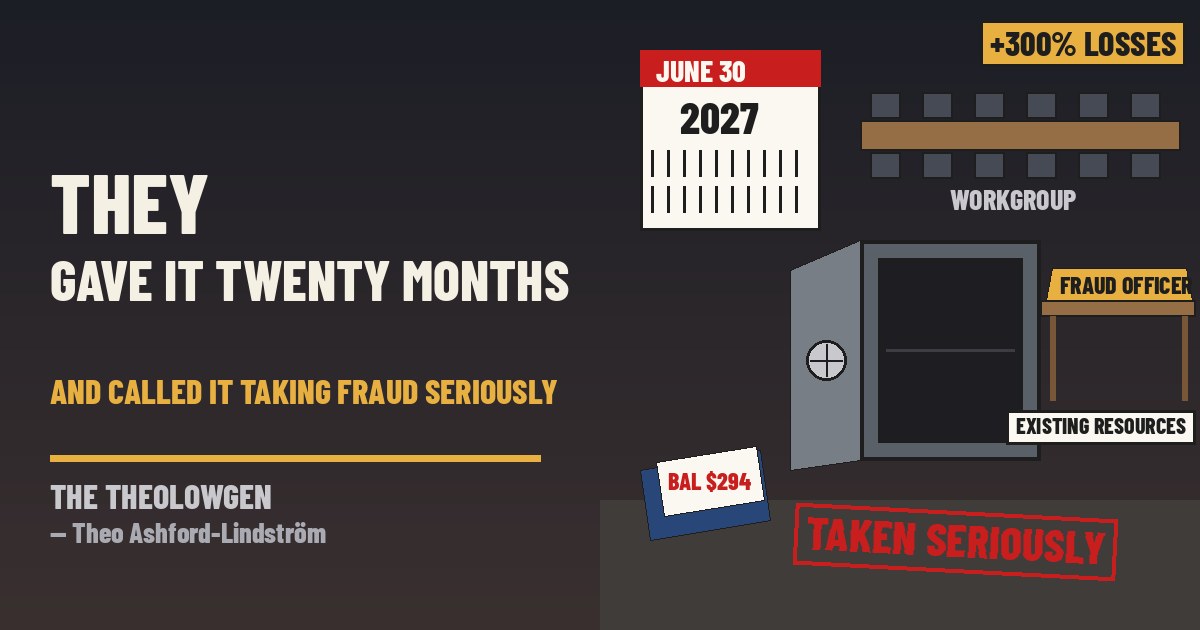
They gave the fraud twenty months and called it taking fraud seriously. I know the sentence. It is the one a government says when its own auditor has just handed it a number with a percent sign the size of a barn door and it needs, by the end of the business day, to look like it is moving. You do not fix anything by the end of the business day. You create something. A title. A workgroup. A framework with a due date far enough away that the people who signed the order may be in different jobs when it arrives. Back at the You Know Who Post, in a cardigan that cost more than a small town’s bank balance, I wrote the approving headline for this kind of morning more times than I can count. ‘State Steps Up.’ Nobody ever asked what the state stepped onto.
Here is the record. Washington State Auditor Pat McCarthy’s office said Oct. 27, 2026, that in fiscal year 2025 it conducted 54% more fraud investigations than before and documented a more than 300% increase in the amount of public funds lost, to $2.3 million, compared with the previous three-year average — and that is only what her investigators caught. “The single best defense against fraud is a strong set of checks and balances inside government programs,” McCarthy said, adding that her office and others “have identified too many programs launched without the proper controls in place and too many governments giving unchecked authority to a single person, leading to losses, questioned costs and fewer services available.” Her office has run 21 internal-controls workshops since 2024 for representatives of about 150 local governments, and this year created a director-level Special Investigations Division. Its director, Brandi Pritchard, told TVW’s The Impact what that looks like on the ground: the town of Cusick, she said, keeps an average bank balance of $200,000 to $300,000, “and all of a sudden they go to the bank and they have $294 to their name.” The same day, Gov. Bob Ferguson signed an executive order creating the state’s first Chief Fraud Prevention Officer, covering health and human services programs at the Health Care Authority and the departments of Health, Social & Health Services, Labor & Industries and Children, Youth & Families. The governor’s office says he “intends to implement this work using existing resources.” The order also creates a Public Funds Fraud Prevention & Accountability Workgroup of his cabinet agencies, co-chaired by his own office and the Office of Financial Management, which has until June 30, 2027 — twenty months — to produce a statewide framework and to make recommendations on, among other things, a public-facing dashboard. And he will ask the Legislature to expand Washington’s Medicaid-only False Claims Act to all false claims against the state, enforced, his office says, “solely through private individuals” who would collect a percentage of whatever the court awards.
Now the defense, and it is not nothing. “Washington takes fraud seriously,” Ferguson said. “As we continue to face challenging state budgets and devastating cuts from the federal government, it is more important than ever to protect every dollar.” McCarthy, who is not his employee, applauded. Twenty-five states have full False Claims Acts and Washington is one of five with only a Medicaid version; closing that gap is a real thing. Fine. Then read the shape of it. The losses are counted by the auditor, an independently elected office whose own investigators keep describing small governments where one person held the checkbook. The response is a new coordinator over five of the governor’s own agencies, funded with no new money, plus a committee of those same agencies, co-chaired by the governor’s office, whose framework is due after the next legislative session has come and gone. The state that launched programs without controls will now write a framework about controls, and grade it. And when it finally does reach for teeth, it does not hire them: it lets a private person sue on the state’s behalf and keep a cut, which is the state’s way of admitting it would rather pay a commission than do the job. I hate that I find that the most honest line in the order. The bureau does not trust the bureau either.
Deb was treasurer of the church council for six years and says the rule was two signatures on every check and nobody, including Pastor, got the checkbook overnight. Buck says he would have taken the fraud job using existing resources, and that his existing resources are a pickup and a flashlight. I love them. They are seasoning.
“Taking fraud seriously” is the alibi. The twenty months are the story. Sit with them until they confess. A state that just watched its documented losses more than quadruple has answered with the cheapest things a government can make — a title, a committee and a deadline — and a plan to outsource the suing. Maybe the framework will be excellent. I hope it is; Cusick deserved better than $294. But seriousness is measured in controls installed, not officers named. The cardigan stays. Fill the notebook. Then ask your legislator, out loud, before the session starts: how much of the $2.3 million has come back, what does the fraud officer cost if it isn’t new money, and what exactly is supposed to stop the next one-signature checkbook between now and June 30, 2027?
Sources:
- Office of the Washington State Auditor, “State Auditor: Governor’s fraud prevention workgroup an important step,” Oct. 27, 2026
- Office of Gov. Bob Ferguson, “Governor Ferguson creates Health & Human Services Chief Fraud Prevention Officer as part of new fraud-fighting initiative,” Oct. 27, 2026
- TVW, Mike McClanahan, “The Year in Fraud: New Special Investigations Division at SAO,” Oct. 14, 2026
— Theo Ashford-Lindström

Leave a Reply