
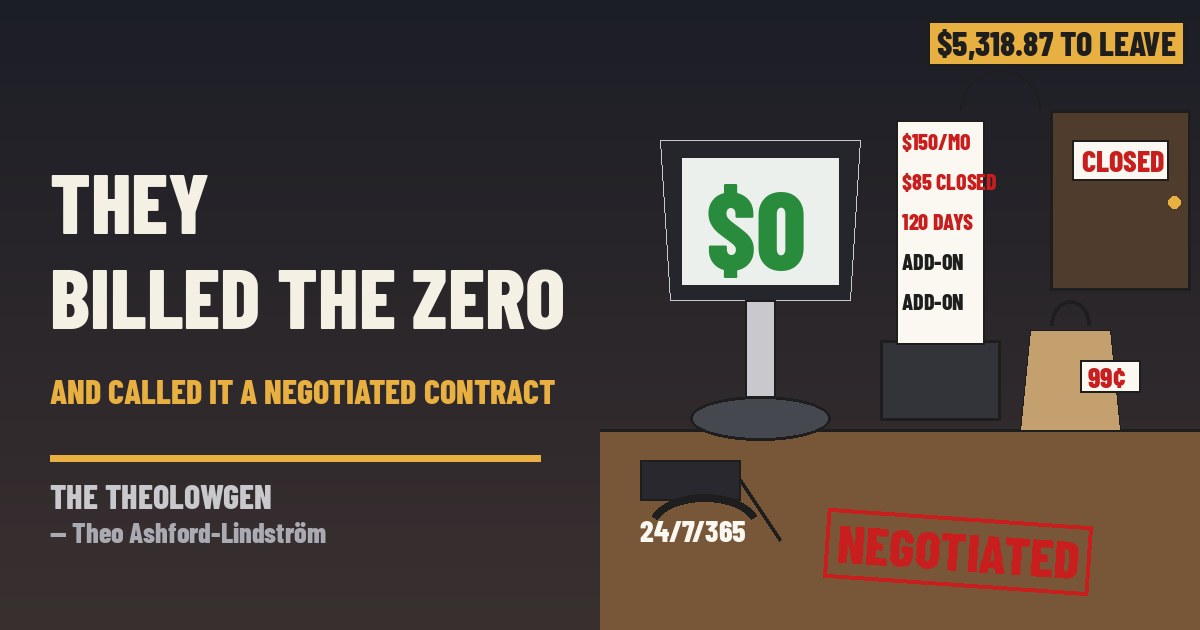
They billed the zero-dollar plan and called it a negotiated contract. I know the sentence. It is what a company says when it has been caught selling a price that isn’t a price, and the only defense left is that the customer is a grown-up who should have read the part in small type. Zero is the most expensive number in American commerce. Free trial, free shipping, free phone, $0 down: every one of them is a door that locks from the outside. I used to love the restaurants this story is about — the two-terminal places with the handwritten specials board, the owner who also does the dishes — mostly from a distance, mostly at brunch, mostly in a cardigan that could have paid their card-processing bill for a quarter. The cardigan stays. So does the arithmetic.
Here is the record. On Oct. 29, 2026, the Federal Trade Commission, the attorneys general of Colorado, Florida, Illinois, Iowa, Nebraska, Oklahoma and Utah, and the people of California through the Los Angeles County Counsel and San Francisco City Attorney sued Toast Inc. and affiliated entities in federal court in Northern California. The complaint, as the FTC describes it, says restaurants must enroll in auto-renewing subscriptions averaging around $900 a month and are often enrolled in, and charged for, add-ons like payroll and timekeeping they didn’t agree to. It says Toast advertises a Pay-as-you-Go plan with hardware and software for $0 a month in exchange for higher processing fees — and then: restaurants that don’t start processing within 120 days must return all the hardware or pay its full retail value; restaurants that close temporarily still pay $85 a month for payment processing; customers who cancel owe an undisclosed early termination fee of $150 for each remaining month of their contract. From September 2021 through late July 2023, the complaint says, Toast added a $0.99 fee to certain online orders over $10 — a fee that went to Toast, not the restaurant, on top of what restaurants already paid. “Nowhere did Toast state that it, not local restaurants, would keep the fee,” the plaintiffs wrote, per Payments Dive. Cancelling allegedly takes 30 days’ written notice of “intent not to renew,” not clearly disclosed at signup; some who gave it got no answer and kept being charged, and others were routed into retention pitches. One customer, the FTC says, was charged a $5,318.87 early termination fee, which Toast refused to refund, when he cancelled after four years. And the promised “24/7/365” support, the plaintiffs say, often wasn’t there. None of this is proven yet; it is a complaint.
Now the defense, and Toast had it out the same day. “We strongly disagree with the allegations in the lawsuit filed by the FTC and will vigorously defend the Company,” it said. The federal subscription law at issue, the Restore Online Shoppers’ Confidence Act, was passed “to address certain online subscription practices,” Toast says, and “no court has held that ROSCA applies to negotiated business-to-business agreements.” Applying it here, the company warns, could “rewrite the laws of commercial contracts” and result in “less competitive terms and more harm to small businesses.” It says it has cooperated with the FTC since mid-2025, that the agency “disregarded the information we provided showing the extent to which our restaurant customers negotiate their contracts,” and that nearly 200,000 business locations run on Toast. Fine. Maybe the statute doesn’t fit; a judge will decide that, and I am not here to canonize a federal commission or seven attorneys general who discovered small restaurants the week they could put out a press release about them. Both parties are the help, and this time both of them signed the complaint. But read what the defense is defending. Not the $0. Not the 99 cents taken from a diner’s takeout order and kept. Not the $5,318.87. It is defending the word “negotiated” — as if a one-terminal taco counter negotiated with a publicly traded payments company the way two lawyers negotiate, as if the person who also does the dishes had leverage over a cancellation clause. That is the oldest move capital has: call the take-it-or-leave-it form a contract between equals, and then call the fine print freedom.
Deb says she quit the bank that charged her a fee for closing her account and told the teller it was the best fee she ever paid. Buck says any machine that charges you $85 a month to not use it is a boat. I love them. They are seasoning.
“A negotiated contract” is the alibi. The zero is the story. Sit with it until it confesses. A company that runs nearly 200,000 locations sold the smallest of them a number it could not deliver, then built the exit so that leaving cost more than staying, then answered the lawsuit by arguing about which law the complaint is filed under. Maybe Toast wins on ROSCA. Winning on the statute is not the same as the $0 being true. The cardigan stays. Fill the notebook. Then ask your favorite two-terminal place, out loud, next time you pick up: what does the free plan actually cost you, how long is your contract, and if you wanted to leave tomorrow, what would they bill you to go?
Sources:
- Federal Trade Commission, “FTC and States Take Action Against Toast Inc. over Hidden and Unauthorized Fees, Deceptive Subscription and Cancellation Practices and Other Unlawful Conduct,” Oct. 29, 2026
- Payments Dive, “FTC, states sue Toast over fees,” Oct. 29, 2026
- Toast (Business Wire), “Toast Responds to FTC Lawsuit,” Oct. 29, 2026
— Theo Ashford-Lindström

Leave a Reply