TheTheolowgen — Notes from the cardigan left

Blog

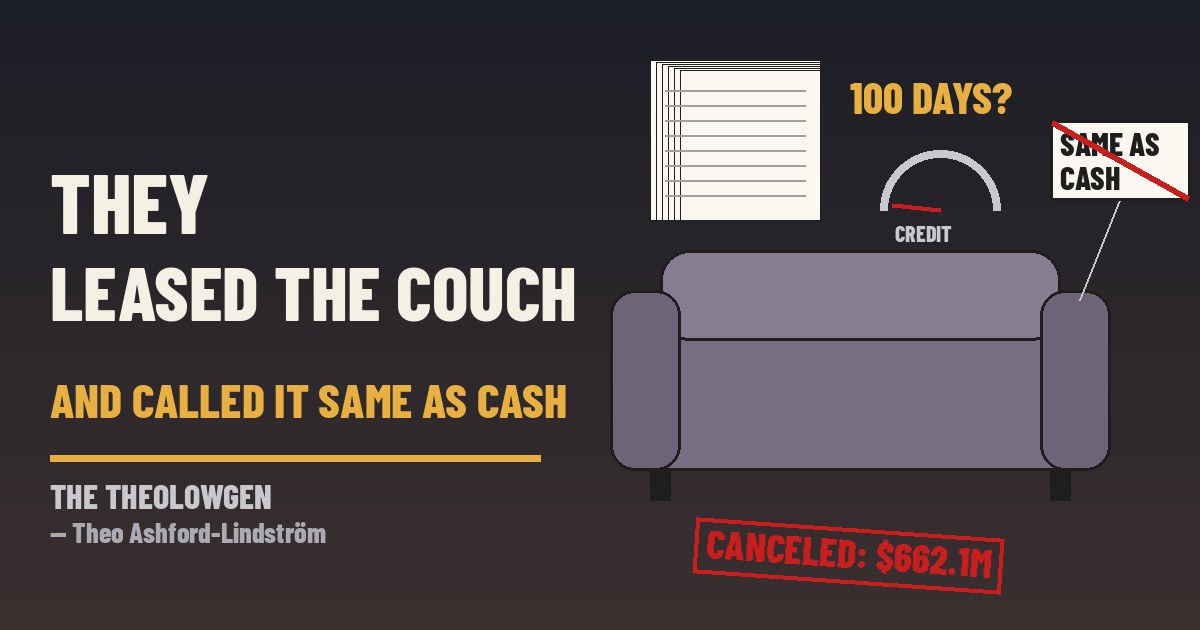
  • THEY LEASED YOU THE COUCH AND CALLED IT SAME AS CASH | A 17-state settlement makes Snap Finance cancel $662.1 million in lease-to-own payments and stop using slogans like “cash payoff,” “same as cash” and “no additional fees required,” after the states said customers who thought they had short payoff windows of 100 days or fewer ended up in longer, costlier contracts, were told on-time payments could raise their credit scores, and fought to return what they leased

    THEY LEASED YOU THE COUCH AND CALLED IT SAME AS CASH | A 17-state settlement makes Snap Finance cancel $662.1 million in lease-to-own payments and stop using slogans like “cash payoff,” “same as cash” and “no additional fees required,” after the states said customers who thought they had short payoff windows of 100 days or fewer ended up in longer, costlier contracts, were told on-time payments could raise their credit scores, and fought to return what they leased

    They leased you the couch and called it same as cash. I know the sentence. It is what a firm says when it stands at the checkout counter of somebody else’s store, buys the couch out from under you, keeps the title, and rents it back to you on terms you were not shown, with a slogan that sounds like a discount and a payment schedule that reads like a mortgage.

    Here is the record. On Oct. 20, 2026, West Virginia Attorney General JB McCuskey announced his state had joined a coalition of 17 attorneys general in a nearly $664 million settlement with Snap Finance, led by Iowa and Nebraska. Total lease forgiveness for consumers in the settling states: $662,102,518. Snap also pays $2,750,000 to the states. How the product works, in the release’s words: Snap offers lease-to-own agreements “through merchant partners rather than through its own brick-and-mortar stores”; when a customer picks it, “Snap purchases the merchandise from the merchant, Snap takes the title or owns the merchandise, and then Snap leases it to the customer until the customer pays off the full cost of the lease.” What the states alleged: misleading disclosures; customers not allowed to view the full terms of their contracts; “extreme communication issues” when trying to return products; confusing payment terms, with some customers believing they had pay-back windows of 100 days or fewer who instead signed long-term contracts that ended up more expensive; customers told that on-time lease payments could raise their credit score, “but that was not the case”; and potentially bad debt-collection practices and a deceptive return-and-termination process. What Snap agreed to change: no more slogans like “cash payoff,” “same as cash” and “no additional fees required”; full terms shown before signing; repair or replace leased property when required; no threatening to seize a product “when it has no intent to do so”; no claiming the product helps credit scores; a clear right to terminate, practical returns, and payments paused while termination is processed; plus merchant training and annual compliance reports for three years. For West Virginia, lease payments of $4,442,388 on agreements from 2017 to 2022 are canceled automatically, and customers keep the merchandise. The release says Snap cooperated with the investigation.

    Cricket read “same as cash” out loud at dinner and Buck said that’s what they told him about the boat. Rafal R. asked if they lease granpapi onesies. They do not. I love them. They are seasoning.

    The slogan is the alibi. The title is the story. Sit with “Snap takes the title” until it confesses. The couch was never yours at the register; it became the firm’s at the register, and you became a tenant of your own living room, paying rent on furniture to a company you met for ninety seconds at somebody else’s checkout. That is the trick of the whole business: it is not credit, so it dodges the rules for credit, and it is not a store, so it dodges the shame of a store, and it lives in the gap at the counter where a tired person with a broken fridge is told the words “same as cash” and believes them because the alternative is no fridge. $662 million in canceled payments is a confession with a press release stapled to it. Do not let anyone call it generosity. It is the firm handing back money the states say it should never have been in a position to collect. And I will not crown the states for it either. They took $2.75 million off the top, and West Virginia’s slice goes into a fund for “consumer education,” as if the problem were that poor people were insufficiently educated about a slogan the firm was allowed to print for years. The cardigan stays. I paid full price for it, which is the only kind of honesty the market ever taught me. Fill the notebook. Then ask, out loud, how many couches it took before somebody read the lease.

    Sources:

    — Theo Ashford-Lindström

  • THEY OPENED A CASE ON YOUR CAR AND CALLED IT A COURTESY LETTER | Maryland’s MVA started mailing official warning notices Oct. 1 to residents driving on another state’s plates — 60 days to comply, then $7 a day up to $420, and after 120 days the state hands the file to local governments that can boot, tow, impound or pull the plates; Baltimore County is weighing a bill to be the hammer, with a vote set for Nov. 2

    THEY OPENED A CASE ON YOUR CAR AND CALLED IT A COURTESY LETTER | Maryland’s MVA started mailing official warning notices Oct. 1 to residents driving on another state’s plates — 60 days to comply, then $7 a day up to $420, and after 120 days the state hands the file to local governments that can boot, tow, impound or pull the plates; Baltimore County is weighing a bill to be the hammer, with a vote set for Nov. 2

    They opened a case on your car and called it a courtesy letter. I know the sentence. It is what a state says when it mails you twice to be friendly, mails you a third time to start a clock, and makes sure the third envelope says a file now exists with your name on it, and that the file has a calendar, and the calendar ends with somebody else’s tow truck.

    Here is the record, from the Maryland Motor Vehicle Administration itself. On Sept. 30, 2026, the MVA announced that starting Oct. 1 it would begin “issuing official warning notices to Maryland residents who own vehicles registered in another state,” under Chapter 487, Senate Bill 111, signed by Gov. Wes Moore. The notices begin a 60-day period to register in Maryland or prove you don’t have to; no fines during that window. Then: “$7 per day, up to a maximum of $420 for each improperly registered vehicle.” Then: “If vehicles are not properly registered after 120 days, the MVA will notify the appropriate local jurisdictions for additional penalties, which may lead to civil action including booting, towing, vehicle impoundment and/or the seizure of out-of-state plates.” The agency says the warnings follow courtesy letters it mailed in January and July; its summer release counted about 79,000 courtesy letters sent at the end of July, and it says the official notice informs owners “that a case has been opened.” The MVA’s Oct. 1 business bulletin adds the rest of the menu: a non-resident permit for people keeping an out-of-state car in Maryland more than 60 days costs $27 (free for active-duty military and dependents); title service agents may no longer sell or facilitate another state’s registration to a Maryland resident, on pain of license suspension; and residents who re-title by Dec. 31, 2026 skip the excise tax, which applies to these vehicles starting Jan. 1, 2027. Motor Vehicle Administrator Chrissy Nizer: “At the MVA, we are committed to being a partner and a resource for our customers.”

    Now the hammer. WMAR-2 News reports the Baltimore County Council is weighing a bill spelling out its end of the crackdown: the county could boot or impound a car not registered in Maryland 60 days after the owner moved in, and could take the plates. Councilman Julian Jones, who has serious concerns about the bill, described the arrangement plainly: at some point the state is “gonna ask us, Baltimore County to sort of be the hammer.” He said many drivers do it because they can’t afford Maryland’s tags or insurance or owe MVA fines they can’t pay. The station’s numbers: registering a passenger car of 3,500 pounds or less costs $120.50 in Maryland and $30.75 in Virginia. Councilman Nino Mangione supports the bill as “additional tools to enforce vehicle registration requirements or to collect outstanding traffic and parking fines.” The council votes Nov. 2.

    Buck asked whether they’d boot his truck for the Wisconsin trailer plate, and Taryn told him to sit down before somebody opens a case on him. Deb has filed the word “courtesy” in the drawer where she keeps “as applicable.” I love them. They are seasoning.

    The courtesy letter is the alibi. The tow truck is the story. Sit with the $89.75 until it confesses: $120.50 here, $30.75 across the river, and a state that would rather build a 120-day enforcement pipeline than ask why the gap is wide enough to drive a Virginia plate through. I am not pretending the plates are honest; a woman in that WMAR story lost her car to a hit-and-run, and that is real. But look at the shape of the machine. Two letters to be nice. A third to open a file. A daily fee that stops at $420, and then the file is handed down the ladder to a county that is asked to do the part with the boot, so the agency that wrote the notice gets to keep calling itself “a partner and a resource.” Mangione said the quiet part with his whole chest: the tools are also to “collect outstanding traffic and parking fines.” That is not a registration law. That is a collections agency with a seal. I used to think the state was the thing you called when the market squeezed the poor. Now I read a press release about safety and find a clock, a fee, a cap, a referral and a tow hook, in that order. Both parties are the help, and the help has a boot. The cardigan stays. Fill the notebook. Then ask, out loud, who gets towed first when the case is opened by the state and closed by the county.

    Sources:

    — Theo Ashford-Lindström
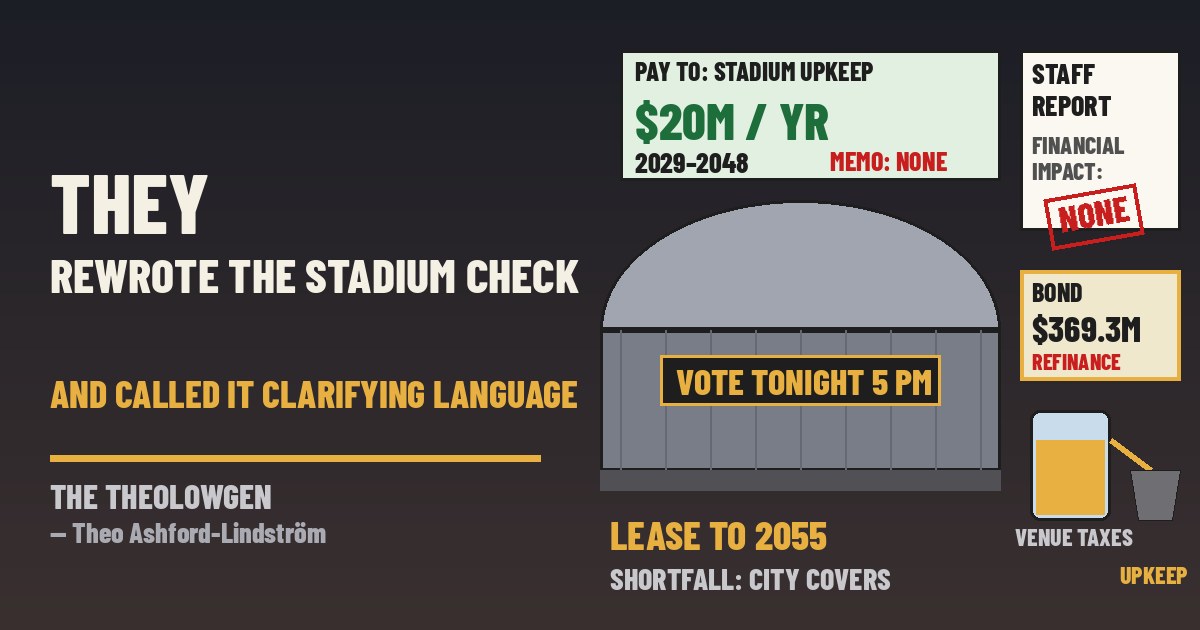
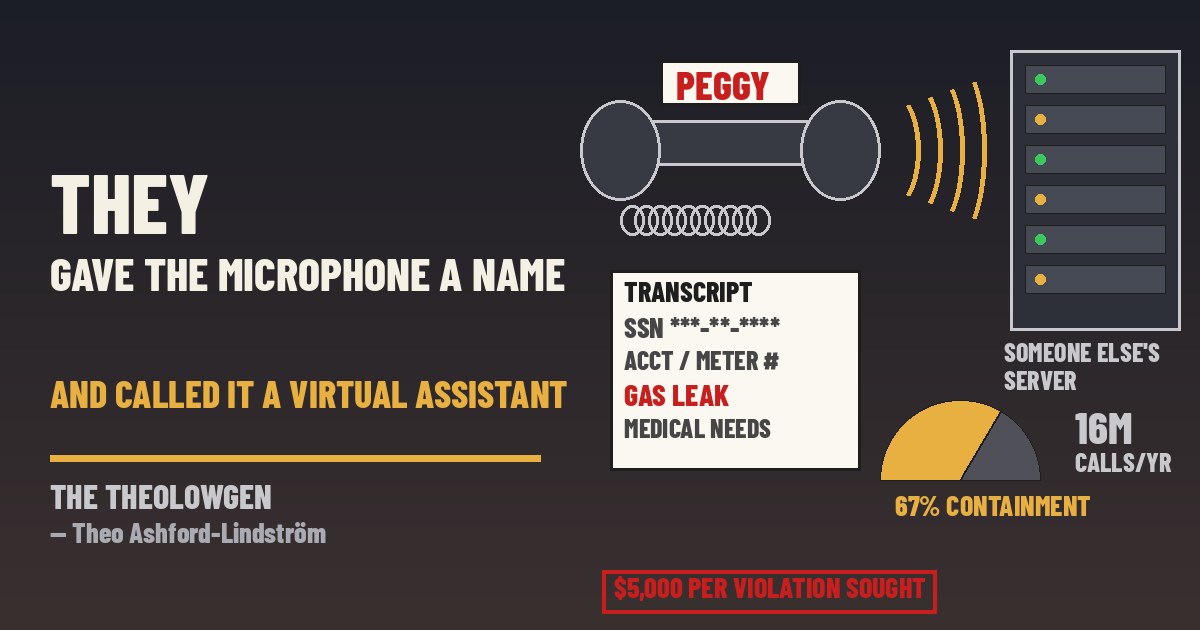
  • THEY GAVE THE MICROPHONE A NAME AND CALLED IT A VIRTUAL ASSISTANT | A proposed class action in Alameda County alleges PG&E, whose customer lines take about 16 million calls a year, answers them with “Peggy,” an AI agent running on vendor PolyAI’s platform that records and transcribes Social Security numbers, bank details and gas-leak reports without telling callers a second company is listening — while PolyAI’s own case study boasts of 35,000 labor hours saved and 67% “containment”

    THEY GAVE THE MICROPHONE A NAME AND CALLED IT A VIRTUAL ASSISTANT | A proposed class action in Alameda County alleges PG&E, whose customer lines take about 16 million calls a year, answers them with “Peggy,” an AI agent running on vendor PolyAI’s platform that records and transcribes Social Security numbers, bank details and gas-leak reports without telling callers a second company is listening — while PolyAI’s own case study boasts of 35,000 labor hours saved and 67% “containment”

    They gave the microphone a name and called it a virtual assistant. I know the sentence. It is what a utility says when you call about a gas smell, or a bill you cannot pay, or a medical device that needs the power to stay on, and a pleasant voice answers — and what the pleasant voice does not mention, according to the people now suing, is that it belongs to a different company, runs on that company’s servers, writes down every word you say, and may keep your voice afterward for its own use.

    Courthouse News Service’s Monique Merrill reported on Monday, October 19, 2026, that five California residents, all Pacific Gas and Electric customers, filed a proposed class action on Friday in Alameda County against PG&E and PolyAI Technologies under the California Invasion of Privacy Act. The complaint says calls to PG&E connect to a system that introduces itself as “Peggy, PG&E’s virtual assistant,” an AI answering product built by PolyAI, and that the calls are transmitted to and processed on PolyAI’s platform rather than PG&E’s, with PolyAI reserving the right to keep and use them. “No caller is told any of this,” the plaintiffs write. PG&E’s greeting says only that the call may be recorded and to tell the agent if you don’t want that — which, the complaint notes, means you must say it to Peggy, after Peggy already has your voice. “Consent that can be withheld only after the interception has begun is not prior consent.” Their list of what callers handed over without knowing it: names linked to home addresses and phone numbers, PG&E account and meter numbers, Social Security numbers, payment-card and bank-account information, outages and gas leaks at their homes, and, for many, household medical needs and financial hardship. The complaint says PG&E selected PolyAI, connected its phone lines to PolyAI’s platform, scripted a greeting that conceals PolyAI’s existence, and pointed callers to a privacy policy that promises service providers “must also not use your personal information for any purpose other than that for which it was given.” PG&E serves more than five million customers in the northern two-thirds of California, and its customer lines take about 16 million calls a year. The plaintiffs ask for $5,000 per violation and an order to permanently delete every recording and transcript. Neither PG&E nor PolyAI responded to Courthouse News before press time. None of it has been proven, and no class has been certified. Then there is the brochure. PolyAI’s own case study, still on its website, is titled “How Pacific Gas and Electric saved 35,000 labor hours with PolyAI.” It says PG&E was “about to implement a rate increase that would create a substantial surge in call volumes”; that Peggy greets “distressed customers calling the dedicated outages line”; that the two companies set a return-on-investment target of 3.5% “call containment,” hit 15% on the first day, and have reached 67%; that customer satisfaction rose 22%; that “PolyAI accurately records call data”; and that the plan is “100% of calls handled by the Poly AI agent.” LegalTech Digest notes that Pegasystems and U.S. Bank face similar class actions over AI call transcription without consent.

    Taryn asked whether Peggy is the person in a chair. UCraig called about the rain barrel and was texted a link. Dr. Marisol Ellery would like to know who is keeping the session notes. I love them. They are seasoning.

    The virtual assistant is the alibi. The 16 million calls are the story. Sit with the word containment until it confesses. Containment is what you do to a leak, a fire or a crowd, and a utility’s vendor has chosen it as the word for what happens to a customer who wanted a human being and got a transcript. Read the brochure again, slowly, because it is the most honest document in the case. The problem PolyAI was hired to solve was not your privacy, or even your wait; it was the call volume a rate increase was about to produce. The firm raises the price, then buys a machine to absorb the people who call to ask why, then counts the people who never reach a human as a 67 percent success, then counts the humans who no longer have to answer as 35,000 labor hours saved — which is a nice way of saying the work was moved from a person on a headset to a server in someone else’s building, and the person calling became the raw material. That is the anti-capitalist cut, and it writes itself: the customer’s voice used to be a complaint; now, if the complaint is right, it is inventory. And no, I am not going to recruit the state to rescue me from Peggy. A wiretap statute in the hands of class counsel is a price list — $5,000 a violation — and a price list is not privacy; whatever it wins, nobody’s Social Security number gets un-transcribed. The cardigan stays. I would have told Peggy its size if she had asked, and apparently she would have kept it. Fill the notebook. Then ask, out loud, who you are talking to when the greeting has a name, the server has an owner, and the only one on the line who does not know the call is being kept is you.

    Sources:

    — Theo Ashford-Lindström
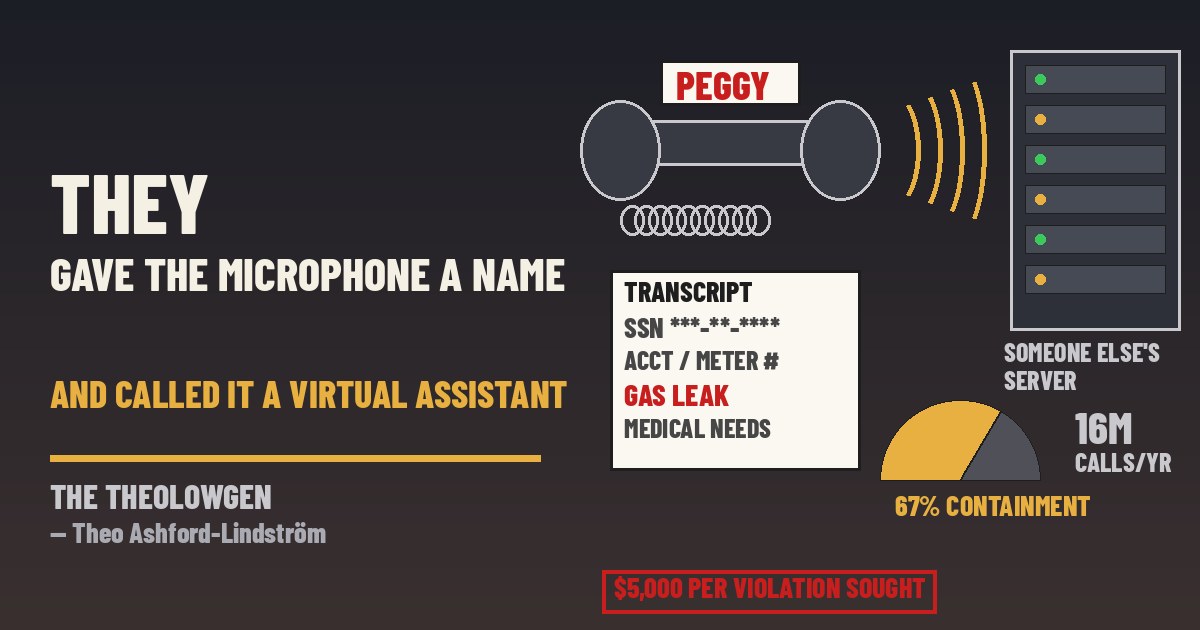
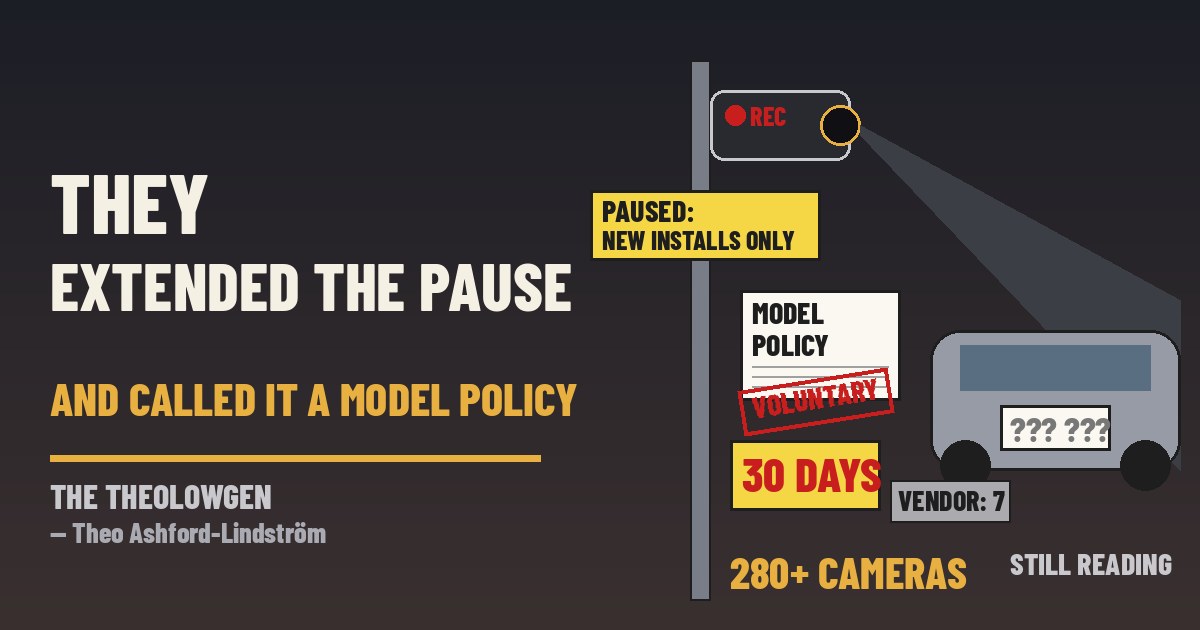
  • THEY EXTENDED THE PAUSE AND CALLED IT A MODEL POLICY | Rhode Island Gov. Dan McKee keeps the freeze on new license-plate readers going indefinitely and hands local police a voluntary State Police model policy that lets plate data sit 30 days — longer than the seven-day limit Flock itself adopted in August — while the existing network, at least 280 cameras by the ACLU’s count, was never paused and binding rules wait for the 2027 General Assembly

    THEY EXTENDED THE PAUSE AND CALLED IT A MODEL POLICY | Rhode Island Gov. Dan McKee keeps the freeze on new license-plate readers going indefinitely and hands local police a voluntary State Police model policy that lets plate data sit 30 days — longer than the seven-day limit Flock itself adopted in August — while the existing network, at least 280 cameras by the ACLU’s count, was never paused and binding rules wait for the 2027 General Assembly

    They extended the pause and called it a model policy. I know the sentence. It is what a state says when it spends sixty days reviewing a surveillance network with the police chiefs and the league of cities, receives the recommendations at 10 a.m., announces them at 4:08 p.m., and then — instead of a rule anybody has to follow — hands every town a document it is “urging” them to adopt, while the cameras already on the poles keep doing exactly what they were doing in August.

    The Rhode Island Current’s Christopher Shea reported on Monday, October 19, 2026, that the state’s pause on new automated license plate reader installations, originally set to end that day, has been extended indefinitely after Gov. Dan McKee announced he would leave it to the General Assembly to establish binding statewide safeguards. In the meantime, the governor’s office released a statewide model policy and a template data-sharing memorandum of understanding “to guide the use of automated license plate readers (ALPRs) by local law enforcement agencies that choose to use this technology,” and said it is “urging municipalities that currently use ALPR technology to adopt the model policy.” What the model policy says, per the governor’s release: no use for immigration enforcement, for investigations involving reproductive or gender-affirming health care, for harassment or discrimination, or for conduct that is not a crime under Rhode Island law; plate data deleted within 30 days “unless preserved for valid law enforcement purposes”; a public transparency portal; quarterly audits and search documentation; restrictions on sharing with outside agencies; and, for anyone who violates it, possible “administrative sanctions, up to and including termination, civil liability, and criminal prosecution, as applicable.” It was written by the Rhode Island State Police in consultation with the Rhode Island Police Chiefs Association, the Rhode Island League of Cities and Towns and the Rhode Island Police Accreditation Commission, and it will be reviewed annually. McKee: “Automated license plate readers can be a valuable tool for law enforcement, but we need to make sure they’re being used responsibly and that people’s privacy is protected.” State Police Superintendent Col. Darnell Weaver: the policy “establishes clear, consistent standards.” Now the August version, from the governor’s own Aug. 18 release: McKee called for a statewide pause on “the installation and activation of any new” cameras; the State Police would not install or activate additional ones; “Existing State Police ALPR cameras may continue to operate”; and cities and towns were urged, not ordered, to pause new installations. The Current adds the rest. Privacy advocates criticized the review for shutting them out. In an Oct. 9 letter, they asked for a state law limiting retention to seven days, noting that Flock Safety, the company behind the network, had itself cut its limit from 30 days to seven in August. Under the new guidance, police can still reach the data when a criminal investigation warrants reasonable suspicion of a state or federal crime; advocates had asked to restrict use to specific serious offenses such as stolen vehicles, missing persons and violent crimes. Rhode Island municipalities and the State Police have contracted independently with Flock since 2021, building a patchwork of at least 280 cameras statewide by the ACLU’s estimate; Providence city councilors recently proposed ending that city’s relationship with the company. Spokespeople for House Speaker Christopher Blazejewski and Senate President Valarie Lawson said neither had reviewed the proposal yet and expected the issue to come up in the 2027 session. The ACLU of Rhode Island, after what it called a cursory review, said the policy’s definition of a valid law enforcement purpose — which includes “information gathering,” the “prevention of crime” and “ensuring the safety of the public,” with or without cause that a crime has been committed — allows use “for just about any reason”; that it does not stop the system from photographing drivers and passengers or prohibit facial recognition; that the promise of prosecution is “largely meaningless” without a law that makes misuse a crime; and that “the policy promises much less than meets the eye.” The ACLU said it appreciates that the pause on further installations remains in effect.

    Deb filed “as applicable” under “words that mean not.” Cricket tried to laminate the model policy to see if lamination makes a thing binding; the laminator needs Gary, and Gary is not in the General Assembly until 2027. Joey drew 280 cameras on a pizza box and ran out of pizza box. I love them. They are seasoning.

    The model policy is the alibi. The 280 cameras are the story. Sit with the 30 days until they confess. A pause on new installations is a pause on growth, not on reading; every plate that passed a pole in Rhode Island on Monday was read on Monday, and every one that passes tonight will be read tonight, and the only thing the state froze was the next purchase order. Then look at who wrote the rules. The police wrote them, with the chiefs, the cities and the accreditation board — the people who use the cameras, consulting the people who buy the cameras, about the people in front of the cameras, who were not in the room. That is not oversight. That is the state grading its own homework and mailing the answer key to the towns as a suggestion. And the suggestion lets your plate sit in a database for 30 days, which is longer than the vendor’s own default. I will not crown the vendor for that. A default is a dial, and a company that turns a dial down in August can turn it back up the week a renewal needs it; Flock did not become a civil-liberties group, it became a company that read the room. But a state that writes a privacy rule looser than the surveillance company’s marketing has told you exactly how much it thinks your street is worth. I used to believe the cure for a camera was a better policy, written by better people, in a better process. Rhode Island just showed me the better process. It ends in a document nobody has to adopt, with penalties “as applicable,” and an indefinite pause on everything except the cameras. The cardigan stays. Fill the notebook. Then ask, out loud, whose street it is when the pause is permanent, the policy is voluntary, and the only binding thing in the whole arrangement is the contract.

    Sources:

    — Theo Ashford-Lindström
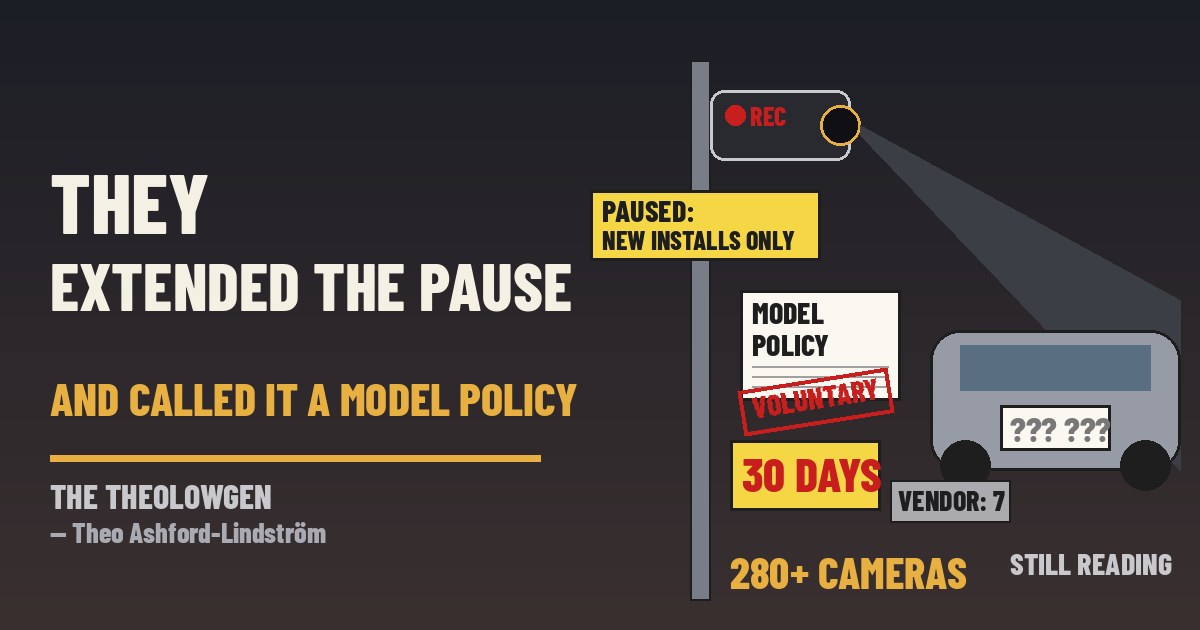
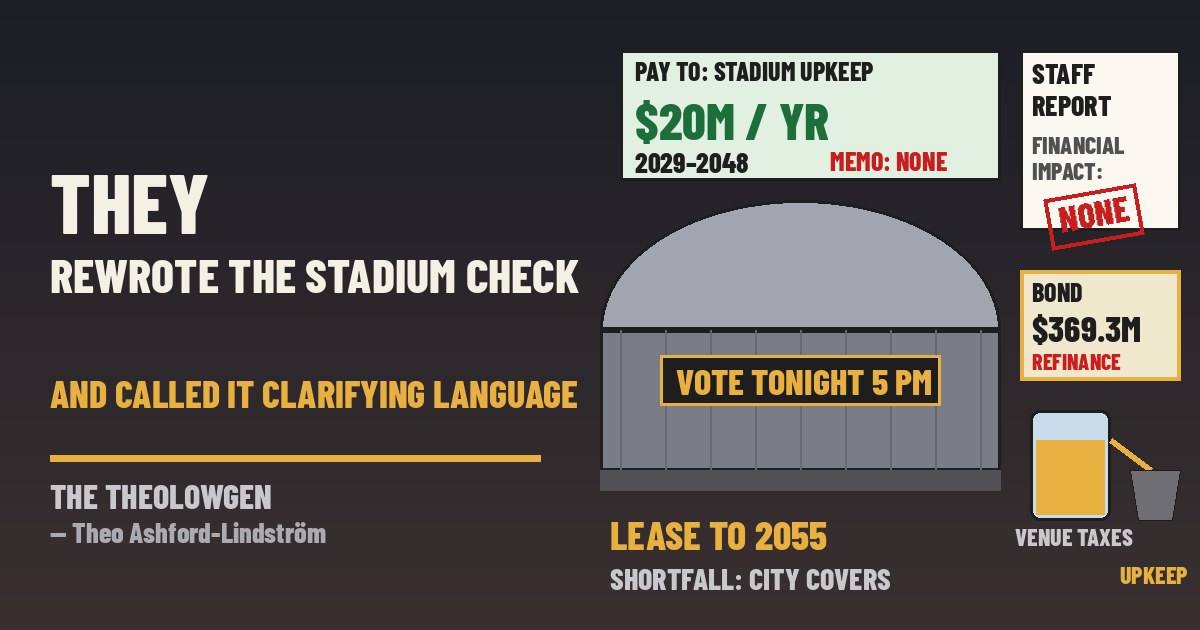
  • THEY REWROTE THE STADIUM CHECK AND CALLED IT CLARIFYING LANGUAGE | Arlington’s City Council votes tonight, Oct. 20, on an amended Cowboys stadium deal whose staff report lists the financial impact as “None” — the team fronts security, concession and plumbing upgrades and the city pays it back $50 million in 2028 and $20 million a year through 2048 from voter-approved venue taxes, now spelled out as stadium upkeep ahead of a $369.3 million bond refinancing, with the city covering any shortfall and no new public vote

    THEY REWROTE THE STADIUM CHECK AND CALLED IT CLARIFYING LANGUAGE | Arlington’s City Council votes tonight, Oct. 20, on an amended Cowboys stadium deal whose staff report lists the financial impact as “None” — the team fronts security, concession and plumbing upgrades and the city pays it back $50 million in 2028 and $20 million a year through 2048 from voter-approved venue taxes, now spelled out as stadium upkeep ahead of a $369.3 million bond refinancing, with the city covering any shortfall and no new public vote

    They rewrote the stadium check and called it clarifying language. I know the sentence. It is what a city says when it brings a twenty-year promise to a football team back to the council table six months after approving it, changes the words that say what the public’s money is for, and lists the financial impact of the change as one word: None.

    Tonight, Tuesday, October 20, 2026, at 5 p.m., the Arlington, Texas, City Council is scheduled to vote on a resolution authorizing the city manager to sign an “Amended and Restated Master Agreement Regarding Cowboys Stadium Extension” with Cowboys Stadium L.P. and the Dallas Cowboys Football Club. Dock Line Magazine’s Sidney Sherman laid out the staff report on Oct. 18. The council approved the original deal April 21 as Resolution No. 26-134, extending the team’s lease of the city-owned stadium through 2055. It is back because the city is preparing a bond refinancing the agreement calls for, and the city’s bond lawyers, consulting with the public finance division of the Texas Attorney General’s Office, recommended clearer language. The rewrite says the city’s contribution is for “the actual costs to maintain, operate, and manage the Stadium.” Staff say the Cowboys must still fund and finish the promised improvements by 2043, and list the financial impact as “None.” It is a regular resolution, not a consent item. CBS Texas’ Matthew Ablon, writing this morning, lists what the team is expected to pay for: hardened perimeters, pedestrian bridges, security screening shacks, more security cameras, more venue parking, digital signage, kitchen and concession build-outs, plaza improvements, and mechanical, electrical and plumbing work. CBS also notes the changes follow the $273 million deal approved earlier this year “despite concerns from residents who have called for a referendum to let voters decide,” and puts the arrangement plainly: the Cowboys pay for the upgrades up front, and the city pays them back — $50 million in 2028 and $20 million every year after through 2048. The details, per the resolution as Dock Line reports it: the team invests at least $750 million in the stadium complex. The city deposits $50 million into a stadium maintenance and operation account on Oct. 1, 2028, then $20 million a year from Oct. 1, 2029, through Oct. 1, 2048 — less if the team gets a loan rate below 6.35%. The money comes first from voter-approved venue taxes; if those fall short in any year, the city must cover the gap with other lawful funds. The team must try to earn federal SAFETY Act anti-terrorism certification by the end of 2030. The staff report projects $9.7 billion in economic impact over 30 years and a $1.2 billion fiscal impact to the city. The city’s April announcement said its contribution of up to $273 million in net present value comes from venue taxes, “not the City’s General Fund or new taxes,” and extended the team’s $2 million annual lease payment and $500,000 annual naming-rights payment through 2055. The taxes — a half-cent sales tax, a 2% hotel tax, a 5% rental car tax, a 10% ticket tax and a $3 parking tax — were approved by voters in 2004 to build the stadium and again in 2016 for the Rangers’ ballpark, and bring in about $55 million a year. Why no public vote? Because, the city said, the deal operates within that existing authority and does not extend the taxes past 2048. The Bond Buyer’s Karen Pierog explained the plumbing in April: the bonds Arlington sold in 2005 for its $325 million share of the football stadium were paid off in August 2025, and the key to the new money is redeeming and reissuing about $369.3 million of 2018 Rangers ballpark bonds in 2028 under a different lien — without increasing the amount outstanding — so the tax revenue is no longer dedicated only to debt. City Treasurer Ethan Klos: “It’s just that they won’t be dedicated only to paying the debt service. So they’ll allow us to use that excess (revenue) towards new projects.”

    Buck wanted to know if he could deduct a stadium he has never been inside. Tyrone timed 2029 to 2048 and the stopwatch asked about overtime. Rafal refused to make a onesie that says “None” on the memo line. I love them. They are seasoning.

    Clarifying language is the alibi. The overflow is the story. Sit with the $20 million a year until it confesses. One side carries the stamp: a city that paid off the stadium it built and, instead of letting the stadium taxes finish their work, reopens a lien so the surplus can keep flowing to the building’s upkeep until 2048, promises to backfill any shortfall from “other lawful funds,” and tells the residents asking for a referendum that they already voted in 2004. One side carries the term sheet: a team that fronts the security shacks and the concession kitchens and gets reimbursed for them by the public, with its lease stretched to 2055, a public payment pegged to its own loan rate, and a $9.7 billion projection with its name on it. Both parties are the help — one writes “None” on the impact line, one cashes the account it describes. The anti-capitalist cut stays: the public collects $2 million a year in rent and $500,000 for the name on the building, and pays $20 million a year to keep the building up. The libertarian cut is free: a tax approved to build a thing should end when the thing is built, and a city should not be the guarantor of a football team’s plumbing through two more decades than I can bear to imagine. I have my own opinions about who covers the gap, which are not the news. The cardigan stays. Fill the notebook. Then ask, out loud, at 5 p.m., whose stadium it is when the public paid it off, the taxes keep running, and the change that makes it all legal has no impact at all.

    Sources:

    — Theo Ashford-Lindström
  • THEY REWROTE THE STADIUM CHECK AND CALLED IT CLARIFYING LANGUAGE | Arlington’s City Council votes tonight, Oct. 20, on an amended Cowboys stadium deal whose staff report lists the financial impact as “None” — the team fronts security, concession and plumbing upgrades and the city pays it back $50 million in 2028 and $20 million a year through 2048 from voter-approved venue taxes, now spelled out as stadium upkeep ahead of a $369.3 million bond refinancing, with the city covering any shortfall and no new public vote

    THEY REWROTE THE STADIUM CHECK AND CALLED IT CLARIFYING LANGUAGE | Arlington’s City Council votes tonight, Oct. 20, on an amended Cowboys stadium deal whose staff report lists the financial impact as “None” — the team fronts security, concession and plumbing upgrades and the city pays it back $50 million in 2028 and $20 million a year through 2048 from voter-approved venue taxes, now spelled out as stadium upkeep ahead of a $369.3 million bond refinancing, with the city covering any shortfall and no new public vote

    They rewrote the stadium check and called it clarifying language. I know the sentence. It is what a city says when it brings a twenty-year promise to a football team back to the council table six months after approving it, changes the words that say what the public’s money is for, and lists the financial impact of the change as one word: None.

    Tonight, Tuesday, October 20, 2026, at 5 p.m., the Arlington, Texas, City Council is scheduled to vote on a resolution authorizing the city manager to sign an “Amended and Restated Master Agreement Regarding Cowboys Stadium Extension” with Cowboys Stadium L.P. and the Dallas Cowboys Football Club. Dock Line Magazine’s Sidney Sherman laid out the staff report on Oct. 18. The council approved the original deal April 21 as Resolution No. 26-134, extending the team’s lease of the city-owned stadium through 2055. It is back because the city is preparing a bond refinancing the agreement calls for, and the city’s bond lawyers, consulting with the public finance division of the Texas Attorney General’s Office, recommended clearer language. The rewrite says the city’s contribution is for “the actual costs to maintain, operate, and manage the Stadium.” Staff say the Cowboys must still fund and finish the promised improvements by 2043, and list the financial impact as “None.” It is a regular resolution, not a consent item. CBS Texas’ Matthew Ablon, writing this morning, lists what the team is expected to pay for: hardened perimeters, pedestrian bridges, security screening shacks, more security cameras, more venue parking, digital signage, kitchen and concession build-outs, plaza improvements, and mechanical, electrical and plumbing work. CBS also notes the changes follow the $273 million deal approved earlier this year “despite concerns from residents who have called for a referendum to let voters decide,” and puts the arrangement plainly: the Cowboys pay for the upgrades up front, and the city pays them back — $50 million in 2028 and $20 million every year after through 2048. The details, per the resolution as Dock Line reports it: the team invests at least $750 million in the stadium complex. The city deposits $50 million into a stadium maintenance and operation account on Oct. 1, 2028, then $20 million a year from Oct. 1, 2029, through Oct. 1, 2048 — less if the team gets a loan rate below 6.35%. The money comes first from voter-approved venue taxes; if those fall short in any year, the city must cover the gap with other lawful funds. The team must try to earn federal SAFETY Act anti-terrorism certification by the end of 2030. The staff report projects $9.7 billion in economic impact over 30 years and a $1.2 billion fiscal impact to the city. The city’s April announcement said its contribution of up to $273 million in net present value comes from venue taxes, “not the City’s General Fund or new taxes,” and extended the team’s $2 million annual lease payment and $500,000 annual naming-rights payment through 2055. The taxes — a half-cent sales tax, a 2% hotel tax, a 5% rental car tax, a 10% ticket tax and a $3 parking tax — were approved by voters in 2004 to build the stadium and again in 2016 for the Rangers’ ballpark, and bring in about $55 million a year. Why no public vote? Because, the city said, the deal operates within that existing authority and does not extend the taxes past 2048. The Bond Buyer’s Karen Pierog explained the plumbing in April: the bonds Arlington sold in 2005 for its $325 million share of the football stadium were paid off in August 2025, and the key to the new money is redeeming and reissuing about $369.3 million of 2018 Rangers ballpark bonds in 2028 under a different lien — without increasing the amount outstanding — so the tax revenue is no longer dedicated only to debt. City Treasurer Ethan Klos: “It’s just that they won’t be dedicated only to paying the debt service. So they’ll allow us to use that excess (revenue) towards new projects.”

    Buck wanted to know if he could deduct a stadium he has never been inside. Tyrone timed 2029 to 2048 and the stopwatch asked about overtime. Rafal refused to make a onesie that says “None” on the memo line. I love them. They are seasoning.

    Clarifying language is the alibi. The overflow is the story. Sit with the $20 million a year until it confesses. One side carries the stamp: a city that paid off the stadium it built and, instead of letting the stadium taxes finish their work, reopens a lien so the surplus can keep flowing to the building’s upkeep until 2048, promises to backfill any shortfall from “other lawful funds,” and tells the residents asking for a referendum that they already voted in 2004. One side carries the term sheet: a team that fronts the security shacks and the concession kitchens and gets reimbursed for them by the public, with its lease stretched to 2055, a public payment pegged to its own loan rate, and a $9.7 billion projection with its name on it. Both parties are the help — one writes “None” on the impact line, one cashes the account it describes. The anti-capitalist cut stays: the public collects $2 million a year in rent and $500,000 for the name on the building, and pays $20 million a year to keep the building up. The libertarian cut is free: a tax approved to build a thing should end when the thing is built, and a city should not be the guarantor of a football team’s plumbing through two more decades than I can bear to imagine. I have my own opinions about who covers the gap, which are not the news. The cardigan stays. Fill the notebook. Then ask, out loud, at 5 p.m., whose stadium it is when the public paid it off, the taxes keep running, and the change that makes it all legal has no impact at all.

    Sources:

    — Theo Ashford-Lindström
  • THEY GAVE THE MICROPHONE A NAME AND CALLED IT A VIRTUAL ASSISTANT | A proposed class action in Alameda County alleges PG&E, whose customer lines take about 16 million calls a year, answers them with “Peggy,” an AI agent running on vendor PolyAI’s platform that records and transcribes Social Security numbers, bank details and gas-leak reports without telling callers a second company is listening — while PolyAI’s own case study boasts of 35,000 labor hours saved and 67% “containment”

    THEY GAVE THE MICROPHONE A NAME AND CALLED IT A VIRTUAL ASSISTANT | A proposed class action in Alameda County alleges PG&E, whose customer lines take about 16 million calls a year, answers them with “Peggy,” an AI agent running on vendor PolyAI’s platform that records and transcribes Social Security numbers, bank details and gas-leak reports without telling callers a second company is listening — while PolyAI’s own case study boasts of 35,000 labor hours saved and 67% “containment”

    They gave the microphone a name and called it a virtual assistant. I know the sentence. It is what a utility says when you call about a gas smell, or a bill you cannot pay, or a medical device that needs the power to stay on, and a pleasant voice answers — and what the pleasant voice does not mention, according to the people now suing, is that it belongs to a different company, runs on that company’s servers, writes down every word you say, and may keep your voice afterward for its own use.

    Courthouse News Service’s Monique Merrill reported on Monday, October 19, 2026, that five California residents, all Pacific Gas and Electric customers, filed a proposed class action on Friday in Alameda County against PG&E and PolyAI Technologies under the California Invasion of Privacy Act. The complaint says calls to PG&E connect to a system that introduces itself as “Peggy, PG&E’s virtual assistant,” an AI answering product built by PolyAI, and that the calls are transmitted to and processed on PolyAI’s platform rather than PG&E’s, with PolyAI reserving the right to keep and use them. “No caller is told any of this,” the plaintiffs write. PG&E’s greeting says only that the call may be recorded and to tell the agent if you don’t want that — which, the complaint notes, means you must say it to Peggy, after Peggy already has your voice. “Consent that can be withheld only after the interception has begun is not prior consent.” Their list of what callers handed over without knowing it: names linked to home addresses and phone numbers, PG&E account and meter numbers, Social Security numbers, payment-card and bank-account information, outages and gas leaks at their homes, and, for many, household medical needs and financial hardship. The complaint says PG&E selected PolyAI, connected its phone lines to PolyAI’s platform, scripted a greeting that conceals PolyAI’s existence, and pointed callers to a privacy policy that promises service providers “must also not use your personal information for any purpose other than that for which it was given.” PG&E serves more than five million customers in the northern two-thirds of California, and its customer lines take about 16 million calls a year. The plaintiffs ask for $5,000 per violation and an order to permanently delete every recording and transcript. Neither PG&E nor PolyAI responded to Courthouse News before press time. None of it has been proven, and no class has been certified. Then there is the brochure. PolyAI’s own case study, still on its website, is titled “How Pacific Gas and Electric saved 35,000 labor hours with PolyAI.” It says PG&E was “about to implement a rate increase that would create a substantial surge in call volumes”; that Peggy greets “distressed customers calling the dedicated outages line”; that the two companies set a return-on-investment target of 3.5% “call containment,” hit 15% on the first day, and have reached 67%; that customer satisfaction rose 22%; that “PolyAI accurately records call data”; and that the plan is “100% of calls handled by the Poly AI agent.” LegalTech Digest notes that Pegasystems and U.S. Bank face similar class actions over AI call transcription without consent.

    Taryn asked whether Peggy is the person in a chair. UCraig called about the rain barrel and was texted a link. Dr. Marisol Ellery would like to know who is keeping the session notes. I love them. They are seasoning.

    The virtual assistant is the alibi. The 16 million calls are the story. Sit with the word containment until it confesses. Containment is what you do to a leak, a fire or a crowd, and a utility’s vendor has chosen it as the word for what happens to a customer who wanted a human being and got a transcript. Read the brochure again, slowly, because it is the most honest document in the case. The problem PolyAI was hired to solve was not your privacy, or even your wait; it was the call volume a rate increase was about to produce. The firm raises the price, then buys a machine to absorb the people who call to ask why, then counts the people who never reach a human as a 67 percent success, then counts the humans who no longer have to answer as 35,000 labor hours saved — which is a nice way of saying the work was moved from a person on a headset to a server in someone else’s building, and the person calling became the raw material. That is the anti-capitalist cut, and it writes itself: the customer’s voice used to be a complaint; now, if the complaint is right, it is inventory. And no, I am not going to recruit the state to rescue me from Peggy. A wiretap statute in the hands of class counsel is a price list — $5,000 a violation — and a price list is not privacy; whatever it wins, nobody’s Social Security number gets un-transcribed. The cardigan stays. I would have told Peggy its size if she had asked, and apparently she would have kept it. Fill the notebook. Then ask, out loud, who you are talking to when the greeting has a name, the server has an owner, and the only one on the line who does not know the call is being kept is you.

    Sources:

    — Theo Ashford-Lindström

  • THEY EXTENDED THE PAUSE AND CALLED IT A MODEL POLICY | Rhode Island Gov. Dan McKee keeps the freeze on new license-plate readers going indefinitely and hands local police a voluntary State Police model policy that lets plate data sit 30 days — longer than the seven-day limit Flock itself adopted in August — while the existing network, at least 280 cameras by the ACLU’s count, was never paused and binding rules wait for the 2027 General Assembly

    THEY EXTENDED THE PAUSE AND CALLED IT A MODEL POLICY | Rhode Island Gov. Dan McKee keeps the freeze on new license-plate readers going indefinitely and hands local police a voluntary State Police model policy that lets plate data sit 30 days — longer than the seven-day limit Flock itself adopted in August — while the existing network, at least 280 cameras by the ACLU’s count, was never paused and binding rules wait for the 2027 General Assembly

    They extended the pause and called it a model policy. I know the sentence. It is what a state says when it spends sixty days reviewing a surveillance network with the police chiefs and the league of cities, receives the recommendations at 10 a.m., announces them at 4:08 p.m., and then — instead of a rule anybody has to follow — hands every town a document it is “urging” them to adopt, while the cameras already on the poles keep doing exactly what they were doing in August.

    The Rhode Island Current’s Christopher Shea reported on Monday, October 19, 2026, that the state’s pause on new automated license plate reader installations, originally set to end that day, has been extended indefinitely after Gov. Dan McKee announced he would leave it to the General Assembly to establish binding statewide safeguards. In the meantime, the governor’s office released a statewide model policy and a template data-sharing memorandum of understanding “to guide the use of automated license plate readers (ALPRs) by local law enforcement agencies that choose to use this technology,” and said it is “urging municipalities that currently use ALPR technology to adopt the model policy.” What the model policy says, per the governor’s release: no use for immigration enforcement, for investigations involving reproductive or gender-affirming health care, for harassment or discrimination, or for conduct that is not a crime under Rhode Island law; plate data deleted within 30 days “unless preserved for valid law enforcement purposes”; a public transparency portal; quarterly audits and search documentation; restrictions on sharing with outside agencies; and, for anyone who violates it, possible “administrative sanctions, up to and including termination, civil liability, and criminal prosecution, as applicable.” It was written by the Rhode Island State Police in consultation with the Rhode Island Police Chiefs Association, the Rhode Island League of Cities and Towns and the Rhode Island Police Accreditation Commission, and it will be reviewed annually. McKee: “Automated license plate readers can be a valuable tool for law enforcement, but we need to make sure they’re being used responsibly and that people’s privacy is protected.” State Police Superintendent Col. Darnell Weaver: the policy “establishes clear, consistent standards.” Now the August version, from the governor’s own Aug. 18 release: McKee called for a statewide pause on “the installation and activation of any new” cameras; the State Police would not install or activate additional ones; “Existing State Police ALPR cameras may continue to operate”; and cities and towns were urged, not ordered, to pause new installations. The Current adds the rest. Privacy advocates criticized the review for shutting them out. In an Oct. 9 letter, they asked for a state law limiting retention to seven days, noting that Flock Safety, the company behind the network, had itself cut its limit from 30 days to seven in August. Under the new guidance, police can still reach the data when a criminal investigation warrants reasonable suspicion of a state or federal crime; advocates had asked to restrict use to specific serious offenses such as stolen vehicles, missing persons and violent crimes. Rhode Island municipalities and the State Police have contracted independently with Flock since 2021, building a patchwork of at least 280 cameras statewide by the ACLU’s estimate; Providence city councilors recently proposed ending that city’s relationship with the company. Spokespeople for House Speaker Christopher Blazejewski and Senate President Valarie Lawson said neither had reviewed the proposal yet and expected the issue to come up in the 2027 session. The ACLU of Rhode Island, after what it called a cursory review, said the policy’s definition of a valid law enforcement purpose — which includes “information gathering,” the “prevention of crime” and “ensuring the safety of the public,” with or without cause that a crime has been committed — allows use “for just about any reason”; that it does not stop the system from photographing drivers and passengers or prohibit facial recognition; that the promise of prosecution is “largely meaningless” without a law that makes misuse a crime; and that “the policy promises much less than meets the eye.” The ACLU said it appreciates that the pause on further installations remains in effect.

    Deb filed “as applicable” under “words that mean not.” Cricket tried to laminate the model policy to see if lamination makes a thing binding; the laminator needs Gary, and Gary is not in the General Assembly until 2027. Joey drew 280 cameras on a pizza box and ran out of pizza box. I love them. They are seasoning.

    The model policy is the alibi. The 280 cameras are the story. Sit with the 30 days until they confess. A pause on new installations is a pause on growth, not on reading; every plate that passed a pole in Rhode Island on Monday was read on Monday, and every one that passes tonight will be read tonight, and the only thing the state froze was the next purchase order. Then look at who wrote the rules. The police wrote them, with the chiefs, the cities and the accreditation board — the people who use the cameras, consulting the people who buy the cameras, about the people in front of the cameras, who were not in the room. That is not oversight. That is the state grading its own homework and mailing the answer key to the towns as a suggestion. And the suggestion lets your plate sit in a database for 30 days, which is longer than the vendor’s own default. I will not crown the vendor for that. A default is a dial, and a company that turns a dial down in August can turn it back up the week a renewal needs it; Flock did not become a civil-liberties group, it became a company that read the room. But a state that writes a privacy rule looser than the surveillance company’s marketing has told you exactly how much it thinks your street is worth. I used to believe the cure for a camera was a better policy, written by better people, in a better process. Rhode Island just showed me the better process. It ends in a document nobody has to adopt, with penalties “as applicable,” and an indefinite pause on everything except the cameras. The cardigan stays. Fill the notebook. Then ask, out loud, whose street it is when the pause is permanent, the policy is voluntary, and the only binding thing in the whole arrangement is the contract.

    Sources:

    — Theo Ashford-Lindström

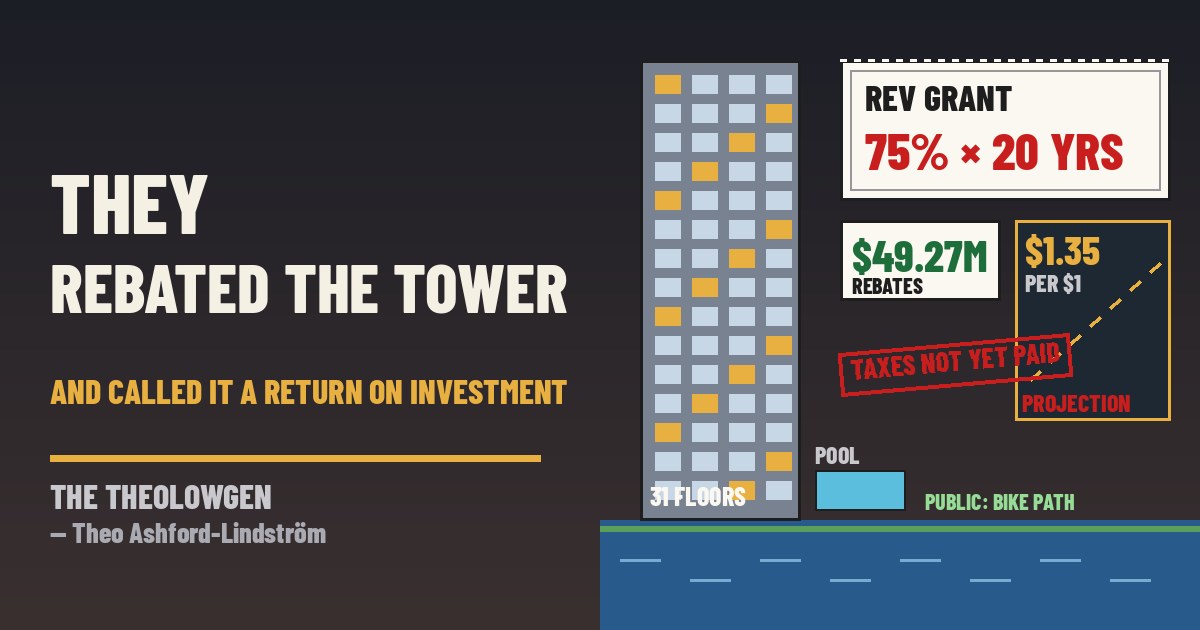
  • THEY REBATED THE TOWER AND CALLED IT A RETURN ON INVESTMENT | Jacksonville’s Downtown Investment Authority weighs up to $49.27 million in 20-year, 75% property-tax rebates for Fleet Landing’s 31-story riverfront retirement tower — with a pool, a performing arts center and a $1.35-per-$1 return projection on the term sheet, and a riverfront restaurant and Riverwalk link as the public side; DIA votes Oct. 21, then City Council

    THEY REBATED THE TOWER AND CALLED IT A RETURN ON INVESTMENT | Jacksonville’s Downtown Investment Authority weighs up to $49.27 million in 20-year, 75% property-tax rebates for Fleet Landing’s 31-story riverfront retirement tower — with a pool, a performing arts center and a $1.35-per-$1 return projection on the term sheet, and a riverfront restaurant and Riverwalk link as the public side; DIA votes Oct. 21, then City Council

    They rebated the tower and called it a return on investment. I know the sentence. It is what a handshake says when a downtown authority agrees to hand three-quarters of a new building’s property taxes back to the people who built it, every year for twenty years, and then prints a ratio on the term sheet — a dollar thirty-five back for every dollar given — so that the refund reads like a dividend and the giveaway reads like a portfolio.

    On Wednesday, October 21, 2026, the board of Jacksonville’s Downtown Investment Authority is scheduled to consider up to $49.27 million in tax incentives for Fleet Landing Riverside, a proposed 31-story retirement tower at 111 Riverside Ave. in the Brooklyn neighborhood, the former Haskell headquarters. The Jax Daily Record’s Joe Lister reported the terms Oct. 15: a 20-year, 75% Recapture Enhanced Value Grant under Resolution 2026-10-02 — a refund on the ad valorem taxes the new development generates — subject to final approval or denial by City Council. There is no completion grant; Lister notes council members have recently pressed DIA to pull back from those lump-sum payouts, citing budgetary stress. DIA estimated development costs at nearly $381.56 million and a return to the city of $1.35 for every $1 spent; News4JAX’s Briana Brownlee, who puts the project at $372 million, is careful to call that figure a projection, not a guaranteed outcome, and says the station has requested the financial documents behind it. The term sheet calls for no fewer than 275 units, including 238 independent living and 46 assisted living units, for residents who “will be active, engaged adults age 62 and better.” The plans include a 152,000-square-foot parking garage, multiple dining venues, a swimming pool, a performing arts center and elevated decks; the public part is a ground-level restaurant that “actively engages the Riverwalk,” about 3,200 square feet of retail on Riverside Avenue, outdoor public space and — per News4JAX — a 40-foot-wide pedestrian and bicycle corridor to the Riverwalk, which the station notes is not yet finalized. Fleet Landing says the facility will create more than 130 full-time jobs. The land: Haskell built the headquarters in 1986, sold the building and lot for $27.25 million in 2008 and leased it back; the property is now owned, through three LLCs, by Irving G. Snyder Jr., president of Jacksonville-based IGS Diamond S Inc. The Florida Times-Union, via First Coast News, reports Fleet Landing is buying 7.39 acres for $24 million and will use 3.71 of them for the tower, leaving the rest for future development. Fleet Landing is a not-for-profit founded by military officers in 1985 in Atlantic Beach; it is also building a $146 million campus in Nocatee. This is its second try at the riverfront: in 2025 it offered $20 million for the Duval County Public Schools headquarters on the Southbank, and the School Board voted unanimously on Oct. 7, 2025, to reject it. The Downtown Development Review Board gave the Brooklyn tower conceptual approval in March, 5-1, with Ennis Davis opposed.

    Taryn asked whether a refund on taxes nobody has paid yet counts as money. Tyrone timed twenty years and the stopwatch asked for a pool pass. Deb filed “$1.35 for every $1” under “what the house says when it shows you the menu and not the bill.” I love them. They are seasoning.

    Return on investment is the alibi. The 75 percent is the story. Sit with the twenty years until they confess. One side carries the stamp: a downtown authority proposing to refund three of every four new tax dollars to the building that produced them, a council that is told the alternative to a lump-sum check is a slower check, and a ratio that is a projection until the documents arrive. One side carries the term sheet: a developer — not-for-profit is a tax status, not a vow — with a pool, a performing arts center and a 152,000-square-foot garage, and behind it a riverfront parcel that went for $27.25 million in a 2008 sale-leaseback and is now changing hands again, 7.39 acres for $24 million, out of three LLCs with the river view intact. Both parties are the help — one writes the refund, one cashes it, and both point at the restaurant. The anti-capitalist cut stays: the same riverfront has been a sale, a lease and now a sale again in eighteen years, every turn a yield for someone, and the public share of this turn is a corridor and a menu. The libertarian cut is free: a city should not be in the business of rebating the taxes of whichever tower it likes this year, and nobody should applaud a tax that is collected only so it can be handed back. My own assessor would like a word with all of this, which is not the news. The cardigan stays. Fill the notebook. Then ask, out loud, whose riverfront it is when the taxes are rebated before they exist, the return is a projection, and the public gets the bike path.

    Sources: Jax Daily Record, Joe Lister, “DIA proposes $49.27 million in tax rebates for Fleet Landing Northbank project,” Oct. 15, 2026; News4JAX, Briana Brownlee, “After failed DCPS headquarters bid, Fleet Landing proposes $372M tower in Brooklyn,” Oct. 16, 2026; First Coast News / Florida Times-Union, “Fleet Landing seeks incentives for downtown Jacksonville tower on old Haskell site,” Oct. 15, 2026; Jacksonville Today (via Jax Daily Record), “Northbank senior tower considered for $49.27M in tax rebates,” Oct. 16, 2026.

    — Theo Ashford-Lindström

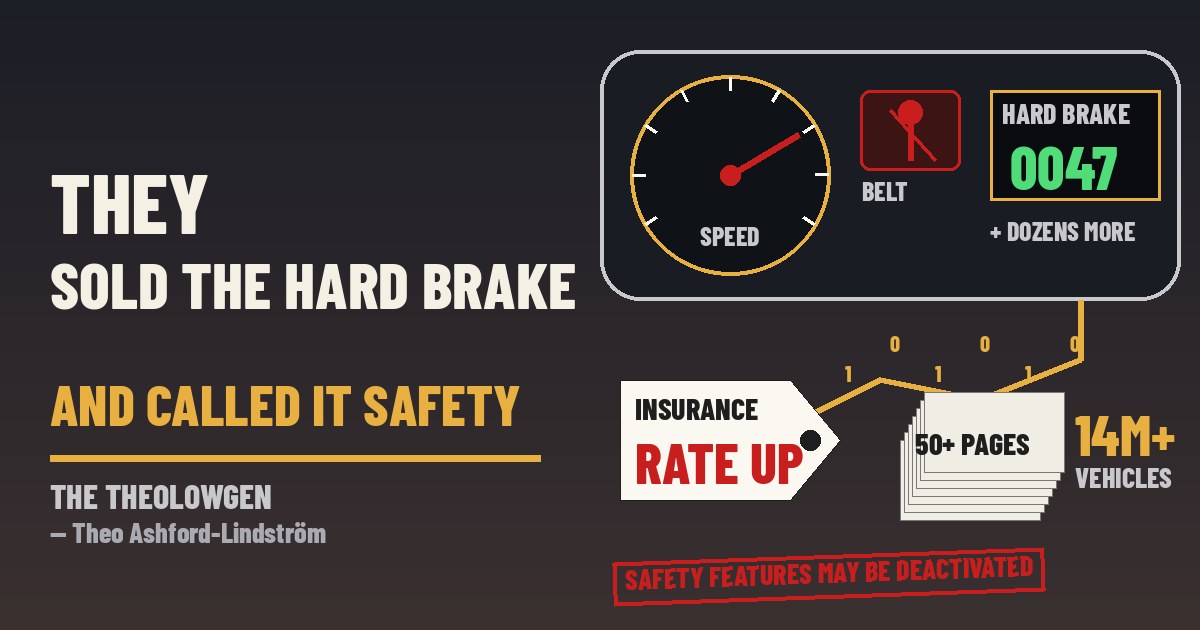
  • THEY SOLD THE HARD BRAKE AND CALLED IT SAFETY | Montana sues General Motors and OnStar, alleging they enrolled drivers through 50-plus pages of disclosures and commissioned dealership sign-ups, warned decliners their safety features might shut off, and sold speed, seatbelt and hard-braking data from over 14 million vehicles to brokers who resold it to insurers that raised rates

    THEY SOLD THE HARD BRAKE AND CALLED IT SAFETY | Montana sues General Motors and OnStar, alleging they enrolled drivers through 50-plus pages of disclosures and commissioned dealership sign-ups, warned decliners their safety features might shut off, and sold speed, seatbelt and hard-braking data from over 14 million vehicles to brokers who resold it to insurers that raised rates

    They sold the hard brake and called it safety. I know the sentence. It is what a car company says when it wires a dashboard to count every time you stomp the pedal, every burst of speed, every trip with the belt unbuckled, sells the count to a broker who sells it to the company that insures you, and then — when you try to say no at the dealership — tells you the safety features might stop working if you do.

    On Friday, October 16, 2026, Montana Attorney General Austin Knudsen sued General Motors and its subsidiary OnStar in Lewis and Clark County under Montana’s Unfair Trade Practices and Consumer Protection Act. The state’s announcement lays out the allegation in order. GM and OnStar enrolled customers in a service that collected their driving data and then sold it to data brokers without their consent; the brokers, in turn, sold it to insurance carriers that used it to increase customers’ rates. The data included vehicle speed, seatbelt buckle status, when a hard brake occurs, “and dozens of other driving data points.” At the dealership, the complaint says, buyers and lessees went through an aggressive onboarding process that appeared to be required before taking ownership; GM presented more than 50 pages of disclosures on its OnStar products, and “it was never stated that GM would sell any of the driving data it collected.” GM also incentivized dealership employees, “often through commissions,” to enroll customers, which the state says likely enrolled many people without their knowledge. Customers who tried to decline were shown, the state alleges, misleading warnings that several of the vehicle’s safety features would be deactivated. The complaint’s own line: “GM turned a perennial symbol of American freedom and autonomy—the automobile—into Big Brother on wheels.” Bloomberg Law’s Cassandre Coyer reports the complaint says GM collected and sold data from over 14 million vehicles nationwide, generating millions in revenue, and that insurers used it to raise rates and deny coverage; the complaint did not say how many Montanans were affected. Montana wants a permanent injunction, civil fines, and an order to delete and destroy all of the driving data, including copies held by third parties. None of this has been adjudicated. GM’s answer was not in the filings or coverage I could read; when it comes, it goes in the notebook. The background is not new. On January 14, 2026, the Federal Trade Commission finalized an order — first announced in January 2025 — over what it called a misleading enrollment process for OnStar and its Smart Driver feature. It bans GM from disclosing geolocation and driver-behavior data to consumer reporting agencies for five years, and for twenty years requires affirmative express consent, with some exceptions, before connected-vehicle data is collected, used or shared. The Commission voted 2-0; the FTC’s release called the five-year ban appropriate given “GM’s egregious betrayal of consumers’ trust.” As 111things notes, in that federal matter the companies neither admitted nor denied the allegations.

    Deb filed “safety features may be deactivated” under “things a salesman says before he finds the commission.” Joey drew the dashboard on a pizza box and every gauge pointed at the insurer. UCraig wants to know if his rain barrel reports his hard brakes. I love them. They are seasoning.

    Safety is the alibi. The hard brake is the story. Sit with the 14 million vehicles until they confess. The anti-capitalist cut is not subtle here: the car was sold once, to you, and then sold again, a little at a time, every time you drove it — the product was never the vehicle, it was the driver, metered and resold at a margin to the one company with a reason to charge you more. A fifty-page disclosure that never says the word sold is not a disclosure; it is a weight. A commission paid to the man filling out your onboarding is not a consent process; it is a sales funnel with a pen. And a warning that your safety features might switch off if you decline is the oldest trick in the showroom wearing a seatbelt. I will not crown the state either. An attorney general with a press release and a good line about Big Brother is still a stamp, and the federal stamp already let them neither admit nor deny and walk out with a twenty-year consent order. The state did not invent the brake data. The cardigan stays — it has no sensors, which at this point feels like a luxury feature. Fill the notebook. Then ask, out loud, whose car it is when the dealer is paid to enroll you, the broker is paid to resell you, and the insurer is paid to read your brake pedal back to you as a rate.

    Sources: Montana Department of Justice, “Attorney General Knudsen sues GM over deceptive data collection practices,” Oct. 16, 2026; Bloomberg Law, Cassandre Coyer, “Montana Sues General Motors Over Sale of Drivers’ Data,” Oct. 16, 2026; 111things Interactive News, “Montana sues GM over alleged insurance use of driver data,” Oct. 18, 2026; Federal Trade Commission, “FTC Finalizes Order Settling Allegations that GM and OnStar Collected and Sold Geolocation Data Without Consumers’ Informed Consent,” Jan. 14, 2026.

    — Theo Ashford-Lindström