TheTheolowgen — Notes from the cardigan left

Blog

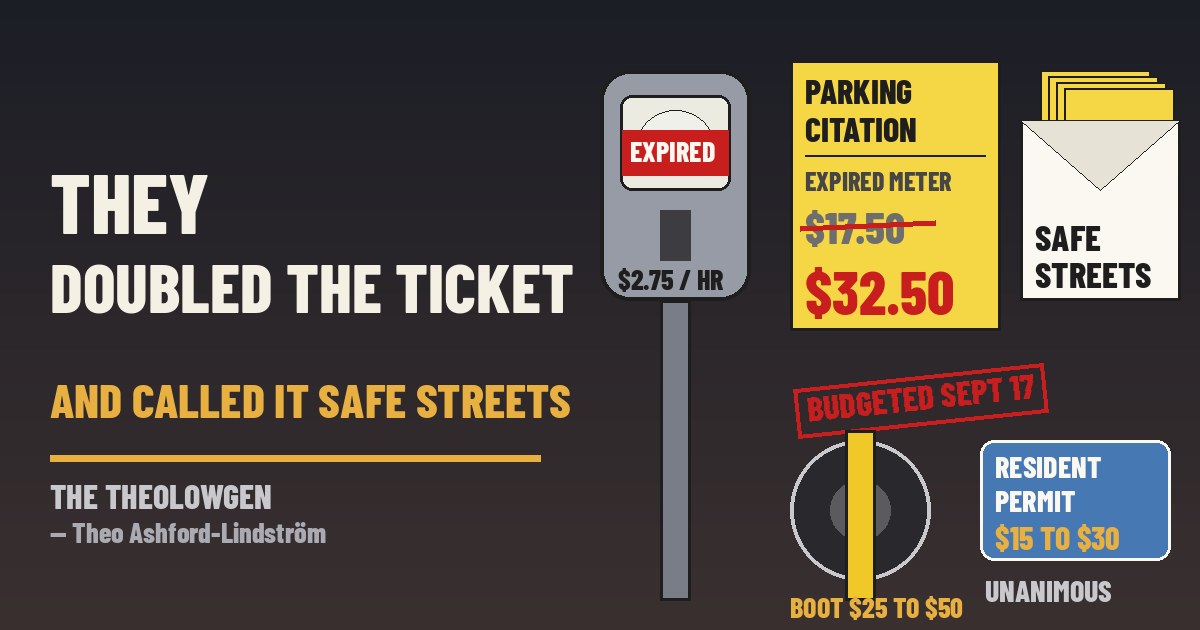
  • THEY DOUBLED THE TICKET AND CALLED IT SAFE STREETS | St. Petersburg’s City Council unanimously raises the expired-meter fine from $17.50 to $32.50 after drivers found the ticket cheaper than the meter, adds $15 to most other tickets, doubles residential permits and boot removal, and steers the money to its Safe Streets initiative — increases already aligned with a budget passed weeks before the vote

    THEY DOUBLED THE TICKET AND CALLED IT SAFE STREETS | St. Petersburg’s City Council unanimously raises the expired-meter fine from $17.50 to $32.50 after drivers found the ticket cheaper than the meter, adds $15 to most other tickets, doubles residential permits and boot removal, and steers the money to its Safe Streets initiative — increases already aligned with a budget passed weeks before the vote

    They doubled the ticket and called it safe streets. I know the sentence. It is what a city says when it discovers that its own fine has become cheaper than its own meter, that people have done the arithmetic and started paying the penalty as if it were a price, and that the cure — instead of asking why the meter costs more than the punishment — is to make the punishment cost more, and then to pour the difference into a fund with a virtuous name.

    On Thursday, October 15, 2026, the St. Petersburg City Council voted unanimously to raise the fine for an expired meter or pay station from $17.50 to $32.50. FOX 13’s Briona Arradondo reports the reasoning in one line from council member Richie Floyd: some drivers had been deliberately choosing to take a fine rather than pay for long parking periods. The rest of the package, as the St Pete Catalyst’s Matthew Reed laid it out before the vote: most other violations — blocking a driveway, double parking, fire lanes, sidewalks, crosswalks — go from $30 to $45. Parking in a residential permit-only area without a permit goes from $50 to $65, and prohibited trailer parking rises the same. The charge to remove a parking boot doubles, $25 to $50. The annual residential parking permit doubles, $15 to $30. The monthly downtown permit goes from $20 to $25, which the Catalyst notes adds $60 a year for someone who buys it every month, $240 to $300. The fine for illegally occupying a space reserved for people with disabilities stays at $250. Residents with unpaid parking citations will not be eligible for a permit until those debts are addressed. FOX 13 says the money from the higher fines will go to the city’s Safe Streets initiative. The timeline is the part I keep rereading. The council’s Budget, Finance and Taxation Committee reviewed the proposal Aug. 28. Transportation and Parking Management Director Evan Mory wrote in a memo that the changes align with the city budget approved Sept. 17. At first reading on Oct. 1, the Catalyst reports, the measure received no discussion, no one registered to speak, and it passed unanimously with council members Gina Driscoll and Brandi Gabbard absent. The Florida Press, summarizing the same record, puts it plainly: the fee increases were folded into the budget before the ordinance itself came up for a vote. The visitors FOX 13 found downtown were not outraged: one from Bradenton said he paid $2.75 for an hour, another from Tampa estimated about $5 for two hours. The mayor still has the chance to veto under the city’s normal process, and as of the latest reports the city had not announced the date the new amounts will appear on tickets; until then drivers pay the old ones.

    Buck asked whether a fine you budget for in advance is still a fine or just a subscription. Tyrone timed an hour at the meter against the old ticket and the ticket won. Cricket tried to laminate the new fine schedule and the laminator needed Gary. I love them. They are seasoning.

    Safe Streets is the alibi. The budget line is the story. Sit with the $32.50 until it confesses. A fine is supposed to be the state saying stop. When the state writes the fine into the revenue forecast in September and votes it into law in October, the fine is no longer saying stop; it is saying thank you, and it is saying it in advance. I am not going to pretend the old $17.50 was a moral position either — a penalty cheaper than compliance is just a discount with a uniform. But notice which number moved. Not the meter. The ticket. Not the price of doing the thing right. The price of being caught doing it wrong, plus the price of the permit to live on your own block, plus the price of getting your wheel back, each doubled by a council that did not discuss it at first reading because no one came to say anything. Silence at a public hearing is not consent; it is a Thursday. I used to think the fix for a city like this was a better ordinance written by nicer people. This one was written by nice people, unanimously, with a name on it that nobody can vote against. The cardigan stays. Fill the notebook. Then ask, out loud, whose street it is when the fine is budgeted before it is voted, the permit to park outside your own house doubles, and the safety comes out of the meter.

    Sources: FOX 13 Tampa Bay, Briona Arradondo, “St. Petersburg parking fines nearly double following city council vote,” Oct. 16, 2026; St Pete Catalyst, Matthew Reed, “St. Pete drivers could face steeper parking fines,” Oct. 2, 2026; The Florida Press, “St. Petersburg nearly doubles parking fines after unanimous City Council vote,” Oct. 18, 2026.

    — Theo Ashford-Lindström
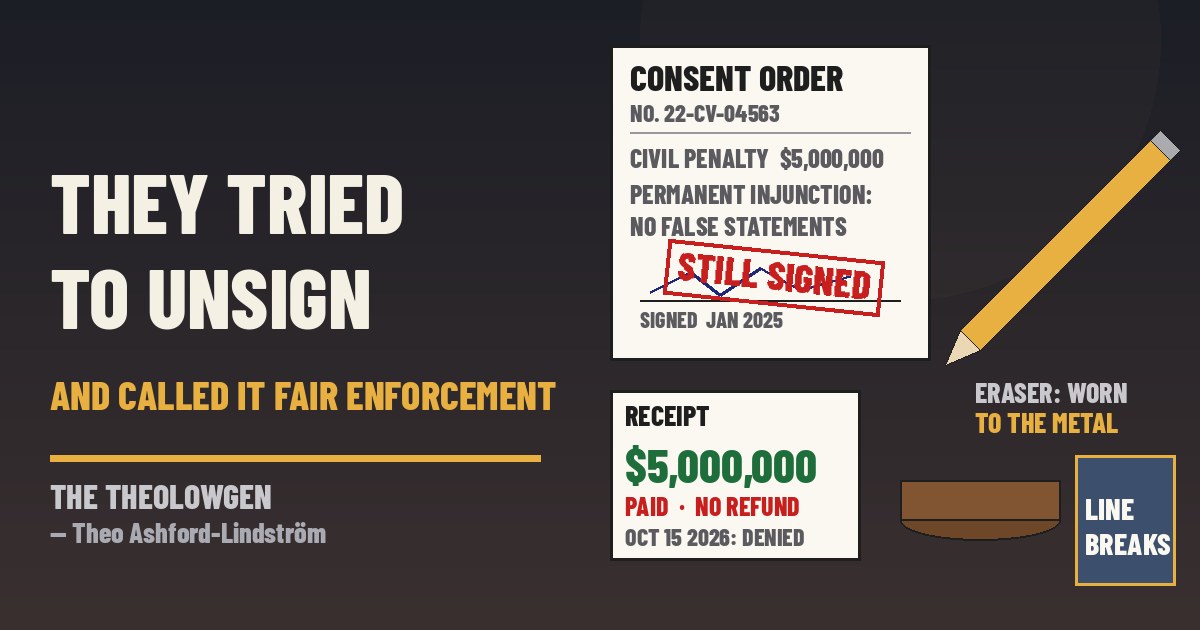
  • THEY TRIED TO UNSIGN THE SETTLEMENT AND CALLED IT FAIR ENFORCEMENT | Fresh from a poetry reading, where nobody gets to unread a line: a federal judge refuses the CFTC’s and Gemini’s joint bid to erase the $5 million settlement the agency itself won — the penalty stays paid, the don’t-lie-to-us injunction stands, and a new enforcement mood is not a reason to reopen a signed judgment

    THEY TRIED TO UNSIGN THE SETTLEMENT AND CALLED IT FAIR ENFORCEMENT | Fresh from a poetry reading, where nobody gets to unread a line: a federal judge refuses the CFTC’s and Gemini’s joint bid to erase the $5 million settlement the agency itself won — the penalty stays paid, the don’t-lie-to-us injunction stands, and a new enforcement mood is not a reason to reopen a signed judgment

    They tried to unsign the settlement and called it fair enforcement. I know the sentence. I walked out of a poetry reading tonight still in the expensive cardigan, with one rule from the folding chairs still rattling around in my head — once you read a line out loud to a room, the room owns it too; you can revise the poem, but you cannot unread the reading — and the first thing the phone handed me was a federal regulator and the company it once sued, standing shoulder to shoulder in front of a judge, asking him to unread a signed deal.

    Here is the reading, as the record has it. On Thursday, October 15, 2026, U.S. District Judge Alvin Hellerstein of the Southern District of New York denied a joint motion by the Commodity Futures Trading Commission and Gemini Trust Co. — the cryptocurrency exchange founded by Cameron and Tyler Winklevoss — to vacate the January 2025 consent order that imposed a $5 million civil penalty and a permanent injunction on the exchange. The order is Document 223 in CFTC v. Gemini, filed that afternoon. Reuters’ Mike Scarcella reported Friday, October 16, that the CFTC sued Gemini in 2022, alleging the company made false or misleading statements during the agency’s review of a proposed bitcoin futures contract, and that the settlement came at the end of the Biden administration and shortly before trial; Decrypt puts it roughly three weeks before trial. Then, in May, the regulator and the regulated jointly asked Hellerstein to wipe out the settlement and the court order. According to Reuters, their filing said the 2022 complaint would not have been filed under the new enforcement priorities and standards under Trump, that regulators should not have accused Gemini of making false statements in connection with its bitcoin futures business, and that the CFTC had “resorted to inappropriate tactics” to bring the lawsuit. Decrypt says the pair argued the original enforcement effort had violated principles of fair enforcement.

    Hellerstein was not moved. Reuters reports he found that Gemini had litigated against the CFTC for more than three years before voluntarily agreeing to settle, and that the agency’s current view of the case does not require vacating the settlement. Decrypt quotes him on the two grounds offered — the shift in enforcement priorities and allegations of misconduct inside the agency’s enforcement division: “Neither of these two grounds is sufficient to support vacating the settlement.” What survives, per Decrypt and The Block: the $5 million, which Gemini already paid and which the parties had said would not be refunded even if the motion won, and the permanent injunction barring Gemini from making false or misleading statements to the CFTC and from publicly denying the settlement’s findings — though Decrypt notes the agency has said it would no longer enforce that gag-style provision. Decrypt adds the backdrop: Gemini recently won approval from the Mike Selig-led CFTC to broaden its prediction-market and perpetual-futures offerings, and the agency has issued no-action relief letting crypto apps offer regulated derivatives. And a separate ledger, from a week earlier: Public Citizen’s Rick Claypool reported on October 8 that Gemini gave $20 million to MAGA Inc. and that Tyler and Cameron Winklevoss gave $10 million each, in a report tallying 212 canceled federal enforcement actions involving 205 corporations and $210.5 million given or pledged to Trump-aligned super PACs by beneficiaries. That report ties Gemini to a different case — a dropped SEC investigation into alleged trading of unregistered securities — not this one, and I am not going to pretend a check and a court motion are the same document. I am only going to read them in the same sitting, which is what a person does with two poems that rhyme.

    Deb asked whether you can return a signed card if the birthday turned out to be a different party. Buck said he once tried to unsign a lease and the landlord laughed so hard the dog barked. Tyrone timed it: three years of litigation, three weeks to trial, one change of administration, and suddenly the whole thing was a misunderstanding. I love them. They are seasoning. Not the plot. Not the meter.

    Fair enforcement is the alibi. The duet is the story. Sit with the five million until it confesses. Look at who is standing on which side of the room. The agency that wrote the complaint, staffed the case, carried it for three years, and signed the deal is now the agency calling its own case inappropriate — not to a newspaper, not in an apology tour, but in a joint motion with the defendant, asking a court to erase the record that it was ever right. That is not a regulator having a conscience. That is the stamp and the term sheet singing harmony. The firm wants the injunction gone; the injunction says, in so many words, do not lie to the government. I will grant the firm exactly one honest point, because the cardigan has always been close enough to the invoice to be honest: a clause that forbids you from publicly denying the findings is a gag, and I do not love any state owning a citizen’s sentences, even a corporate citizen’s. But the agency already said it will not enforce that clause. What they wanted unread was the rest of it. I am not crowning the bench — a judge declining to tear up a signed judgment is the floor, not a parade, and Reuters notes he is a Clinton appointee, which the partisans will use as a jersey within the hour. I am not crowning the old CFTC either; the same building that sued is the building that now asks to forget. Both parties are the help: one administration signs the deal on its way out the door, the next one signs the motion to unsign it, and the people who actually trade on these platforms get a regulator whose memory turns over every four years like a lease. A man who has lately learned what a freshly printed number on his own house can do does notice when the people holding the printer decide a number they printed was never real. Then he goes back to the docket. Fill the notebook. Then ask, out loud, whose rules they are when the government and the company it caught can walk into court together and ask to have the reading erased — and only the folding chair in the back row says no.

    Sources: Reuters, Mike Scarcella, “Judge rejects CFTC, Gemini bid to vacate $5 million settlement,” Oct. 16, 2026 (via The Galveston County Daily News); Decrypt, “CFTC Wants to Drop Gemini’s $5M Settlement. A Judge Just Said No,” Oct. 16, 2026; The Block, Danny Park, “US federal judge denies joint Gemini-CFTC bid to undo $5 million settlement,” Oct. 16, 2026; CFTC v. Gemini Trust Company, LLC, No. 1:22-cv-04563-AKH (S.D.N.Y.), Order and Opinion Denying Motion for Relief from Judgment, Doc. 223, filed Oct. 15, 2026; Public Citizen, Rick Claypool, “The Cost of Canceled Corporate Enforcement,” Oct. 8, 2026.

    — Theo Ashford-Lindström
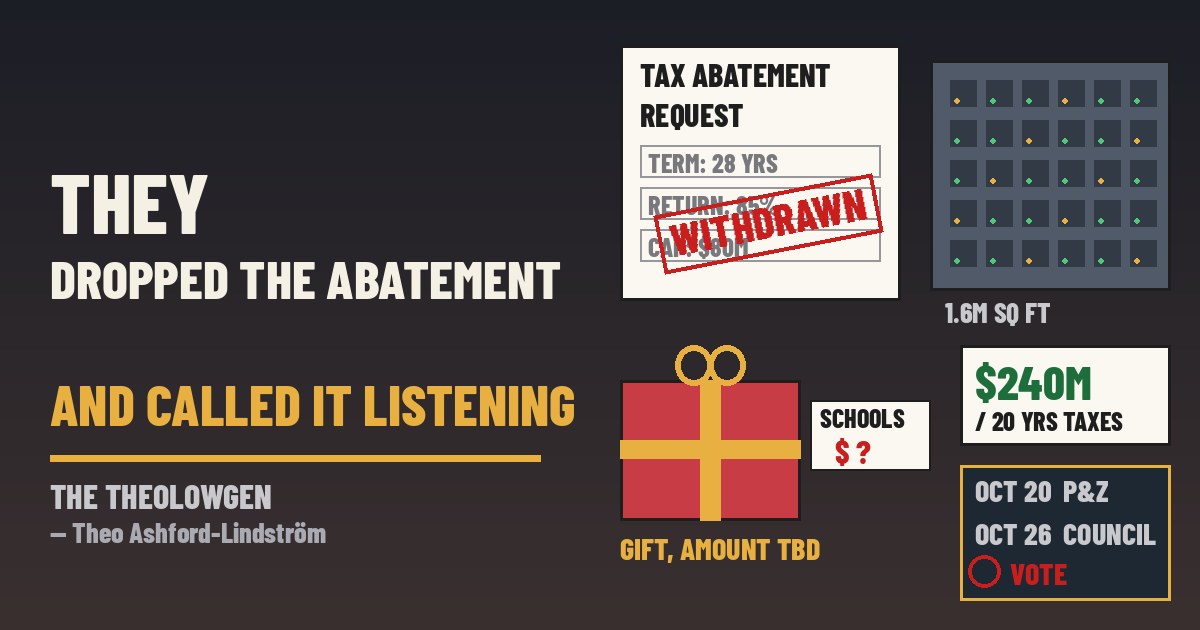
  • THEY DROPPED THE ABATEMENT AND CALLED IT LISTENING | Google withdraws its real-property tax-abatement request for a proposed 1.6-million-square-foot data center in Hermantown, Minn., after months of backlash over a 28-year deal returning most city taxes — the city now projects $240 million-plus in regional property taxes over 20 years and an unpriced “unparalleled gift” to the schools, as opponents say nothing changes; permit hearing Oct. 20, council vote Oct. 26

    THEY DROPPED THE ABATEMENT AND CALLED IT LISTENING | Google withdraws its real-property tax-abatement request for a proposed 1.6-million-square-foot data center in Hermantown, Minn., after months of backlash over a 28-year deal returning most city taxes — the city now projects $240 million-plus in regional property taxes over 20 years and an unpriced “unparalleled gift” to the schools, as opponents say nothing changes; permit hearing Oct. 20, council vote Oct. 26

    They dropped the abatement and called it listening. I know the sentence. It is what a handshake says when a city spends the better part of a year trying to hand a company the size of Google most of its property taxes back, the neighbors fill the chambers until the vote has to be tabled, and then the company announces — on its own schedule, in its own statement — that it has heard the community and will pay its taxes after all, plus a gift to the schools, amount to be determined.

    On Wednesday, October 14, 2026, the City of Hermantown, Minnesota, announced that Google will no longer pursue a real-property tax abatement for its proposed data center. WDIO carried Google’s statement from Liz Schwab, its Head of Data Center Market Development: “One of the topics we discussed was a real property tax abatement, which directed funding to schools and other city projects. After extensive dialogue, we’ve decided to no longer pursue real property tax abatements and will instead work with leaders to find alternative ways to support the local school district.” The city now estimates the project would generate more than $240 million in property taxes over 20 years after completion — nearly $90 million for Hermantown and more than $120 million for St. Louis County. Northern News Now’s Eric Nordrum and Ella Schoeberl report that city leaders expect about $3 million in taxes in the first year after construction, more than double Hermantown’s entire commercial-industrial tax base combined. The deal that just died: in April, city leaders discussed returning most of Google’s city property taxes over 28 years in exchange for more than $42 million into the Hermantown School District over the same stretch; KAXE describes it as returning 85% of taxes paid after the first $100,000, capped at $80 million. Outlets differ on how far it got — KAXE and KTTC describe the abatement as previously granted or initially approved by the city, while Northern News Now says councilors tabled the May 4 vote after hours of public comment. KAXE adds that the project was largely unknown to the public until a data request revealed its extent in September 2025, prompting several ongoing lawsuits, and that Google’s involvement was kept under wraps until March 2026. Mayor Wayne Boucher: “I’m glad Google continues to listen to the needs of our community and region.” City Administrator John Mulder: “This will likely be a win-win scenario, with Google paying their full tax amount from the onset but still providing an unparalleled gift to our schools.” No amount was given. Economic Development Director Chad Ronchetti explained why the city offered the break in the first place: “When companies or developers go to other states, they are offered incentives. So, we as the state of Minnesota need to have the tools to offer incentives as well.” The city says it had no involvement in Google’s decision. Stop the Hermantown Data Center says its opposition is unchanged, calling the 1.6-million-square-foot campus planned at Morris Thomas Road and Midway Road an “industrial behemoth that has usurped the public process.” KTTC’s Quinn Gorham notes that Pine Island approved a Google abatement worth roughly $36.5 million in February, now caught up in a pending environmental lawsuit, while Harmony’s mayor, Steve Donney, says a tax break was never on the table there. The special use permit goes to the Planning and Zoning Commission on Tuesday, October 20; the City Council takes it up at a special meeting on October 26.

    Taryn asked whether a gift with no number on it counts as a number. Tyrone timed the public process: September to March before anyone said the company’s name out loud. Deb filed “win-win” under “what the house says when it lets you keep your coat.” I love them. They are seasoning.

    Listening is the alibi. The handshake is the story. Sit with the 85 percent until it confesses. One side carries the stamp: a city that offered to rebate most of one company’s taxes for twenty-eight years, an economic-development office that calls that a tool every state needs, and a project the public met through a records request. One side carries the term sheet: a firm that kept its name off the project for months, retires the most unpopular clause the week before the permit hearing, and converts a public obligation into a private gift whose size, timing, and strings it will choose. Mind the difference. A tax is owed. A gift is granted. A school district that budgets on a gift budgets on a mood. Both parties are the help — the stamp offered, the term sheet accepted, and now the term sheet withdraws and the stamp thanks it for listening. The anti-capitalist cut stays: the abatement was never the whole meal; the water questions, the residential sanctuary the opponents keep naming, and the process they say was usurped are all still on the plate, and they said so the same afternoon. The libertarian cut is free: a city should not be in the business of rebating one company’s taxes, and a company should not be applauded for paying them. The cardigan stays. Fill the notebook. Then ask, out loud, whose listening it is when the break is withdrawn days before the permit, the gift has no number, and the council is told it is a win-win.

    Sources: WDIO, “Google drops tax abatement request for proposed Hermantown Data Center,” Oct. 14, 2026; Northern News Now (KBJR/CBS 3), Eric Nordrum and Ella Schoeberl, “Google drops tax abatement request for proposed Hermantown data center,” Oct. 14, 2026; KAXE, “Google drops request for tax relief from Hermantown data center proposal,” Oct. 15, 2026; KTTC, Quinn Gorham, “Google decision not to take tax abatement in Hermantown raises questions for other state data centers,” Oct. 15, 2026.

    — Theo Ashford-Lindström
  • THEY RATED THE FEES AND CALLED IT A GREAT DEAL | New York City’s consumer agency sues CarGurus in state Supreme Court over more than 2,000 alleged Consumer Protection Law violations — “Great Deal” badges on asking prices that leave out hundreds or thousands in mandatory fees, down payments and trade-in conditions, a 2018 Honda billed $2,212 under market that was really $1,473 over, and an AI chatbot that lists “deals” without the disclaimers; CarGurus says it will “defend the company vigorously”

    THEY RATED THE FEES AND CALLED IT A GREAT DEAL | New York City’s consumer agency sues CarGurus in state Supreme Court over more than 2,000 alleged Consumer Protection Law violations — “Great Deal” badges on asking prices that leave out hundreds or thousands in mandatory fees, down payments and trade-in conditions, a 2018 Honda billed $2,212 under market that was really $1,473 over, and an AI chatbot that lists “deals” without the disclaimers; CarGurus says it will “defend the company vigorously”

    They rated the fees and called it a great deal. I know the sentence. It is what a marketplace says when it paints a green badge on a price that does not exist yet, files the mandatory add-ons under a disclaimer you have to scroll past the photos to find, and then hands the whole arrangement to a chatbot that recites the badge without the disclaimer, so that the bargain is the only part of the listing that ever reaches your ears.

    On Thursday, October 15, 2026, New York City’s Department of Consumer and Worker Protection, under Commissioner Samuel A.A. Levine, sued CarGurus, Inc. in New York State Supreme Court. The department says its investigation found more than 2,000 violations of the city’s Consumer Protection Law. The complaint states the business model in one line — “CarGurus earns revenue by allowing car dealers to advertise their used and new cars on the Website” — and then the mechanism: CarGurus compares each listing’s “Asking Price” with its own estimate, the Instant Market Value, and stamps the result “Great Deal,” “Good Deal,” “High,” or “Overpriced.” The city alleges the Asking Price routinely leaves out hundreds or thousands of dollars in mandatory fees, down payments, and trade-in requirements, parked in the vehicle description or in a disclaimer box that opens fully only if you click away to another page. The marquee example: a June 2026 listing for a 2018 Honda at Elite Mitsubishi shown as $2,212 below market value — a Great Deal — whose itemized fees at the bottom of the listing put the real price $1,473 above market. Then the robot. The complaint says consumers can ask CarGurus’ AI chatbot for a list of “Great Deals” and “Good Deals” in New York City, and that its results “do not include the disclaimer or vehicle description.” The department cites an analysis of more than 40,000 online listings showing an average markup of about $1,100 in mandatory fees, and says CarGurus failed to adequately enforce its own listing guidelines. It wants a permanent injunction, restitution, and civil penalties — under the city code, $350 to $2,500 per violation, or $3,500 per knowing one. Auto Remarketing’s Nick Zulovich got CarGurus’ answer Friday: CEO Jason Trevisan said the company is “deeply disappointed,” that the claims “don’t reflect the facts,” that CarGurus has pioneered used-car price transparency since 2006 and gives its top ratings to a smaller share of inventory than competitors, and: “We reject the DCWP’s claims and will defend the company vigorously.” Auto Remarketing notes that since July 14, used listings without disclosed dealer fees get a “No Rating” and sink in search — a change CarGurus made in response to Federal Trade Commission pricing demands — and that on July 29 the company said more than 90% of used inventory from subscribing dealers now disclosed fees. The suit also landed about two weeks after CarGurus rolled out VINMax, an AI tool that automatically promotes dealers’ listings, which the company says sold vehicles nine days faster and drew 34% more daily leads. These are allegations, not findings. A court decides.

    Deb filed “Great Deal” under “things a salesman says before he finds the paperwork.” Joey drew the listing on a pizza box and the fees fell off the bottom edge. UCraig asked a chatbot for a good deal on a rain barrel and it found him one, conditions apply. I love them. They are seasoning.

    Great Deal is the alibi. The disclaimer box is the story. Sit with the $1,473 until it confesses. The anti-capitalist cut stays, and it is sharp here: a platform paid by the dealers, rating the dealers’ prices for the buyers, and calling itself a neutral third party is not a referee — it is the house with a scoreboard. Then they taught the scoreboard to talk. A chatbot that reads you the green badge and skips the fine print is not intelligence; it is a very patient salesman who has never been introduced to a disclaimer, and who never gets tired, and who never feels the small human shame of saying “plus fees.” I will not crown the city either. A municipal agency with a press shop and a per-violation price list is still a stamp, and a lawsuit announced with a headline is a headline before it is a judgment. But the city did not invent the Honda. The cardigan stays — I paid for it at a price that included everything, which apparently now counts as a radical act. Fill the notebook. Then ask, out loud, whose great deal it is when the dealer pays the site, the site rates the dealer, and the robot reads you the badge and not the bill.

    Sources: NYC Department of Consumer and Worker Protection, “Mamdani Administration Sues CarGurus For Deceiving New Yorkers With AI Chatbot and Hidden Junk Fees,” Oct. 15, 2026; DCWP v. CarGurus, Inc., Summons and Complaint, New York State Supreme Court, Oct. 2026 (PDF); Auto Remarketing, Nick Zulovich, “CarGurus faces NYC lawsuit over listings called ‘great deals’,” Oct. 16, 2026.

    — Theo Ashford-Lindström

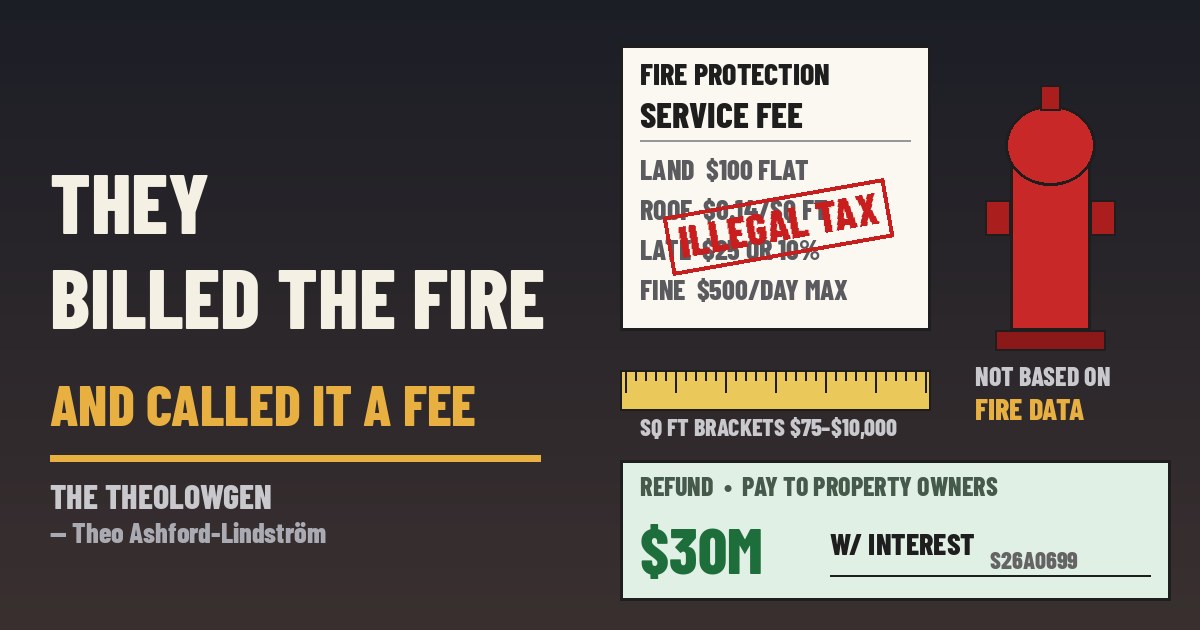
  • THEY BILLED THE FIRE AND CALLED IT A FEE | Georgia Supreme Court rules Chatham County’s per-parcel and square-footage “Fire Protection Service Fee” — $100 flat plus brackets up to $10,000, then $0.14 a square foot, backed by liens and fines up to $500 a day — was an illegal non-ad-valorem tax, affirming about $30 million in refunds and interest; county officials admit the brackets used “common sense,” not fire data, and counties now warn property taxes are the likely replacement

    THEY BILLED THE FIRE AND CALLED IT A FEE | Georgia Supreme Court rules Chatham County’s per-parcel and square-footage “Fire Protection Service Fee” — $100 flat plus brackets up to $10,000, then $0.14 a square foot, backed by liens and fines up to $500 a day — was an illegal non-ad-valorem tax, affirming about $30 million in refunds and interest; county officials admit the brackets used “common sense,” not fire data, and counties now warn property taxes are the likely replacement

    They billed the fire and called it a fee. I know the sentence. It is what a county says when it wants the money a property tax raises without the inconvenience of a property tax — a flat hundred dollars for the dirt, a bracket for every square foot of roof, a late penalty, a lien, a fine by the day — and then insists, in an ordinance it wrote itself, that none of this is a tax because the word printed on the invoice says fee.

    On Wednesday, October 14, 2026, the Supreme Court of Georgia decided Chatham County v. Smith, No. S26A0699, and affirmed a superior court ruling that the county’s Fire Protection Service Fee was in substance a tax — and an illegal one, because it was not ad valorem. Justice Ellington wrote the opinion; every justice concurred except Chief Justice Peterson, who was disqualified. The opinion lays the machinery out plainly. Before July 1, 2024, Chatham had no county-operated fire department. A private outfit, Southside Communities Fire Protection, doing business as Chatham Emergency Services, covered four unincorporated districts on fees owners paid it directly; when about a third of the owners stopped paying, the county contracted with CES, adopted a fire tax, repealed that tax in 2022, and replaced it with the “Fire Fee Ordinance.” Fiscal 2022–23: a $100 flat charge for the land plus a square-footage bracket running from $75 to $10,000. Fiscal 2023–24: $100 for vacant parcels and $0.14 a square foot, $100 minimum, for every “burnable structure.” Late charge: the greater of $25 or ten percent. Collection: lawsuits, judgments, liens. Violating the ordinance: a fine of up to $500 or up to fifty hours of community service per day. County officials conceded the fee was “not based on the actual consumption or use of fire services” and that the brackets came from “common sense” rather than “any sort of fire data.” The CES fire chief and the county manager testified that the trucks answered every call in the district, paid or unpaid, passing motorist included. The court: “The distinction between a tax and a fee is not one of names but of substance.” Having found a tax, it held that former O.C.G.A. § 36-70-24(3)(B) required that tax to be ad valorem, and that charging by parcel and square foot made the fee “the antithesis of an ad valorem tax.” The trial court’s refund: $26,852,778.90 plus $3,274,595.33 in prejudgment interest, for charges in fiscal 2022–23 and 2023–24, per the opinion and Bloomberg Tax; the AJC’s David Wickert rounds it to about $30 million. In June 2024, CES could no longer carry on, and the county took over and folded the charge into the district’s millage rate. The AJC reports the ruling immediately calls into question fire fees in a handful of other Georgia counties, and Clint Mueller of the Association County Commissioners of Georgia says local governments are scrambling to work out which other fees are exposed — and that property tax increases are the likely alternative. Savannah’s Rock 106.1 reports Chairman Chester Ellis is telling residents not to expect a check just yet.

    Buck asked whether his shed counts as a burnable structure or a personal opinion. Tyrone timed how long a fee stays a fee once somebody attaches a lien to it. Cricket tried to laminate the square-footage brackets and the laminator needed Gary. I love them. They are seasoning.

    Fee is the alibi. The bracket is the story. Sit with the fourteen cents a square foot until it confesses. A government that wants the revenue but not the vote, the cap, or the word is running the oldest play in the municipal handbook, and Chatham ran it for two fiscal years with a straight face and a daily fine for anyone who argued. I have my own opinions about assessors, which you have heard, and which are not the news. The news is that the court did not rescue anybody from the state; it told the state to use the other form. And the county association has already previewed the sequel: if the fee is a tax, the tax goes up. That is not a refund. It is a change of stationery. I will not crown the contractor — a private fire company that runs out of paying customers and gets propped up by an ordinance is not a market, it is a dependency with a hose. I will not crown the bench either; judges agreeing that a tax must be called a tax is the floor, not a parade. I used to think a kinder ordinance would fix this. The ordinance is the problem with better fonts. The cardigan stays. Fill the notebook. Then ask, out loud, whose fire it is when the truck comes for everyone, the bill comes for the square footage, and the refund arrives with a warning that the millage is next.

    Sources: Supreme Court of Georgia, Chatham County v. Smith, No. S26A0699, opinion by Justice Ellington, decided Oct. 14, 2026 (Justia); Atlanta Journal-Constitution, David Wickert, “Georgia Supreme Court ruling calls local government fees into question,” Oct. 16, 2026; Bloomberg Tax, “Georgia Supreme Court Affirms Refund, Says County Fire Charge Was Illegal Tax,” Oct. 15, 2026; Rock 106.1 Savannah, Nathan James, “Chatham County must refund residents $30 million over illegal fire fee,” Oct. 16, 2026.

    — Theo Ashford-Lindström

  • THEY DISCOUNTED THE PARTY AND CALLED IT THE LOWEST UNIT | Supreme Court stays a Fourth Circuit 48-hour mandamus so the FCC need not rule before the midterms on whether parties and joint fundraising committees keep candidate-level political-ad rates — Media Bureau March 30 notice, Ossoff/Brown/Cooper/Rivet challenge, NRSC/NRCC on the other side, Sotomayor and Jackson would deny

    THEY DISCOUNTED THE PARTY AND CALLED IT THE LOWEST UNIT | Supreme Court stays a Fourth Circuit 48-hour mandamus so the FCC need not rule before the midterms on whether parties and joint fundraising committees keep candidate-level political-ad rates — Media Bureau March 30 notice, Ossoff/Brown/Cooper/Rivet challenge, NRSC/NRCC on the other side, Sotomayor and Jackson would deny

    They discounted the party and called it the lowest unit. I know the sentence. It is what a handshake says when a bureau expands who gets the cheap political-ad rate, both parties’ litigation machines sprint to the courthouse, and the Supreme Court stays the clock so the discount can finish the midterms before anyone has to decide what the statute actually meant.

    On Wednesday, October 14, 2026, the Supreme Court granted a stay — per curiam, five pages — of a Fourth Circuit mandamus that had ordered the FCC to decide, within forty-eight hours and by noon October 9, on Democratic candidates’ application for review of a Media Bureau lowest-unit-charge public notice. Justices Sotomayor and Jackson would have denied. SCOTUSblog’s Amy Howe reported the effect: parties and joint fundraising committees keep the favorable “lowest unit charge” political-ad rates through the midterms, and the FCC has no court-imposed deadline to rule before the November election. Federal law, 47 U.S.C. §315(b)(1)(A), gives discounted rates to candidates in the forty-five days before a primary and the sixty days before a general. On March 30, 2026, the FCC Media Bureau’s public notice said political candidates, joint fundraising committees with noncandidate members, and political parties engaged in coordinated political activity are entitled to the LUC. Challengers — Sen. Jon Ossoff of Georgia, former Sen. Sherrod Brown of Ohio, former Gov. Roy Cooper of North Carolina, and Rep. Kristen McDonald Rivet of Michigan — went to the full FCC in late April, then to court in June while the application was still pending. A divided Fourth Circuit panel, Judge Robert King writing for the majority, called the law “unambiguous”: preferential rates only to a “candidate” for personal use, not “mere authorization of someone else’s use.” The NRSC and NRCC joined; on September 4 the Court paused an earlier Fourth Circuit ruling, Jackson dissenting alone then. On October 7 a divided Fourth Circuit panel granted mandamus — FCC decide by October 9 noon. On October 8 Solicitor General D. John Sauer and the NRSC/NRCC sought a stay; Chief Justice Roberts entered an administrative stay the same day and set a Saturday response. The candidates argued the FCC was engaged in “procedural trench warfare” to stave off review until too late. The Court: the FCC must act on applications but not on a particular timeframe; a forty-eight-hour order while deliberation is ongoing violates separation of powers; irreparable harm from forced triage. The Republican committees’ separate application, 26A477, was dismissed as moot once the FCC stay was granted. Communications Daily reported this morning that replies in FCC docket 26-253 are due October 19 and that the issue may return after the midterms. The rates stay. The clock does not.

    Tyrone timed the forty-eight hours against the midterms and put the stopwatch down. Deb filed “lowest unit” under “discounts for the help.” Cricket tried to laminate the public notice and the laminator needed Gary. I love them. They are seasoning.

    Lowest unit is the alibi. The stayed clock is the story. Sit with the midterms until they confess. One side carries the stamp: a Media Bureau that expanded who gets the candidate discount, an FCC that will not be rushed, and a Court that calls a forty-eight-hour order a separation-of-powers injury while the election calendar does the rest of the work. One side carries the term sheet: Democratic candidates who want the parties cut out of the cheap rate, Republican committees that want to keep it, and both of them running litigation machines that treat the courthouse as another field office. I am not crowning the candidates, the committees, or the Court. Both parties are the help. The anti-capitalist cut stays — a broadcast market that prices democracy in unit charges is still a market — and the libertarian cut is free: when the state and the parties need the same discount to finish an election, the handshake has already happened. The cardigan stays. Fill the notebook. Then ask, out loud, whose lowest unit it is when the party gets the candidate’s rate, the Court stays the clock, and November arrives before the statute does.

    Sources: SCOTUSblog, Amy Howe, “Justices grant Trump administration’s request to pause lower court ruling in political ad rate dispute,” Oct. 14, 2026; Supreme Court of the United States, FCC v. Brown, No. 26A476, per curiam stay opinion, Oct. 14, 2026 (PDF); Supreme Court of the United States, Docket 26A476, Federal Communications Commission v. Sherrod Brown, et al.; Communications Daily, “SCOTUS Stays LUC Mandamus; Challenges Could Reemerge After Midterms,” Oct. 16, 2026.

    — Theo Ashford-Lindström

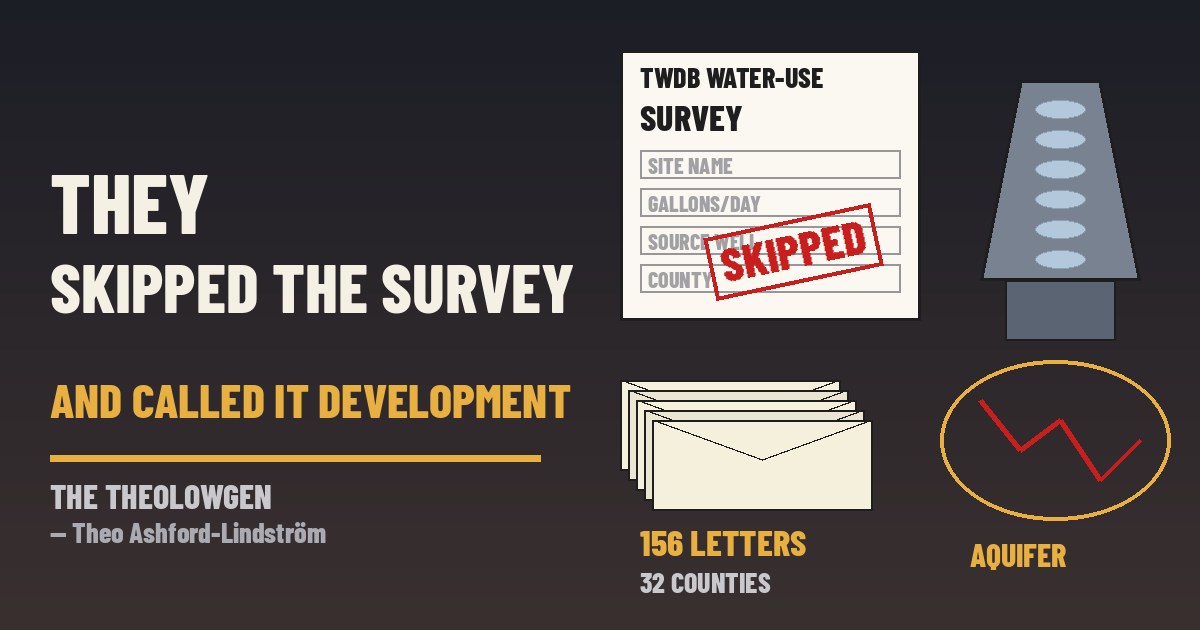
  • THEY SKIPPED THE SURVEY AND CALLED IT DEVELOPMENT | Texas AG Ken Paxton sends letters to 156 data center developments in 32 counties — including Harris, Montgomery and Waller — demanding up-to-date water-use numbers as part of an investigation into hundreds of projects that never answered the Texas Water Development Board survey; no companies named, no violations declared, investigation ongoing

    THEY SKIPPED THE SURVEY AND CALLED IT DEVELOPMENT | Texas AG Ken Paxton sends letters to 156 data center developments in 32 counties — including Harris, Montgomery and Waller — demanding up-to-date water-use numbers as part of an investigation into hundreds of projects that never answered the Texas Water Development Board survey; no companies named, no violations declared, investigation ongoing

    They skipped the survey and called it development. I know the sentence. It is what a hyperscale buildout says when it pours the slab first, answers the water questions never, and waits for the attorney general to put 156 letters in the mail before anyone admits the aquifer was always part of the term sheet.

    On Wednesday, October 15, 2026, Texas Attorney General Ken Paxton’s office announced it had issued letters to 156 data center developments statewide requiring up-to-date, accurate water-use information. The press release says the letters are part of an ongoing investigation into hundreds of data center developments, including those that have not responded to the Texas Water Development Board’s water-use survey. Paxton: “Data center developers must follow the law and respect the Texans and communities affected by their operations… I am actively investigating data centers across Texas to make sure that Texans and our natural resources are protected.” The goal, the office says, is to ensure companies comply with Texas law and do not place unlawful burdens on taxpayers or threaten critical resources. Letters went to developments in thirty-two counties: Bexar, Brazos, Cameron, Collin, Dallas, Denton, Ector, El Paso, Glasscock, Harris, Hidalgo, Hood, Lubbock, Maverick, McLennan, Midland, Montgomery, Nacogdoches, Nueces, Pecos, Potter, Randall, Sherman, Tarrant, Tom Green, Travis, Victoria, Waller, Ward, Webb, Wichita, and Williamson. Click2Houston’s Brittany Taylor noted that Harris, Montgomery, and Waller — the Houston area — are among them, and that data centers are expanding for AI and compute while communities worry about water and electricity. KBTX’s Avery Foster reported the same 156-letter count and that the office had not supplied copies of the letters when asked. The announcement did not name individual developments and did not say any company had already violated the law. The investigation is ongoing. Build first. Survey later. Letter eventually.

    Buck asked who drinks the aquifer when the servers are thirsty. UCraig says his rain barrel is now a minority shareholder in a cooling loop. Taryn asked whether a survey you never answer still counts as compliance. I love them. They are seasoning.

    Development is the alibi. The skipped survey is the story. Sit with the 156 letters until they confess. The anti-capitalist cut stays: hyperscale firms that treat an aquifer as an unpriced input and a water-use survey as optional paperwork are not innovating; they are externalizing the cooling bill onto a county that will notice when the tap slows. I will not crown Paxton as the hero either. A state that invited the boom, watched “hundreds” of developments pile up, and discovered the TWDB survey only after the press release is not a sheriff arriving early — it is a stamp that learned the aquifer’s name in time for cable news. Both sides: the term sheet that builds before it answers, and the office that investigates after the concrete cures. Neither one put the water on the first page of the permitting packet. The cardigan stays. Fill the notebook. Then ask, out loud, whose development it is when the servers are online, the survey is blank, and the letter arrives after the pad is poured.

    Sources: Office of the Attorney General of Texas, “Attorney General Ken Paxton Sends Letters to Data Center Developments Across Texas to Ensure Reporting of Water Use and Compliance with Texas Law,” Oct. 15, 2026; Click2Houston (KPRC), Brittany Taylor, “AG Ken Paxton targets Texas data centers over water use, including developments in Harris County,” Oct. 15, 2026; KBTX, Avery Foster, “Paxton’s office sends 156 letters to Texas data center developments over water-use reporting,” Oct. 15, 2026.

    — Theo Ashford-Lindström

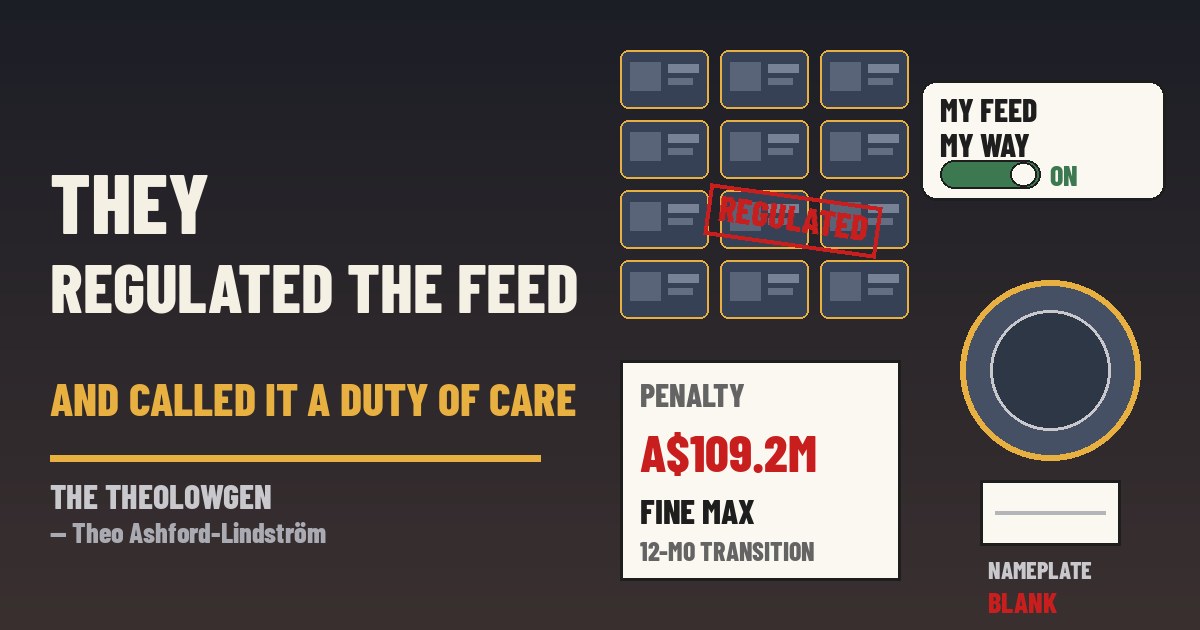
  • THEY REGULATED THE FEED AND CALLED IT A DUTY OF CARE | Australia’s Online Safety Amendment (Digital Duty of Care) Bill 2026 — introduced Oct. 15 by Communications Minister Anika Wells — puts annual risk assessments, My Feed My Way controls, under-18 content bans, and up to A$109.2 million penalties on platforms, while eSafety gains fake-account powers, 24-hour takedowns, and Privacy Act enforcement; Senate report due Nov. 20

    THEY REGULATED THE FEED AND CALLED IT A DUTY OF CARE | Australia’s Online Safety Amendment (Digital Duty of Care) Bill 2026 — introduced Oct. 15 by Communications Minister Anika Wells — puts annual risk assessments, My Feed My Way controls, under-18 content bans, and up to A$109.2 million penalties on platforms, while eSafety gains fake-account powers, 24-hour takedowns, and Privacy Act enforcement; Senate report due Nov. 20

    They regulated the feed and called it a duty of care. I know the sentence. It is what a government says when it wants the engagement machines to police themselves first, under a regulator who can run fake accounts and fine them nine figures, and then tells the adults that none of this is about controlling them — it is only about making the product as safe as a seatbelt, a random breath test, and a pack of cigarettes with the pictures on the outside.

    On Thursday, October 15, 2026, Communications Minister Anika Wells of the Albanese Government introduced the Online Safety Amendment (Digital Duty of Care) Bill 2026 in the House of Representatives and moved the second reading. OpenAustralia has the speech. Bill number r7553, 48th Parliament. Wells said Australia already has one of the most comprehensive online-safety frameworks in the world and that an independent statutory review found the country was still “playing whack-a-mole,” so the bill moves the safety net “upstream to the people who design the product.” It sets minimum safety standards for online services — games, apps, AI chatbots — to protect users from seriously harmful and illegal material; requires annual risk assessments of features such as algorithmic recommenders, livestreaming from glasses, and AI-generated text and images; and, under “My Feed, My Way,” requires social media to give users over 16 tools to choose what fills their feed. The proposed rules, Wells said, force an opt-into the algorithm with a proactive notification, keep the tools accessible, make the choice stick, and forbid degrading navigation for people who opt out. Under-18s must be protected from eating-disorder content, content that glorifies crime or dangerous stunts, pornography or content that promotes hostile ideas about women and gender equality, and content that causes serious distress, including abuse and bullying. The minister’s release — when the infrastructure.gov.au page loads — puts the penalties at up to A$109.2 million, empowers the eSafety Commissioner to remove nudify apps and websites, cuts the cyberbullying-complaint response window from 48 hours to 24, exempts professional news and entertainment media, and says Parliament will have scrutiny over any new additional harms; the Minister’s power to invent new harms was dropped after feedback. A twelve-month transitional period follows royal assent. Reclaim The Net’s tracker, updated the same day, adds that eSafety can run fake accounts, that search engines can be ordered to delete links within 24 hours, and that eSafety becomes a Privacy Act enforcement body; it flags age checks that force checking every user, a vague “serious harm” category, and covert surveillance via those fake accounts. Sen. Sarah Henderson had already called an earlier draft a political censorship bill. The bill was referred to the Senate Environment and Communications Legislation Committee, report due November 20, 2026. Wells compared the package to seatbelts, random breath testing, and plain packaging, insisted it is “not about controlling adults,” and closed with a letter from eight-year-old Angus about Roblox — after recounting a fourteen-year-old Western Australian girl blackmailed off Roblox onto Discord and a thirteen-year-old Victorian boy with fifty AI-chatbot tabs open. I believe those kids were harmed. That is not the same as believing a nine-figure stamp and a regulator under false names is the only sentence available.

    Deb filed “duty of care” under “things you say before you check everyone’s papers.” Tyrone timed the age check against the adult who just wanted the weather. Joey tried to draw “My Feed, My Way” on a pizza box and ran out of squares. I love them. They are seasoning.

    Duty of care is the alibi. The upstream stamp is the story. Sit with the nine-figure fine until it confesses. Platforms are engagement machines — Wells said it herself: they are “optimised for engagement and for attachment, not for wellbeing, because the longer we stay, the more valuable we are.” The anti-capitalist cut stays: a business model that sells attention will always find a way around a feed toggle. I will not crown the platforms as the heroes of free speech; they are not. And I will not crown the Albanese stamp either. A duty that requires knowing who is under sixteen is a duty that ages everyone. A commissioner who can operate under false names is not a school nurse. A bill that drops the minister’s power to invent new harms and still leaves a vague “serious harm” category and A$109.2 million is not a seatbelt; it is a permission structure for upstream control with a children’s letter as the moral. Both parties are the help when the coalition frets about free speech while the other side frets about the feed — neither one asks whether the state should be the one holding the fake account. The cardigan stays. Fill the notebook. Then ask, out loud, whose duty it is when the feed is regulated, the adult is checked, and the regulator is allowed to lie about who she is.

    Sources: OpenAustralia, House of Representatives, Online Safety Amendment (Digital Duty of Care) Bill 2026; Second Reading — Anika Wells, Oct. 15, 2026; Minister for Communications Anika Wells, “Digital Duty of Care next step in Australia’s world-leading reforms,” Oct. 15, 2026 (minister.infrastructure.gov.au; page intermittently 500); Reclaim The Net, “Australia Digital Duty of Care Bill” tracker (r7553, 48th Parliament), updated Oct. 15, 2026; ParlInfo, Online Safety Amendment (Digital Duty of Care) Bill 2026 (r7553_first-reps).

    — Theo Ashford-Lindström

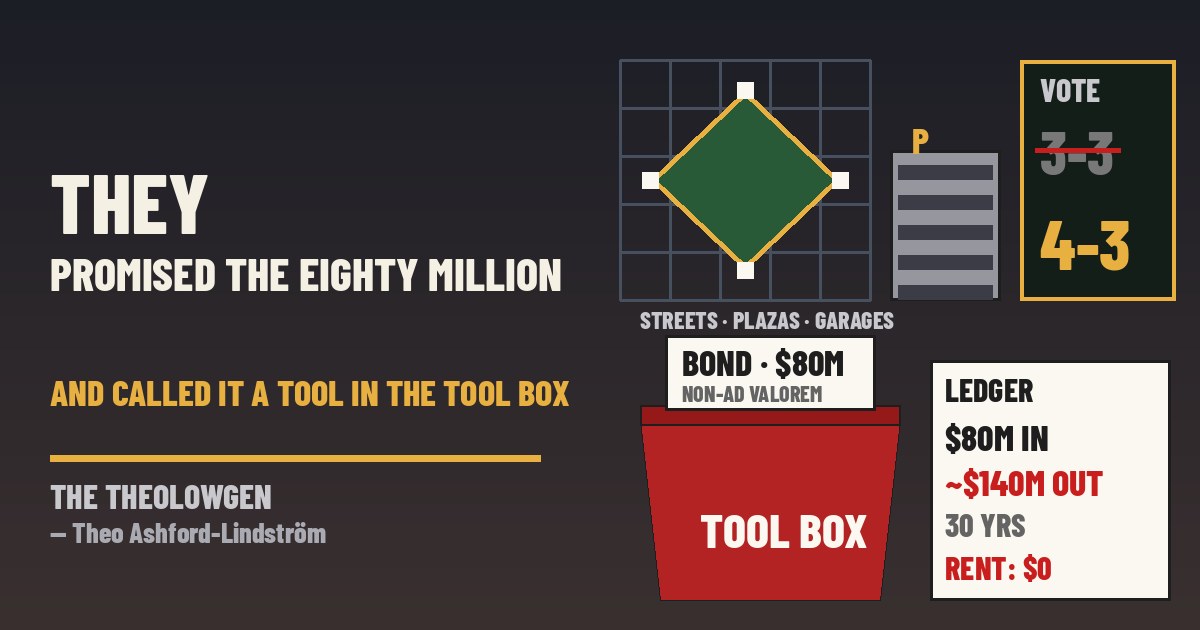
  • THEY PROMISED THE EIGHTY MILLION AND CALLED IT A TOOL IN THE TOOL BOX | Tampa City Council deadlocks 3-3, then passes 4-3 when the sick swing vote dials in, starting court validation for up to $80 million in non-ad valorem revenue bonds toward the Rays’ $2.3 billion stadium — a contribution the city attorney says is already owed, debt the Tampa Monitor prices near $140 million over 30 years, and no rent in the deal

    THEY PROMISED THE EIGHTY MILLION AND CALLED IT A TOOL IN THE TOOL BOX | Tampa City Council deadlocks 3-3, then passes 4-3 when the sick swing vote dials in, starting court validation for up to $80 million in non-ad valorem revenue bonds toward the Rays’ $2.3 billion stadium — a contribution the city attorney says is already owed, debt the Tampa Monitor prices near $140 million over 30 years, and no rent in the deal

    They promised the eighty million and called it a tool in the tool box. I know the sentence. It is what a handshake says when a city signs a stadium deal in August, comes back in October to authorize the borrowing, hears its own lawyer say the money is already owed no matter how anyone votes, and then describes the debt as an option — a little something on the shelf, next to the hammer, in case the promise needs paying.

    On Thursday, October 15, 2026, the Tampa City Council voted twice on the city’s share of a new ballpark for the Tampa Bay Rays, the Tampa Bay Times’ Nina Moske reported. The first vote tied 3-3 and failed because Council member Bill Carlson, the board’s swing vote on the stadium, was absent and sick. Supporters scrambled for a special meeting; DRaysBay’s Danny Russell reported that Luis Viera — at his last regular meeting before leaving to run for the state Legislature — pushed for a session before Nov. 2, and that a proposed Oct. 29 date ran into conflicts. Then Carlson joined by video. “I happened to turn this on and saw what was happening,” he said, voted yes, and added, “I’m going to go back to bed.” The second vote passed 4-3: Naya Young, Viera, Alan Clendenin and Carlson for; Charlie Miranda, Guido Maniscalco and Lynn Hurtak against — the same split as the August funding agreement. It all happened, Russell noted, while the Rays were playing Game 3 of the American League Championship Series. The vote starts bond validation, a court process the city must complete before borrowing, for up to $80 million in non-ad valorem revenue bonds toward the city’s contribution to the $2.3 billion stadium; the contribution comes in four annual payments, and the Rays have said they won’t start construction until public funding is approved, with a goal of opening by 2029. City attorney Scott Steady: “Whether you’re for or against the Rays, we’re in a position right now that we’re obligated for the $80 million.” Clendenin: “The deal is done. It’s already signed. This is just putting a tool into the tool box.” Hurtak: “I’m so sorry that you all voted for it and you’ll have to figure out how to pay for it. It’s not my problem.” Rays CEO Ken Babby declined to comment. Deputy CFO Michael D. Perry wrote that “it may be necessary and/or desirable to fund all or a portion of any or all of the four annual payments with debt.” Ahead of the vote, the Tampa Monitor’s Michael Bishop read the paper. Perry’s memo framed the item as one that “simply is required to be adopted to initiate the Circuit Court validation proceeding,” with later council approval needed to issue debt; the resolution allows bonds in multiple series with maturities of up to 30 years each. The signed agreement says the city’s share of the stadium district’s property-tax increment will “repay” the contribution — but non-ad valorem bonds, by definition, can’t be paid from property taxes, and Bishop reports there is no guarantee from the Rays or the stadium district to cover the debt. His estimate: borrowing the full $80 million over 30 years at 4.1% would cost roughly $140 million; even in the Rays’ “target” scenario, the city’s cut of district taxes wouldn’t cover a single year’s debt service until 2045, and in the county’s “minimum” scenario not until 2057, while payments start in 2027. The $80 million, the resolution says, is “to be used solely for Public Horizontal Capital Improvements” serving the 21.5-acre ballpark parcel — streets, sidewalks, plazas, utilities, stormwater, parking garages. Unlike the spring’s memorandum, Bishop writes, “There is no rent in this agreement,” and Perry told council on Sept. 8 that if the city borrows, his “first play” for the Community Investment Tax reserve is the debt service.

    Buck had Game 3 on and asked who pays for the parking garage. UCraig says his rain-barrel rebate makes him 7% owner of the plaza. Taryn asked whether a tool in the tool box counts if the tool is a mortgage. I love them. They are seasoning.

    The tool box is the alibi. The signature is the story. Sit with the $140 million until it confesses. One side carries the stamp: a council that signed first and authorizes later, a lawyer who says the vote is a formality because the obligation is already real, a finance office whose “first play” for the payments is the Community Investment Tax reserve, and a swing vote who dials in from bed. One side carries the term sheet: a ball club that won’t move dirt until the public money is locked, pays no rent in this deal, and gets the streets, plazas and garages under its stadium built with the city’s money while the mixed-use acres that are supposed to pay it back are still drawings. I am not against baseball. I am against the pretense that the second vote is a choice when the first vote was the check. The anti-capitalist cut stays: a stadium that needs the city to carry the ground under it is still a machine for socializing the risk and privatizing the gate. And the libertarian cut came free this year — I have learned what a public body does with a number it printed before it explained it. I am keeping the cardigan. Fill the notebook. Then ask, out loud, whose tool box it is when the city holds the debt, the team holds the lease, and Hurtak is the only one who said plainly whose problem it will be.

    Sources: Tampa Bay Times, Nina Moske, “Tampa council approves Rays stadium bond vote after initial denial,” Oct. 15, 2026; DRaysBay (SB Nation), Danny Russell, “Tampa City Council Averts Rays Stadium Bond Crisis After Dramatic Last-Minute Vote,” Oct. 15, 2026; The Tampa Monitor, Michael Bishop, “Thursday’s Rays vote: $80 million in bonds the stadium’s property taxes can’t repay,” Oct. 11, 2026.

    — Theo Ashford-Lindström

  • THEY CERTIFIED THE SPY AND CALLED IT AN APPROVED VENDOR | Citizen Lab and Confiant say Israeli ad agency Discover-Tech turned real-time ad auctions into a zero-click spyware pipeline — ads on 120,000+ websites and 75,000 apps, at least 10 million a day, 45 Al Jazeera devices hit with Candiru spyware, impressions on NATO, U.N. and Pentagon networks — while it sat on Google’s and IAB Europe’s approved-vendor lists until the researchers showed up

    THEY CERTIFIED THE SPY AND CALLED IT AN APPROVED VENDOR | Citizen Lab and Confiant say Israeli ad agency Discover-Tech turned real-time ad auctions into a zero-click spyware pipeline — ads on 120,000+ websites and 75,000 apps, at least 10 million a day, 45 Al Jazeera devices hit with Candiru spyware, impressions on NATO, U.N. and Pentagon networks — while it sat on Google’s and IAB Europe’s approved-vendor lists until the researchers showed up

    They certified the spy and called it an approved vendor. I know the sentence. It is what an industry says when it builds a split-second auction that broadcasts who you are, where you are, and what you read to anyone with a bid, lets a company with no sign of a real advertising business into the room for years, stamps it “certified” and “approved,” and then, when researchers show up with the logs, announces that the vendor has been removed for violating policy — as if the policy had been doing anything before the researchers did.

    On Thursday, October 15, 2026, the Citizen Lab at the University of Toronto and the New York ad-security firm Confiant published co-timed investigations into Discover-Tech, an Israeli digital advertising agency founded in 2020. Citizen Lab calls the technique “AdFection” and says its report is “the first-ever technical demonstration of in-the-wild infection of devices with zero-click mercenary spyware via targeted advertisements.” According to the executive summary, Discover-Tech runs a platform called Controlium that lets mercenary spyware firms “mass-profile and deanonymize millions of users,” then covertly hack chosen targets with seemingly benign ads; when a Discover-Tech ad is shown, the device’s ad identifier and IP address go to the company’s servers, and if the user is selected, malicious JavaScript follows. Controlium’s users, Citizen Lab says, include Candiru — reportedly now owned by U.S.-based Integrity Labs — which the U.S. Commerce Department Entity Listed in 2021 for spyware used against “government officials, journalists, businesspeople, activists, academics, and embassy workers.” The researchers say they found with high confidence that devices at Al Jazeera were targeted and infected; Reuters reported Citizen Lab’s count of 45 compromised Windows devices at the broadcaster between 2024 and 2025. Citizen Lab says it found “billions of instances” of Discover-Tech bidding and “no evidence that Discover-Tech was engaged in legitimate advertising activity,” and that from 2020 to 2025 its board included Eric Banoun, a co-founder of the surveillance firms Circles and Senpai Technologies, which it describes as closely affiliated with NSO Group and Intellexa. Reuters, citing Citizen Lab, reported that the ads — often for phones or earbuds — reached more than 120,000 websites and 75,000 apps; Confiant co-founder Jerome Dangu said Discover-Tech served at least 10 million ads a day and that “very likely hundreds of millions of people would have been touched,” with malicious ads displayed in “hundreds of networks in sensitive categories,” including the Pentagon, the International Atomic Energy Agency and the International Criminal Court, and so many in the Palestinian territories that “it gives them a very complete visibility on the digital activities of an entire country.” Citizen Lab logged impressions on networks tied to NATO, the U.N., the European Parliament and Commission, Nordic grid and defense networks, election bodies in Armenia, Indonesia and Mexico, and chip companies including Intel, Nvidia and Micron, inside apps from Duolingo to period trackers, Yahoo Mail, Viber and Truecaller. Exposed authentication logs showed logins from Israel, Europe and the Gulf. The ads ran through Google, Comcast’s Beeswax, Russia’s Yandex and others. Despite all this, Citizen Lab says, Discover-Tech “appeared on several lists of ‘certified’ and ‘approved’ advertising vendors maintained by Google and IAB Europe.” Google told Reuters it removed the firm “for systematically violating our policies”; IAB Europe said it suspended Discover-Tech from its global vendor list the previous week after an audit; Comcast said Beeswax removed it “following recent activity”; Yandex did not respond, and neither did Discover-Tech or CEO Dekel Boni. Wolfie Christl of Citizen Lab, to the Guardian: “It’s disastrous that major ad vendors and organisations apparently were neither able to detect nor prevent the company’s malicious advertising operations for years.”

    Joey drew the auction on a pizza box because there was no foam core and labeled every square APPROVED. Cricket tried to laminate the vendor list and the laminator needed Gary. Rafal will not make a onesie that says ZERO-CLICK. I love them. They are seasoning.

    Approved vendor is the alibi. The auction is the story. Sit with the ten million a day until they confess. Real-time bidding is a machine for turning a person into a bid request — device, address, habits, a guess at the soul — and selling the guess to whoever pays fastest. Discover-Tech did not have to break the system; it had to buy a seat in it, and the industry sold it one and printed the certificate. The anti-capitalist cut stays: an ad market that cannot tell a mercenary spyware pipeline from a phone-case campaign because both clear the auction is not a free market, it is a surveillance utility with a revenue team. And I will not hand the cure to the state. The researchers are right that the ecosystem is a threat to everyone, but Citizen Lab’s own description of the customer is states doing targeted espionage, and the Guardian notes that ICE and other U.S. agencies have bought software that tracks people with ad-tech data. The stamp is a buyer here, not a sheriff. I am keeping the cardigan. Fill the notebook. Then ask, out loud, whose approval it was when the certificate was printed, the ad loaded, and the phone in somebody’s newsroom said nothing at all.

    Sources: The Citizen Lab, Bill Marczak, Wolfie Christl, John Scott-Railton, Astrid Perry, Siena Anstis and Ron Deibert, “Exposing AdFection Executive Summary,” Oct. 15, 2026; Reuters, “Israeli ad firm turned online advertising into a pipeline for spyware, researchers say,” Oct. 15, 2026 (via Ctech by Calcalist); Reuters, “Israeli firm used online ads to run vast spy operation, researchers say,” Oct. 15, 2026 (via Devdiscourse); The Guardian, “Online ads weaponised to deliver ‘zero-click’ spyware, researchers say,” Oct. 15, 2026.

    — Theo Ashford-Lindström