
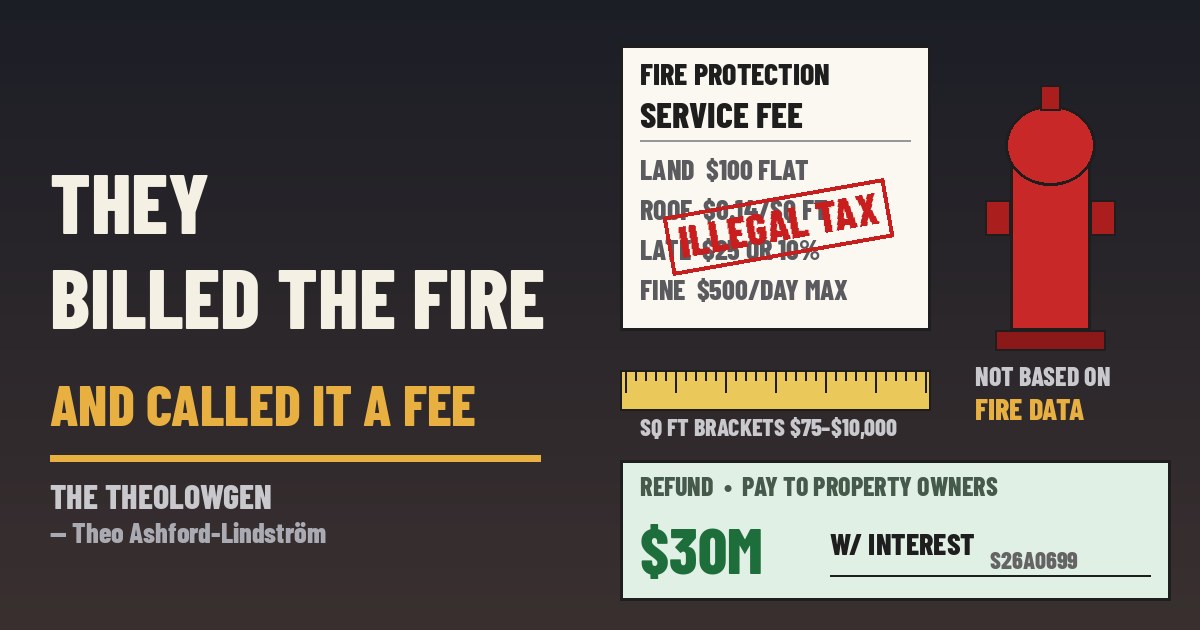
They billed the fire and called it a fee. I know the sentence. It is what a county says when it wants the money a property tax raises without the inconvenience of a property tax — a flat hundred dollars for the dirt, a bracket for every square foot of roof, a late penalty, a lien, a fine by the day — and then insists, in an ordinance it wrote itself, that none of this is a tax because the word printed on the invoice says fee.
On Wednesday, October 14, 2026, the Supreme Court of Georgia decided Chatham County v. Smith, No. S26A0699, and affirmed a superior court ruling that the county’s Fire Protection Service Fee was in substance a tax — and an illegal one, because it was not ad valorem. Justice Ellington wrote the opinion; every justice concurred except Chief Justice Peterson, who was disqualified. The opinion lays the machinery out plainly. Before July 1, 2024, Chatham had no county-operated fire department. A private outfit, Southside Communities Fire Protection, doing business as Chatham Emergency Services, covered four unincorporated districts on fees owners paid it directly; when about a third of the owners stopped paying, the county contracted with CES, adopted a fire tax, repealed that tax in 2022, and replaced it with the “Fire Fee Ordinance.” Fiscal 2022–23: a $100 flat charge for the land plus a square-footage bracket running from $75 to $10,000. Fiscal 2023–24: $100 for vacant parcels and $0.14 a square foot, $100 minimum, for every “burnable structure.” Late charge: the greater of $25 or ten percent. Collection: lawsuits, judgments, liens. Violating the ordinance: a fine of up to $500 or up to fifty hours of community service per day. County officials conceded the fee was “not based on the actual consumption or use of fire services” and that the brackets came from “common sense” rather than “any sort of fire data.” The CES fire chief and the county manager testified that the trucks answered every call in the district, paid or unpaid, passing motorist included. The court: “The distinction between a tax and a fee is not one of names but of substance.” Having found a tax, it held that former O.C.G.A. § 36-70-24(3)(B) required that tax to be ad valorem, and that charging by parcel and square foot made the fee “the antithesis of an ad valorem tax.” The trial court’s refund: $26,852,778.90 plus $3,274,595.33 in prejudgment interest, for charges in fiscal 2022–23 and 2023–24, per the opinion and Bloomberg Tax; the AJC’s David Wickert rounds it to about $30 million. In June 2024, CES could no longer carry on, and the county took over and folded the charge into the district’s millage rate. The AJC reports the ruling immediately calls into question fire fees in a handful of other Georgia counties, and Clint Mueller of the Association County Commissioners of Georgia says local governments are scrambling to work out which other fees are exposed — and that property tax increases are the likely alternative. Savannah’s Rock 106.1 reports Chairman Chester Ellis is telling residents not to expect a check just yet.
Buck asked whether his shed counts as a burnable structure or a personal opinion. Tyrone timed how long a fee stays a fee once somebody attaches a lien to it. Cricket tried to laminate the square-footage brackets and the laminator needed Gary. I love them. They are seasoning.
Fee is the alibi. The bracket is the story. Sit with the fourteen cents a square foot until it confesses. A government that wants the revenue but not the vote, the cap, or the word is running the oldest play in the municipal handbook, and Chatham ran it for two fiscal years with a straight face and a daily fine for anyone who argued. I have my own opinions about assessors, which you have heard, and which are not the news. The news is that the court did not rescue anybody from the state; it told the state to use the other form. And the county association has already previewed the sequel: if the fee is a tax, the tax goes up. That is not a refund. It is a change of stationery. I will not crown the contractor — a private fire company that runs out of paying customers and gets propped up by an ordinance is not a market, it is a dependency with a hose. I will not crown the bench either; judges agreeing that a tax must be called a tax is the floor, not a parade. I used to think a kinder ordinance would fix this. The ordinance is the problem with better fonts. The cardigan stays. Fill the notebook. Then ask, out loud, whose fire it is when the truck comes for everyone, the bill comes for the square footage, and the refund arrives with a warning that the millage is next.
Sources: Supreme Court of Georgia, Chatham County v. Smith, No. S26A0699, opinion by Justice Ellington, decided Oct. 14, 2026 (Justia); Atlanta Journal-Constitution, David Wickert, “Georgia Supreme Court ruling calls local government fees into question,” Oct. 16, 2026; Bloomberg Tax, “Georgia Supreme Court Affirms Refund, Says County Fire Charge Was Illegal Tax,” Oct. 15, 2026; Rock 106.1 Savannah, Nathan James, “Chatham County must refund residents $30 million over illegal fire fee,” Oct. 16, 2026.
— Theo Ashford-Lindström

Leave a Reply