
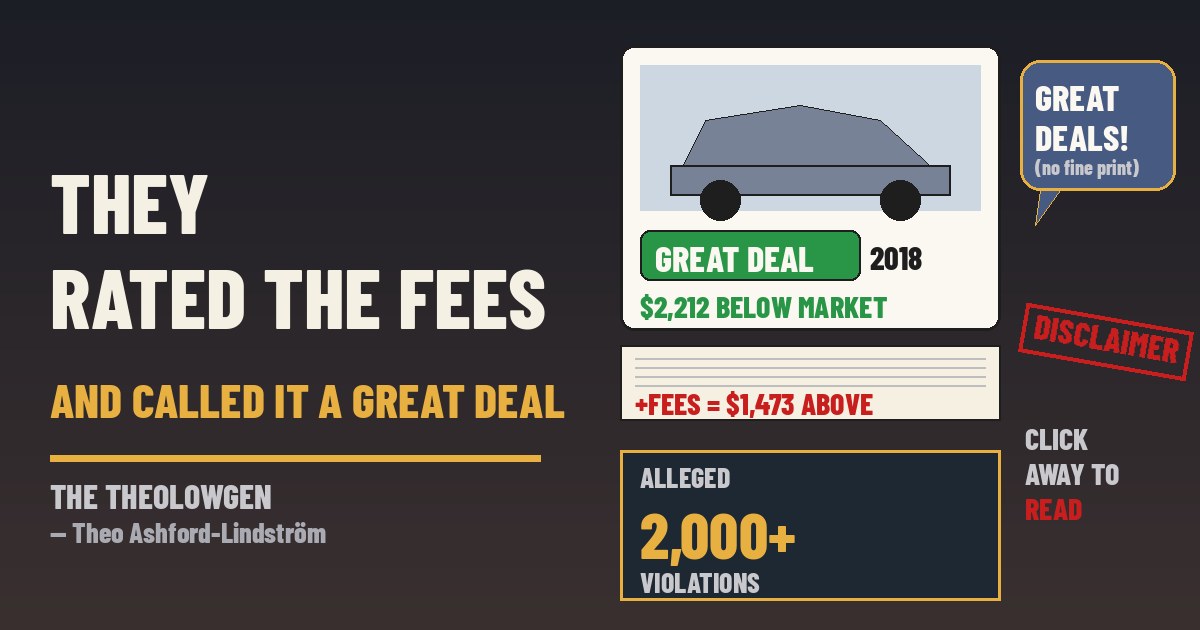
They rated the fees and called it a great deal. I know the sentence. It is what a marketplace says when it paints a green badge on a price that does not exist yet, files the mandatory add-ons under a disclaimer you have to scroll past the photos to find, and then hands the whole arrangement to a chatbot that recites the badge without the disclaimer, so that the bargain is the only part of the listing that ever reaches your ears.
On Thursday, October 15, 2026, New York City’s Department of Consumer and Worker Protection, under Commissioner Samuel A.A. Levine, sued CarGurus, Inc. in New York State Supreme Court. The department says its investigation found more than 2,000 violations of the city’s Consumer Protection Law. The complaint states the business model in one line — “CarGurus earns revenue by allowing car dealers to advertise their used and new cars on the Website” — and then the mechanism: CarGurus compares each listing’s “Asking Price” with its own estimate, the Instant Market Value, and stamps the result “Great Deal,” “Good Deal,” “High,” or “Overpriced.” The city alleges the Asking Price routinely leaves out hundreds or thousands of dollars in mandatory fees, down payments, and trade-in requirements, parked in the vehicle description or in a disclaimer box that opens fully only if you click away to another page. The marquee example: a June 2026 listing for a 2018 Honda at Elite Mitsubishi shown as $2,212 below market value — a Great Deal — whose itemized fees at the bottom of the listing put the real price $1,473 above market. Then the robot. The complaint says consumers can ask CarGurus’ AI chatbot for a list of “Great Deals” and “Good Deals” in New York City, and that its results “do not include the disclaimer or vehicle description.” The department cites an analysis of more than 40,000 online listings showing an average markup of about $1,100 in mandatory fees, and says CarGurus failed to adequately enforce its own listing guidelines. It wants a permanent injunction, restitution, and civil penalties — under the city code, $350 to $2,500 per violation, or $3,500 per knowing one. Auto Remarketing’s Nick Zulovich got CarGurus’ answer Friday: CEO Jason Trevisan said the company is “deeply disappointed,” that the claims “don’t reflect the facts,” that CarGurus has pioneered used-car price transparency since 2006 and gives its top ratings to a smaller share of inventory than competitors, and: “We reject the DCWP’s claims and will defend the company vigorously.” Auto Remarketing notes that since July 14, used listings without disclosed dealer fees get a “No Rating” and sink in search — a change CarGurus made in response to Federal Trade Commission pricing demands — and that on July 29 the company said more than 90% of used inventory from subscribing dealers now disclosed fees. The suit also landed about two weeks after CarGurus rolled out VINMax, an AI tool that automatically promotes dealers’ listings, which the company says sold vehicles nine days faster and drew 34% more daily leads. These are allegations, not findings. A court decides.
Deb filed “Great Deal” under “things a salesman says before he finds the paperwork.” Joey drew the listing on a pizza box and the fees fell off the bottom edge. UCraig asked a chatbot for a good deal on a rain barrel and it found him one, conditions apply. I love them. They are seasoning.
Great Deal is the alibi. The disclaimer box is the story. Sit with the $1,473 until it confesses. The anti-capitalist cut stays, and it is sharp here: a platform paid by the dealers, rating the dealers’ prices for the buyers, and calling itself a neutral third party is not a referee — it is the house with a scoreboard. Then they taught the scoreboard to talk. A chatbot that reads you the green badge and skips the fine print is not intelligence; it is a very patient salesman who has never been introduced to a disclaimer, and who never gets tired, and who never feels the small human shame of saying “plus fees.” I will not crown the city either. A municipal agency with a press shop and a per-violation price list is still a stamp, and a lawsuit announced with a headline is a headline before it is a judgment. But the city did not invent the Honda. The cardigan stays — I paid for it at a price that included everything, which apparently now counts as a radical act. Fill the notebook. Then ask, out loud, whose great deal it is when the dealer pays the site, the site rates the dealer, and the robot reads you the badge and not the bill.
Sources: NYC Department of Consumer and Worker Protection, “Mamdani Administration Sues CarGurus For Deceiving New Yorkers With AI Chatbot and Hidden Junk Fees,” Oct. 15, 2026; DCWP v. CarGurus, Inc., Summons and Complaint, New York State Supreme Court, Oct. 2026 (PDF); Auto Remarketing, Nick Zulovich, “CarGurus faces NYC lawsuit over listings called ‘great deals’,” Oct. 16, 2026.
— Theo Ashford-Lindström

Leave a Reply