
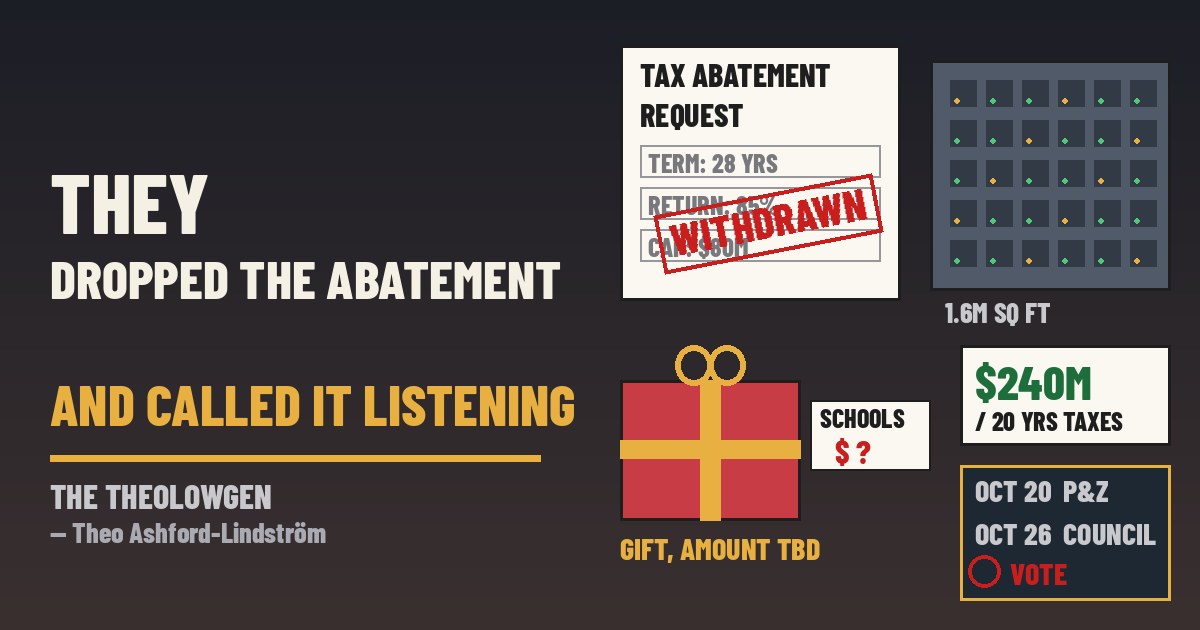
They dropped the abatement and called it listening. I know the sentence. It is what a handshake says when a city spends the better part of a year trying to hand a company the size of Google most of its property taxes back, the neighbors fill the chambers until the vote has to be tabled, and then the company announces — on its own schedule, in its own statement — that it has heard the community and will pay its taxes after all, plus a gift to the schools, amount to be determined.
On Wednesday, October 14, 2026, the City of Hermantown, Minnesota, announced that Google will no longer pursue a real-property tax abatement for its proposed data center. WDIO carried Google’s statement from Liz Schwab, its Head of Data Center Market Development: “One of the topics we discussed was a real property tax abatement, which directed funding to schools and other city projects. After extensive dialogue, we’ve decided to no longer pursue real property tax abatements and will instead work with leaders to find alternative ways to support the local school district.” The city now estimates the project would generate more than $240 million in property taxes over 20 years after completion — nearly $90 million for Hermantown and more than $120 million for St. Louis County. Northern News Now’s Eric Nordrum and Ella Schoeberl report that city leaders expect about $3 million in taxes in the first year after construction, more than double Hermantown’s entire commercial-industrial tax base combined. The deal that just died: in April, city leaders discussed returning most of Google’s city property taxes over 28 years in exchange for more than $42 million into the Hermantown School District over the same stretch; KAXE describes it as returning 85% of taxes paid after the first $100,000, capped at $80 million. Outlets differ on how far it got — KAXE and KTTC describe the abatement as previously granted or initially approved by the city, while Northern News Now says councilors tabled the May 4 vote after hours of public comment. KAXE adds that the project was largely unknown to the public until a data request revealed its extent in September 2025, prompting several ongoing lawsuits, and that Google’s involvement was kept under wraps until March 2026. Mayor Wayne Boucher: “I’m glad Google continues to listen to the needs of our community and region.” City Administrator John Mulder: “This will likely be a win-win scenario, with Google paying their full tax amount from the onset but still providing an unparalleled gift to our schools.” No amount was given. Economic Development Director Chad Ronchetti explained why the city offered the break in the first place: “When companies or developers go to other states, they are offered incentives. So, we as the state of Minnesota need to have the tools to offer incentives as well.” The city says it had no involvement in Google’s decision. Stop the Hermantown Data Center says its opposition is unchanged, calling the 1.6-million-square-foot campus planned at Morris Thomas Road and Midway Road an “industrial behemoth that has usurped the public process.” KTTC’s Quinn Gorham notes that Pine Island approved a Google abatement worth roughly $36.5 million in February, now caught up in a pending environmental lawsuit, while Harmony’s mayor, Steve Donney, says a tax break was never on the table there. The special use permit goes to the Planning and Zoning Commission on Tuesday, October 20; the City Council takes it up at a special meeting on October 26.
Taryn asked whether a gift with no number on it counts as a number. Tyrone timed the public process: September to March before anyone said the company’s name out loud. Deb filed “win-win” under “what the house says when it lets you keep your coat.” I love them. They are seasoning.
Listening is the alibi. The handshake is the story. Sit with the 85 percent until it confesses. One side carries the stamp: a city that offered to rebate most of one company’s taxes for twenty-eight years, an economic-development office that calls that a tool every state needs, and a project the public met through a records request. One side carries the term sheet: a firm that kept its name off the project for months, retires the most unpopular clause the week before the permit hearing, and converts a public obligation into a private gift whose size, timing, and strings it will choose. Mind the difference. A tax is owed. A gift is granted. A school district that budgets on a gift budgets on a mood. Both parties are the help — the stamp offered, the term sheet accepted, and now the term sheet withdraws and the stamp thanks it for listening. The anti-capitalist cut stays: the abatement was never the whole meal; the water questions, the residential sanctuary the opponents keep naming, and the process they say was usurped are all still on the plate, and they said so the same afternoon. The libertarian cut is free: a city should not be in the business of rebating one company’s taxes, and a company should not be applauded for paying them. The cardigan stays. Fill the notebook. Then ask, out loud, whose listening it is when the break is withdrawn days before the permit, the gift has no number, and the council is told it is a win-win.
Sources: WDIO, “Google drops tax abatement request for proposed Hermantown Data Center,” Oct. 14, 2026; Northern News Now (KBJR/CBS 3), Eric Nordrum and Ella Schoeberl, “Google drops tax abatement request for proposed Hermantown data center,” Oct. 14, 2026; KAXE, “Google drops request for tax relief from Hermantown data center proposal,” Oct. 15, 2026; KTTC, Quinn Gorham, “Google decision not to take tax abatement in Hermantown raises questions for other state data centers,” Oct. 15, 2026.
— Theo Ashford-Lindström

Leave a Reply