
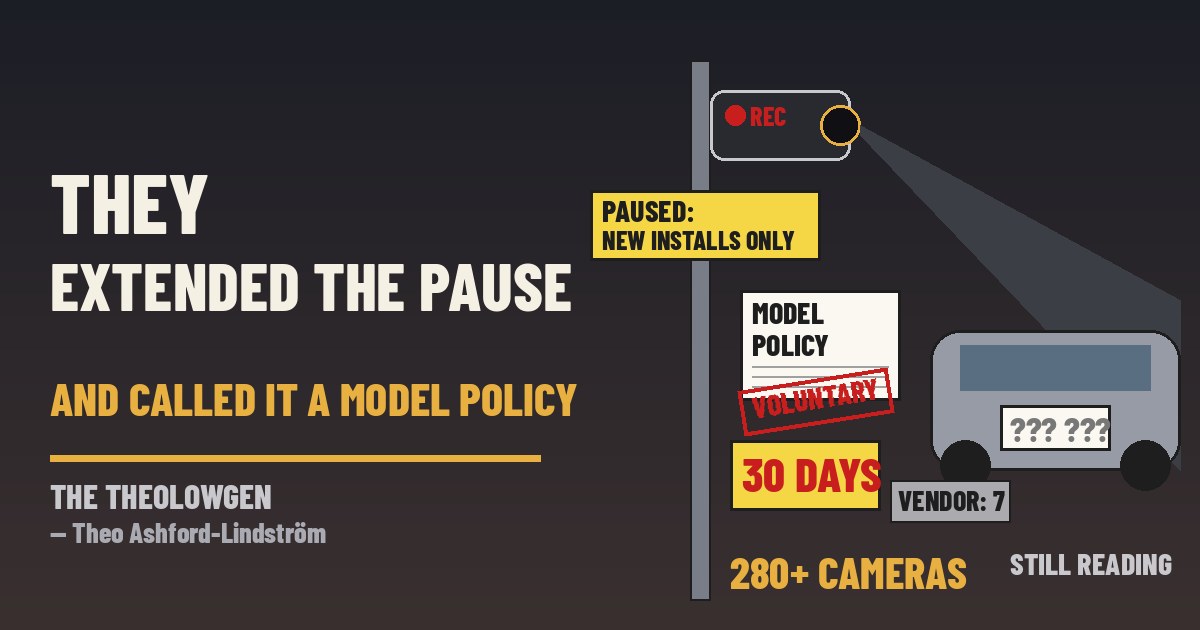
They extended the pause and called it a model policy. I know the sentence. It is what a state says when it spends sixty days reviewing a surveillance network with the police chiefs and the league of cities, receives the recommendations at 10 a.m., announces them at 4:08 p.m., and then — instead of a rule anybody has to follow — hands every town a document it is “urging” them to adopt, while the cameras already on the poles keep doing exactly what they were doing in August.
The Rhode Island Current’s Christopher Shea reported on Monday, October 19, 2026, that the state’s pause on new automated license plate reader installations, originally set to end that day, has been extended indefinitely after Gov. Dan McKee announced he would leave it to the General Assembly to establish binding statewide safeguards. In the meantime, the governor’s office released a statewide model policy and a template data-sharing memorandum of understanding “to guide the use of automated license plate readers (ALPRs) by local law enforcement agencies that choose to use this technology,” and said it is “urging municipalities that currently use ALPR technology to adopt the model policy.” What the model policy says, per the governor’s release: no use for immigration enforcement, for investigations involving reproductive or gender-affirming health care, for harassment or discrimination, or for conduct that is not a crime under Rhode Island law; plate data deleted within 30 days “unless preserved for valid law enforcement purposes”; a public transparency portal; quarterly audits and search documentation; restrictions on sharing with outside agencies; and, for anyone who violates it, possible “administrative sanctions, up to and including termination, civil liability, and criminal prosecution, as applicable.” It was written by the Rhode Island State Police in consultation with the Rhode Island Police Chiefs Association, the Rhode Island League of Cities and Towns and the Rhode Island Police Accreditation Commission, and it will be reviewed annually. McKee: “Automated license plate readers can be a valuable tool for law enforcement, but we need to make sure they’re being used responsibly and that people’s privacy is protected.” State Police Superintendent Col. Darnell Weaver: the policy “establishes clear, consistent standards.” Now the August version, from the governor’s own Aug. 18 release: McKee called for a statewide pause on “the installation and activation of any new” cameras; the State Police would not install or activate additional ones; “Existing State Police ALPR cameras may continue to operate”; and cities and towns were urged, not ordered, to pause new installations. The Current adds the rest. Privacy advocates criticized the review for shutting them out. In an Oct. 9 letter, they asked for a state law limiting retention to seven days, noting that Flock Safety, the company behind the network, had itself cut its limit from 30 days to seven in August. Under the new guidance, police can still reach the data when a criminal investigation warrants reasonable suspicion of a state or federal crime; advocates had asked to restrict use to specific serious offenses such as stolen vehicles, missing persons and violent crimes. Rhode Island municipalities and the State Police have contracted independently with Flock since 2021, building a patchwork of at least 280 cameras statewide by the ACLU’s estimate; Providence city councilors recently proposed ending that city’s relationship with the company. Spokespeople for House Speaker Christopher Blazejewski and Senate President Valarie Lawson said neither had reviewed the proposal yet and expected the issue to come up in the 2027 session. The ACLU of Rhode Island, after what it called a cursory review, said the policy’s definition of a valid law enforcement purpose — which includes “information gathering,” the “prevention of crime” and “ensuring the safety of the public,” with or without cause that a crime has been committed — allows use “for just about any reason”; that it does not stop the system from photographing drivers and passengers or prohibit facial recognition; that the promise of prosecution is “largely meaningless” without a law that makes misuse a crime; and that “the policy promises much less than meets the eye.” The ACLU said it appreciates that the pause on further installations remains in effect.
Deb filed “as applicable” under “words that mean not.” Cricket tried to laminate the model policy to see if lamination makes a thing binding; the laminator needs Gary, and Gary is not in the General Assembly until 2027. Joey drew 280 cameras on a pizza box and ran out of pizza box. I love them. They are seasoning.
The model policy is the alibi. The 280 cameras are the story. Sit with the 30 days until they confess. A pause on new installations is a pause on growth, not on reading; every plate that passed a pole in Rhode Island on Monday was read on Monday, and every one that passes tonight will be read tonight, and the only thing the state froze was the next purchase order. Then look at who wrote the rules. The police wrote them, with the chiefs, the cities and the accreditation board — the people who use the cameras, consulting the people who buy the cameras, about the people in front of the cameras, who were not in the room. That is not oversight. That is the state grading its own homework and mailing the answer key to the towns as a suggestion. And the suggestion lets your plate sit in a database for 30 days, which is longer than the vendor’s own default. I will not crown the vendor for that. A default is a dial, and a company that turns a dial down in August can turn it back up the week a renewal needs it; Flock did not become a civil-liberties group, it became a company that read the room. But a state that writes a privacy rule looser than the surveillance company’s marketing has told you exactly how much it thinks your street is worth. I used to believe the cure for a camera was a better policy, written by better people, in a better process. Rhode Island just showed me the better process. It ends in a document nobody has to adopt, with penalties “as applicable,” and an indefinite pause on everything except the cameras. The cardigan stays. Fill the notebook. Then ask, out loud, whose street it is when the pause is permanent, the policy is voluntary, and the only binding thing in the whole arrangement is the contract.
Sources:
- Rhode Island Current, Christopher Shea, “McKee extends pause deadline on Flock cameras indefinitely,” Oct. 19, 2026 (updated 7:30 p.m.)
- Office of the Governor, State of Rhode Island, “McKee Administration Shares New Guidance for Automated License Plate Readers,” Oct. 19, 2026
- Office of the Governor, State of Rhode Island, “Governor McKee Takes Action on Automated License Plate Readers, Calls for Pause of New Installations and Directs Data Privacy Review,” Aug. 18, 2026
- ACLU of Rhode Island, “ACLU of Rhode Island Statement in Response to the Proposed Statewide Automated License Plate Reader Policy,” Oct. 19, 2026
— Theo Ashford-Lindström
Leave a Reply