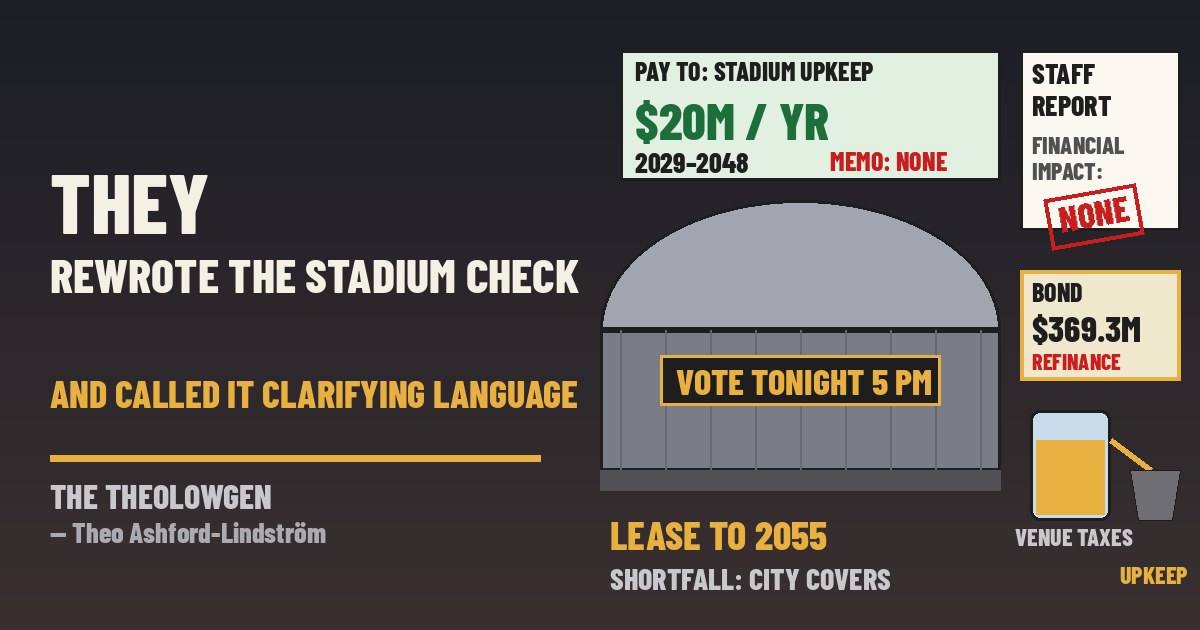
They rewrote the stadium check and called it clarifying language. I know the sentence. It is what a city says when it brings a twenty-year promise to a football team back to the council table six months after approving it, changes the words that say what the public’s money is for, and lists the financial impact of the change as one word: None.
Tonight, Tuesday, October 20, 2026, at 5 p.m., the Arlington, Texas, City Council is scheduled to vote on a resolution authorizing the city manager to sign an “Amended and Restated Master Agreement Regarding Cowboys Stadium Extension” with Cowboys Stadium L.P. and the Dallas Cowboys Football Club. Dock Line Magazine’s Sidney Sherman laid out the staff report on Oct. 18. The council approved the original deal April 21 as Resolution No. 26-134, extending the team’s lease of the city-owned stadium through 2055. It is back because the city is preparing a bond refinancing the agreement calls for, and the city’s bond lawyers, consulting with the public finance division of the Texas Attorney General’s Office, recommended clearer language. The rewrite says the city’s contribution is for “the actual costs to maintain, operate, and manage the Stadium.” Staff say the Cowboys must still fund and finish the promised improvements by 2043, and list the financial impact as “None.” It is a regular resolution, not a consent item. CBS Texas’ Matthew Ablon, writing this morning, lists what the team is expected to pay for: hardened perimeters, pedestrian bridges, security screening shacks, more security cameras, more venue parking, digital signage, kitchen and concession build-outs, plaza improvements, and mechanical, electrical and plumbing work. CBS also notes the changes follow the $273 million deal approved earlier this year “despite concerns from residents who have called for a referendum to let voters decide,” and puts the arrangement plainly: the Cowboys pay for the upgrades up front, and the city pays them back — $50 million in 2028 and $20 million every year after through 2048. The details, per the resolution as Dock Line reports it: the team invests at least $750 million in the stadium complex. The city deposits $50 million into a stadium maintenance and operation account on Oct. 1, 2028, then $20 million a year from Oct. 1, 2029, through Oct. 1, 2048 — less if the team gets a loan rate below 6.35%. The money comes first from voter-approved venue taxes; if those fall short in any year, the city must cover the gap with other lawful funds. The team must try to earn federal SAFETY Act anti-terrorism certification by the end of 2030. The staff report projects $9.7 billion in economic impact over 30 years and a $1.2 billion fiscal impact to the city. The city’s April announcement said its contribution of up to $273 million in net present value comes from venue taxes, “not the City’s General Fund or new taxes,” and extended the team’s $2 million annual lease payment and $500,000 annual naming-rights payment through 2055. The taxes — a half-cent sales tax, a 2% hotel tax, a 5% rental car tax, a 10% ticket tax and a $3 parking tax — were approved by voters in 2004 to build the stadium and again in 2016 for the Rangers’ ballpark, and bring in about $55 million a year. Why no public vote? Because, the city said, the deal operates within that existing authority and does not extend the taxes past 2048. The Bond Buyer’s Karen Pierog explained the plumbing in April: the bonds Arlington sold in 2005 for its $325 million share of the football stadium were paid off in August 2025, and the key to the new money is redeeming and reissuing about $369.3 million of 2018 Rangers ballpark bonds in 2028 under a different lien — without increasing the amount outstanding — so the tax revenue is no longer dedicated only to debt. City Treasurer Ethan Klos: “It’s just that they won’t be dedicated only to paying the debt service. So they’ll allow us to use that excess (revenue) towards new projects.”
Buck wanted to know if he could deduct a stadium he has never been inside. Tyrone timed 2029 to 2048 and the stopwatch asked about overtime. Rafal refused to make a onesie that says “None” on the memo line. I love them. They are seasoning.
Clarifying language is the alibi. The overflow is the story. Sit with the $20 million a year until it confesses. One side carries the stamp: a city that paid off the stadium it built and, instead of letting the stadium taxes finish their work, reopens a lien so the surplus can keep flowing to the building’s upkeep until 2048, promises to backfill any shortfall from “other lawful funds,” and tells the residents asking for a referendum that they already voted in 2004. One side carries the term sheet: a team that fronts the security shacks and the concession kitchens and gets reimbursed for them by the public, with its lease stretched to 2055, a public payment pegged to its own loan rate, and a $9.7 billion projection with its name on it. Both parties are the help — one writes “None” on the impact line, one cashes the account it describes. The anti-capitalist cut stays: the public collects $2 million a year in rent and $500,000 for the name on the building, and pays $20 million a year to keep the building up. The libertarian cut is free: a tax approved to build a thing should end when the thing is built, and a city should not be the guarantor of a football team’s plumbing through two more decades than I can bear to imagine. I have my own opinions about who covers the gap, which are not the news. The cardigan stays. Fill the notebook. Then ask, out loud, at 5 p.m., whose stadium it is when the public paid it off, the taxes keep running, and the change that makes it all legal has no impact at all.
Sources:
- CBS Texas, Matthew Ablon, “Arlington city leaders to consider clarifying AT&T Stadium agreement with Cowboys,” Oct. 20, 2026
- Dock Line Magazine, Sidney Sherman, “Arlington Council Votes Tuesday on Rewriting Its Cowboys Stadium Deal,” Oct. 18, 2026
- City of Arlington, Office of Communication, “City Council Approves Agreement to Extend Dallas Cowboys Lease,” April 21, 2026
- The Bond Buyer, Karen Pierog, “Bonds play a role in Arlington, Texas, lease extension for Dallas Cowboys,” April 23, 2026 (updated April 29, 2026)
— Theo Ashford-Lindström
Leave a Reply