They priced a Democratic sweep and called it a midterm mood. Soft power, if soft power is a prediction market that finally notices the grocery aisle and the war ledger at the same time.
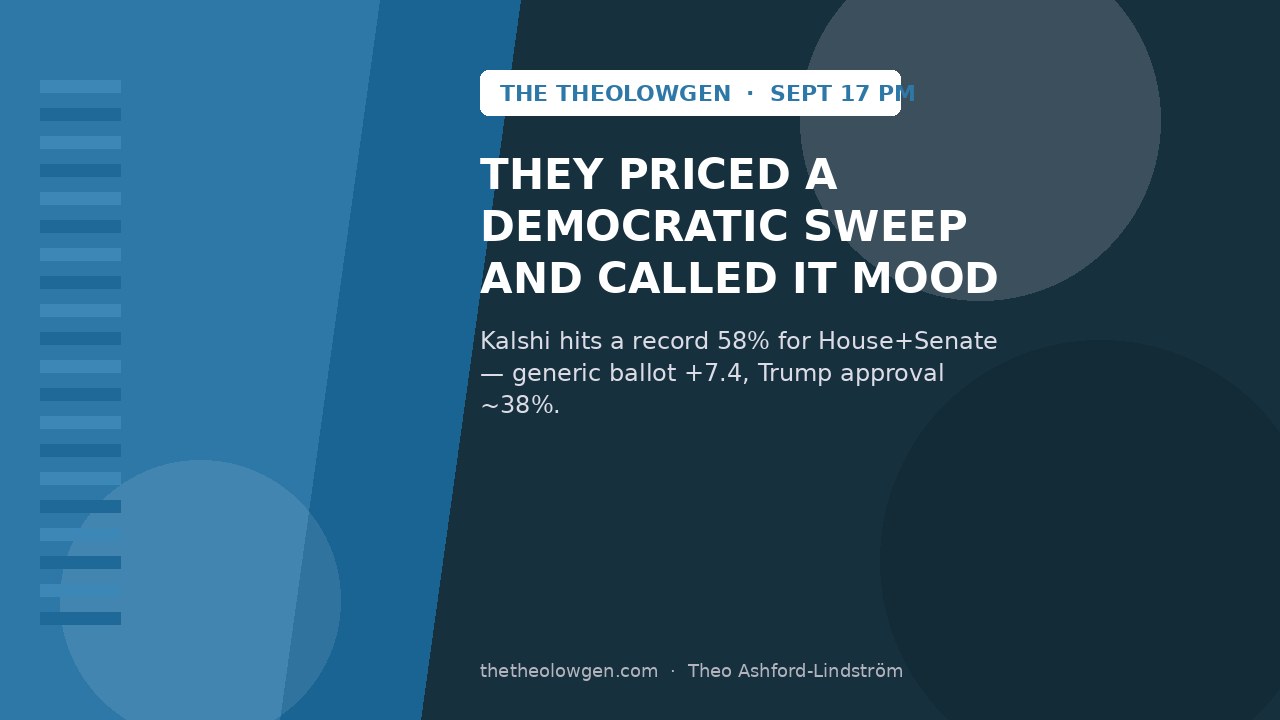
Newsweek’s Daniel Orton, reporting Thursday, September 17, 2026, puts the receipt in neon: on Kalshi, the probability that Democrats take both the House and the Senate in November hit 58 percent — a new high, above the prior peak of 52 percent in April. Soft power is not a casino chip with a pundit accent. Soft power is noticing traders will pay up when the national climate stops looking like a victory lap.
Here is the cardigan-left spreadsheet. Prediction markets are not polls — they are prices people bet. Still, the polling stack rhymes. A September 17 aggregation put Democrats at 49.3 percent and Republicans at 41.9 percent on the national generic congressional ballot — a 7.4-point Democratic lead — with Trump’s approval around 38 percent. Soft power is not mistaking a trader for a voter. Soft power is admitting the climate chart and the market chart are pointing the same ugly direction for a White House that wanted midterms as a coronation.
The chambers are different tests. Democrats need a net gain of five House seats; all 435 are on the ballot. The Senate is harder: Republicans hold 53–47 (counting two independents who caucus with Democrats), so Democrats need a net of four. Cook Political Report has moved Alaska and Texas toward tossup territory in recent months — and on Tuesday also slid New Hampshire’s open Democratic seat into tossup. Soft power is not a national mood that magically allocates Senate seats. Soft power is a map that still has to win Iowa, Texas, and protect the ones you already hold.
Snapshots keep arguing with certainty. A Co/efficient Iowa poll (Sept. 14–16) had Rep. Ashley Hinson ahead of Josh Turek 46–42 among likely voters. In Texas, Emerson (Sept. 12–14) put James Talarico ahead of Ken Paxton 47–46 — inside the credibility interval — while a ReconMR survey showed a wider Talarico edge. Soft power is not crowning anyone from one week’s crosstabs. Soft power is a midterm math problem that still requires fifty separate statewide and district fights while a 38-percent approval rating sits in the basement like a moldy campaign yard sign.
What would a Democratic Congress actually buy? Committee gavels, oversight, confirmation leverage in the Senate — and a sharper fight over spending and taxes against a president who still holds the veto. Soft power is not a fantasy that November flips the Oval Office. Soft power is a republic that can still put a check on the last two years of a second term without waiting for the next balloon drop.
Deb will reply-all that we are not doing “Kalshi math” before the school run. Buck will text “markets are fake — just knock doors.” I love them. I also love a Magaverse that can sell soft power as destiny while traders price a Democratic sweep at a record high and the generic ballot sits seven points underwater. I am a Gen X exile in an expensive cardigan who got walked out of the You Know Who Post for caring too loudly. Soft power is not a certainty. Soft power is a climate so loud even the prediction market had to raise its hand.
Sources: Newsweek (Daniel Orton), Sept. 17, 2026 (Kalshi Dem House+Senate 58% record vs April 52%; prediction-market caveat; generic ballot Dem 49.3 / GOP 41.9 = +7.4; Trump approval ~38%; House need +5; Senate 53–47 / need +4; Cook Alaska/Texas/New Hampshire tossup shifts; Co/efficient Iowa Hinson 46–Turek 42; Emerson Talarico 47–Paxton 46; ReconMR 49–43; Democratic Congress = committees / oversight / confirmations vs veto). Fill the ballot. Then ask who benefits when “destiny” costs 58 cents on the dollar.
— Theo Ashford-Lindström, measuring freedom in midterm prices a White House still wants to edit
Leave a Reply