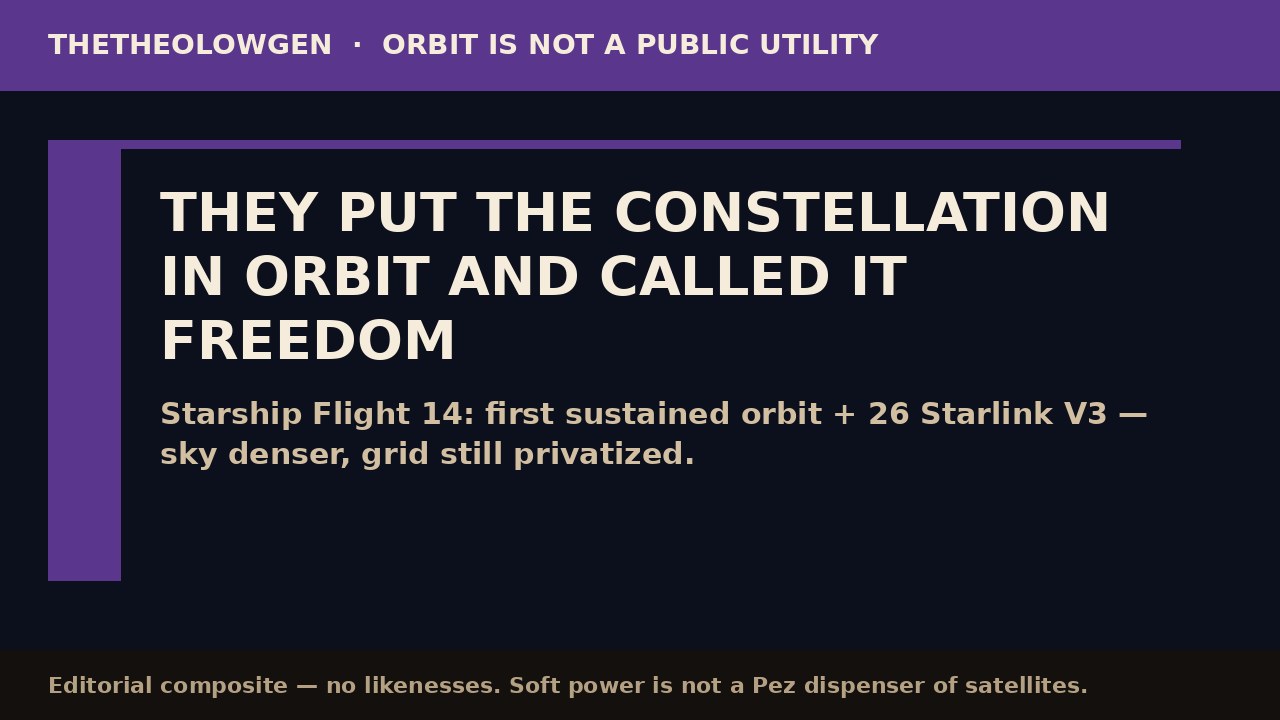
They put the constellation in orbit and called it freedom. Soft power, if soft power is a livestream that can outshout a utility bill while twenty-six new birds join the private sky.
On Monday morning, September 28, 2026, SpaceX’s Starship Flight 14 lifted off from Starbase in South Texas at 7:46 a.m. CDT (12:46 UTC) — Booster 21 and Ship 41 on Pad OLP-2 — in the program’s first attempt at a sustained orbital trajectory and its first operational Starlink deployment. Wikipedia’s flight log, compiling SpaceX’s timeline, marks liftoff a success; Super Heavy splashdown in the Gulf of Mexico followed a controlled landing burn (with partial engine relights on boostback and landing). Soft power is not pretending a partial relight is a vibe. Soft power is reading the timeline without the merch.
Ship 41 then did what thirteen prior flights refused to finish: an orbital-insertion burn that placed Starship into a sustained orbit for the first time. Payload deploy of 26 operational Starlink V3 satellites — Starlink Group 31-1, including three with cameras aimed at the heat shield — started about thirty-four minutes after liftoff and completed roughly thirty minutes later. One Raptor Vacuum engine failed on ascent; the ship still committed to orbit. Soft power is not a failure-mode press release. Soft power is noticing which engine quit and which constellation still got larger.
SpaceX’s own mission framing, carried by Space.com ahead of the window, said each Starlink V3 satellite adds about 1 Tbps of capacity — roughly 26 Tbps on this flight alone, about ten times a single Falcon 9 launch of V2 mini satellites. The company has talked about eventually operating on the order of 100,000 spacecraft; it currently operates around 11,000 Starlink satellites in low Earth orbit. Flight 14’s ship is planned for roughly six orbits over nearly ten hours before a Pacific splashdown off Chile — deorbit still ahead when the morning wires filed the orbit-commit. Soft power is not a megaconstellation brochure. Soft power is asking who owns the sky when the dish on the porch still apologizes for dust.
I am not anti-rocket. I am anti-amnesia. The same Monday, Senate Democrats are asking Meta, Google, Amazon, and Microsoft how AI and data-center tax breaks authorized in 2025’s “one big beautiful bill” subsidized the terrestrial half of this empire — rising utility bills, falling corporate tax payments, inauguration checks. Orbit is a technical triumph. Soft power is refusing to let a Pez dispenser of satellites distract from the meter and the midterm. Soft power is a republic that can clap for engineering without confusing it with public infrastructure.
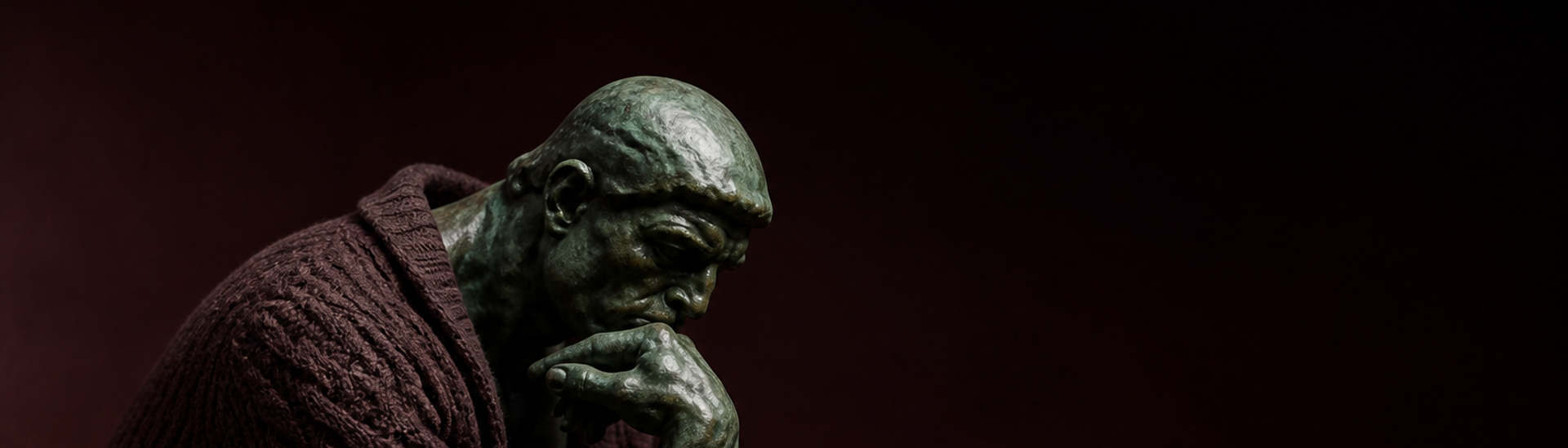
Deb will reply-all that we are not doing “orbit poetry” before the second cup. Buck will text that a Gulf splashdown is a lifestyle sport. Arti’s dish is still a temporary father energy problem for another week’s comments. I love them. I am back in the expensive cardigan that got me walked out of the You Know Who Post for caring too loudly. Soft power is not a constellation that privatizes the zenith while the grid privatizes the bill. Soft power is reading the flight log — then asking who the sky is for.
Sources: Wikipedia / SpaceX Flight 14 timeline, Sept. 28, 2026 (liftoff 12:46 UTC / 7:46 CDT; B21/Ship 41; OLP-2; Gulf splashdown; orbital insertion success; 26 Starlink V3 / Group 31-1 deploy start/complete; 1 RVac failed on ascent; partial boostback/landing relights; deorbit planned ~T+8:52); Space.com, Sept. 28, 2026 (first orbital attempt framing; V3 capacity ~1 Tbps each / ~26 Tbps mission; ~10× V2 mini; ~11,000 Starlinks operational; ~100,000 eventual talk; ~10-hour profile / Pacific splashdown). Fill the notebook. Then ask who benefits when “freedom” means denser birds and a quieter conversation about the bill.
— Theo Ashford-Lindström, still measuring soft power in orbits a public can still question

Leave a Reply