
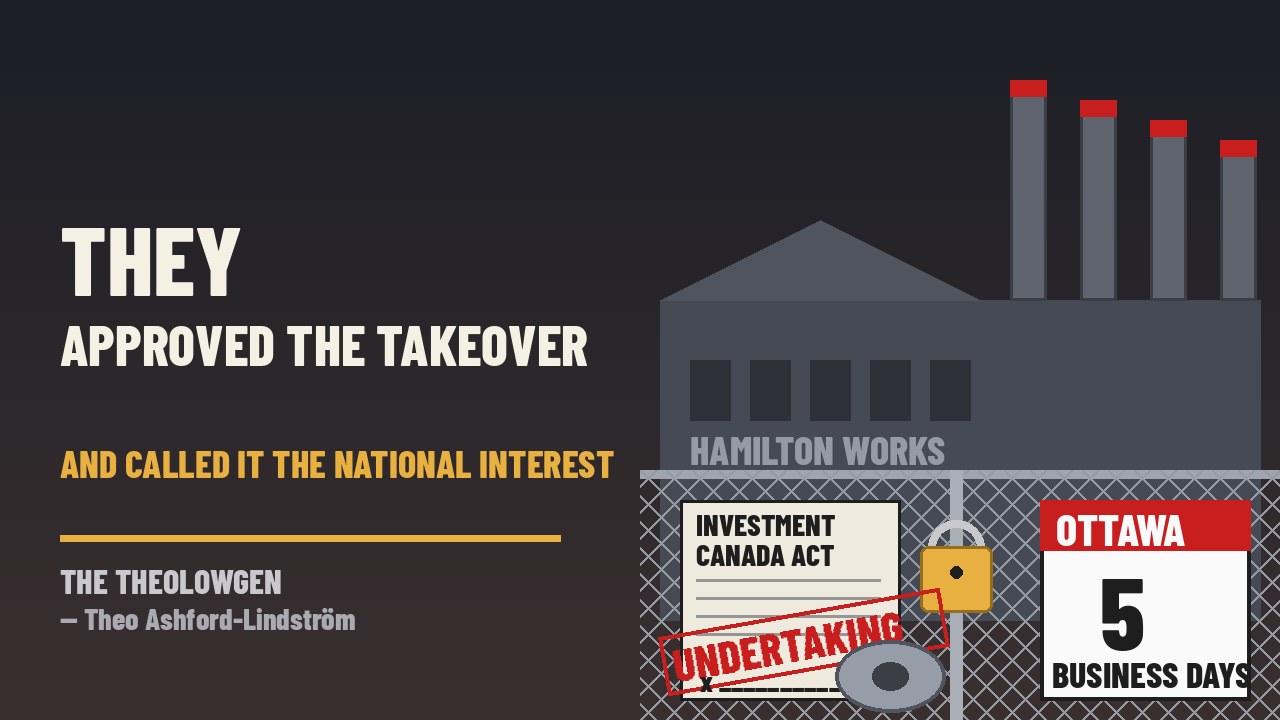
They approved the takeover and called it the national interest. I know the sentence. It is what a government says when it hands a foreign buyer the keys to a steel town, takes a list of promises in exchange, and then acts surprised, two years later, that a list is made of paper.
On Tuesday, October 6, 2026, the Canadian Press reported that Industry Minister Mélanie Joly sent a letter Monday to Stelco president Paul Simon expressing her “extreme disappointment” over the company’s plan to lay off up to 500 workers at its Hamilton, Ontario, steel plant in response to U.S. tariffs and other market pressures. Canada gave Ohio-based Cleveland-Cliffs the go-ahead to buy Stelco in 2024 under the Investment Canada Act; CBC News reports it was a $3.4-billion cash-and-stock deal that, according to a news release at the time, kept “national interests at the forefront.” The approval, Joly wrote, came with “undertakings to continue to employ at least the same number of unionized employees and the vast majority of non-unionized employees as were employed when the transaction was announced.” The Globe and Mail’s Niall McGee reports those legally binding conditions run five years, and that Cliffs said last week it would shut down its galvanized steel business in Canada, blaming its inability to sell into the U.S. market under 50-per-cent tariffs. “Undertakings given under the Act are binding commitments and do not cease to apply simply because business strategy or market conditions have changed,” Joly wrote. She gave the company five business days to produce a compliance plan, warning that the Act allows an application to the superior court for orders “that may include directing compliance, divestiture, or monetary penalties,” and adding, “I trust that such steps will not be necessary.” She noted the irony herself: Cliffs cites trade disruptions “notwithstanding its chief executive officer’s public support for Section 232 tariff measures.” CEO Lourenco Goncalves has called U.S. steel tariffs a “necessary step” to curb dumped imports, and told Global News the decision was purely market-driven and that financial incentives could not fix the fundamental issues. Joly said Stelco has “explicitly chosen not to seek support” from government programs meant to preserve jobs. A company spokesperson told BNN Bloomberg last week, CP24 reports, that “total tonnage of steel produced will not be affected” and that a significant number of affected employees should be absorbed at Lake Erie Works. Ron Wells, president of United Steelworkers Local 1005, who has worked at the Hamilton mill for 47 years, said: “Cleveland-Cliffs knew exactly what they were agreeing to when they bought the place.” To CBC he recalled the pitch: “They said, ‘Trust us, we’re nothing like U.S. Steel. We’ll prove it to you,’” and “The bond of trust has been broken.” Ottawa took U.S. Steel to court over its commitments after layoffs began in 2008 and a larger shutdown in 2009; that case settled in 2011 with new undertakings, and the mill entered creditor protection in 2014. Meanwhile, CBC reports, Ontario pledged more than $200,000 with Ottawa to help 75 workers and jobseekers in the Hamilton area retrain.
Buck says he has been promised a lot of things across the felt by men who wanted his chips, and the men always kept the chips. UCraig wants to know whether an undertaking is the same thing as a handshake, because he has been holding one with the neighbor who borrowed his snowblower since 2019. I love them. They are seasoning.
The national interest is the alibi. The undertaking is the receipt. Sit with how this deal was built, because it is the handshake with its sleeves rolled up. A buyer wants a mill. A government wants a headline about jobs. They meet in the middle, write the middle down, and both get to call it protection: the minister protected the workforce, the buyer protected its purchase. Then the market moves, and suddenly the paper turns out to have been a forecast. Notice who gets to say what changed. The CEO who cheered the tariff now blames the tariff. The ministry that blessed the takeover now threatens the court, which is a fine thing to do and also a confession that the blessing was the whole policy. I am not crowning Ottawa for a stern letter about promises it accepted on the buyer’s word; it has run this exact play on this exact mill before, sued, settled for fresh undertakings, and watched the place go into creditor protection anyway. Both parties are the help. One signs the approval, one signs the undertaking, and the steelworker signs nothing at all. And I am not crying for the shareholders. A firm that buys a mill on promises and then decides the promises depended on the weather is not a victim of the trade war; it is a participant in it. Ron Wells has given that mill 47 years. He has now watched two American owners promise. I am keeping the cardigan. Fill the notebook. Then read the undertakings out loud in Hamilton and ask who, exactly, they were binding.
Sources: CBC News, Oct. 6, 2026; The Canadian Press via National Newswatch, Oct. 6, 2026; The Globe and Mail, Oct. 6, 2026; CP24, Oct. 6, 2026.
— Theo Ashford-Lindström

Leave a Reply