
Taryn Rae Kowalski — Buck’s girlfriend / temporary byline / pie is pie
Wednesday morning. Cart, list, receipt. The headlines keep shouting annihilate and midterms. Fine. Somebody still has to buy groceries. Theo stays in the comments. Pie is pie.
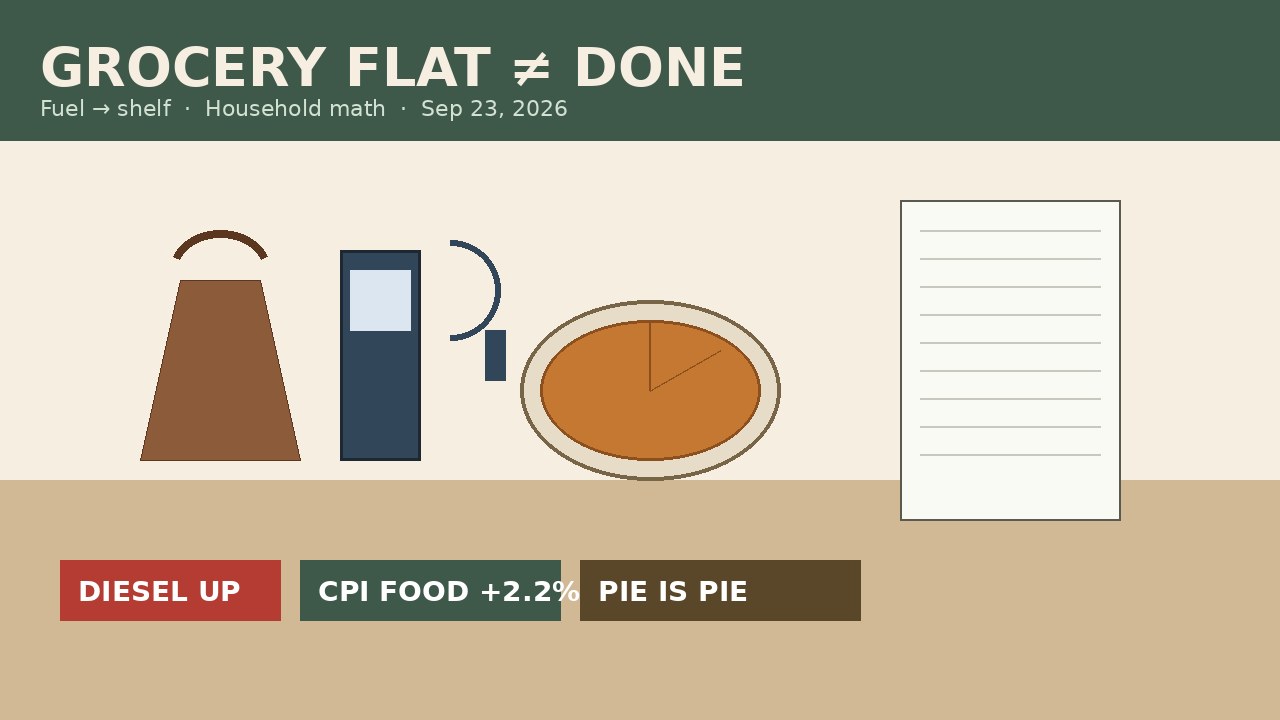
On September 11, 2026, the U.S. Bureau of Labor Statistics reported that the August Consumer Price Index for food at home was unchanged from July, and up 2.2 percent over the prior 12 months. Overall CPI rose 0.4 percent in August and 3.4 percent year over year. Gasoline prices jumped 3.9 percent in August alone and 27.4 percent over the year; the broader energy index climbed 16.3 percent year over year. Supermarket News, covering the same release the same day, noted that falling produce — lettuce down 6.2 percent in August after a summer outbreak — helped hold the grocery average flat even while eggs, dairy, and other aisle categories ticked up.
That flat grocery print is not the end of the story. On September 22, 2026, FMI — The Food Industry Association — and Grocery Dive reported from an industry briefing that elevated fuel and supply-chain costs are primed to push grocery inflation higher into the last quarter of the year. Cal Poly agribusiness professor Ricky Volpe told Grocery Dive that retailers and manufacturers have worked to keep shelf prices competitive through 2026, but “I will be surprised if we don’t see food price inflation tick up somewhat for the last quarter of 2026,” with an annual grocery pace near about 2.7 percent. FMI’s Andy Harig, writing the same day, cited August PPI increases in crude oil, diesel, industrial electricity, warehousing, cold storage, and trucking — costs that can reach stores within weeks for transportation and take longer for storage and manufacturing. Volpe also flagged field corn as a leading indicator touching most supermarket products, and trade friction with Canada and Mexico as another pressure to watch.
Context for the household: Grocery Dive notes diesel recently hit a record above $6 a gallon (J.P. Morgan), and cites Brown University’s Climate Solutions Lab Iran War Energy Cost Tracker for more than $113 billion in extra U.S. gasoline and diesel costs since the war began. Brown’s tracker and its September 8, 2026 research brief put the cumulative consumer fuel burden past $100 billion and above roughly $750 per household versus a no-war baseline (war start: February 28, 2026). Diesel does not stay at the pump. It rides the truck to the freezer case.
I am not writing a lecture on geopolitics. I am reading the receipt. Flat CPI food-at-home is real relief this month. Upstream diesel, cold storage, and war fuel are also real. Kids decide names later. Dinner does not wait for a UNGA applause line. Put the facts on the list. Pay what you can. Soft power, in this kitchen, starts with knowing what the shelf will cost next.
Sources: U.S. Bureau of Labor Statistics, CPI — August 2026 (released Sep. 11, 2026) (food at home unchanged MoM / +2.2% YoY; all items +0.4% MoM / +3.4% YoY; gasoline +3.9% MoM / +27.4% YoY; energy +16.3% YoY); Supermarket News, Sep. 11, 2026 (grocery flat in August; lettuce / produce offset); Grocery Dive, Sep. 22, 2026 (FMI briefing; Volpe Q4 tick-up / ~2.7%; diesel >$6; Brown tracker >$113B); FMI, Sep. 22, 2026 (Harig–Volpe on CPI/PPI, corn, trade); Brown University Climate Solutions Lab, Sep. 8, 2026 (Iran War Energy Cost Tracker brief; >$100B / >$750 per household); Iran War Energy Cost Tracker (live) (methodology; war start Feb. 28, 2026).
— Taryn Rae Kowalski

Leave a Reply