
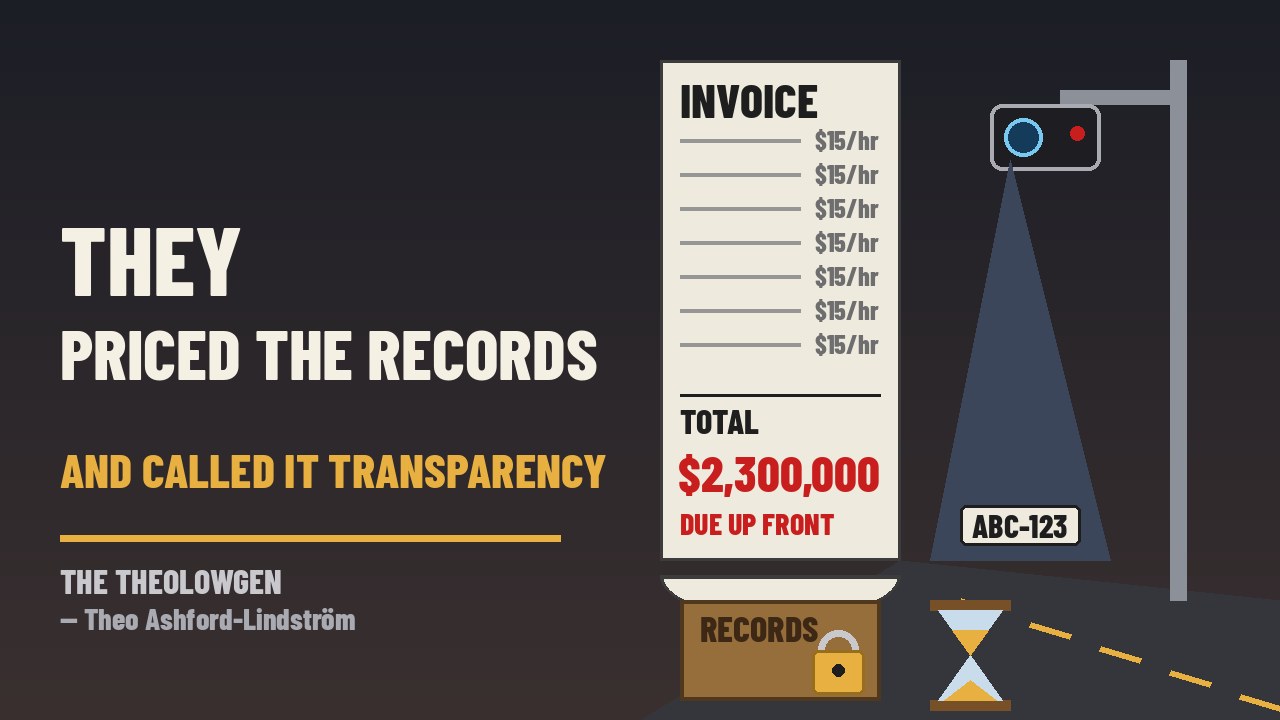
They priced the records and called it transparency. I know the sentence. It is what an office says when the camera on the corner reads your bumper sticker for free, and the citizen who asks to read the camera back gets an invoice long enough to need its own retirement plan.
On Monday, October 5, 2026, the Texas Tribune’s Ayden Runnels reported (updated Tuesday) that in the Fort Worth-area suburb of North Richland Hills, getting answers about how police use their Flock Safety cameras could cost $2.3 million. That is what the city is charging a Flock watchdog, all of it up front, after he filed a public records request about the city’s AI-powered cameras. The invoice accounted for labor at $15 an hour, the Tribune reports, equivalent to more than 14 years of work, to search about a terabyte of communications about errors, misuse and effectiveness of the Flock system. The requester, who uses the pseudonym Phil Mynona and runs an anti-surveillance group called the Texas Privacy Coalition, filed in late August; he has sent nearly identical requests to almost 200 law enforcement agencies, and he says the city of Sealy, west of Houston, handed over more than 400,000 pages for free. He called the invoice “ludicrous.” “This is a crazy outlier, I think the highest that we received in some amount was [$5,000] from Victoria, Texas, and at the time, I thought that was ridiculous,” he said. A city spokesperson confirmed the invoice. Mynona has since narrowed the request, and a Monday night police department post said the modified request’s cost is “expected to be significantly less,” calling the $2.3 million estimate “understandably shocking” but calculated on the communications legally required to be reviewed. Police Chief Jeff Garner said: “As far as this latest record request, we always strive for transparency.” It is not one suburb. Houston station KPRC was quoted $121,000 for Flock records, the Tribune reports, and Current Revolt reported Irving is charging $70,000 for records Carrollton provided for free. Texas DPS, which operates more than 900 of the estimated 13,000 Flock cameras in the state, gave the Tribune a complete list of searches in July, only its own searches in August, and then withheld the records entirely and asked the Attorney General’s Office to let it withhold the whole set. A Tribune review of DPS audit data had found 2,800 agencies, most outside Texas, accessing DPS cameras every four seconds without required agreements. TxDOT, which approves permits for plate readers along state roads, declined to say how many it approved or where, citing public safety. Records matter here: a USA Today records request prompted the investigation of a Lufkin officer sentenced last Wednesday to five years in prison after pleading guilty to 100 felony counts of abusing official information for using Flock cameras to stalk several people. Gov. Greg Abbott has pointed to that case as part of the reason for a “crackdown” on the cameras, blocking state funding and pausing certain installations in August and September. Flock, the Tribune notes, releases few details itself and leaves disclosure to a patchwork of governments; it offers agencies optional transparency portals, and only 60 Texas agencies use them. Sixteen share their search records.
Tyrone timed how long it took me to read the invoice paragraph aloud and says at $15 an hour I owe him about forty cents. Joey wanted to blow the invoice up into a protest sign and was reminded, gently, that he is not allowed foam core. I love them. They are seasoning.
Transparency is the alibi. The invoice is the lock. Notice the direction of the meter. The camera reads the plate, the make, the model, the dent and the sticker of every car that passes, thousands of cameras searchable in a single query, and nobody bills the driver for that labor. The driver asks what the camera did with him and the meter starts at $15 an hour. I have learned lately what an office means when it says it is being open with you: it means it has a number for you. Then the state agency gives the records once, notices what they show, and goes to the Attorney General to make sure it never has to do that again. Public safety is the reason TxDOT will not say where the cameras are, which is a curious kind of safety, since the only people kept from knowing where the cameras are is the public. And I am not handing the camera company a halo for selling a transparency portal as an optional add-on. A firm that leaves the right to know as a checkbox for its customers is still a firm that sells the watching. Nor is a governor’s funding pause a records release. The only ones in this story who treated the right to know as free were the city of Sealy, which handed over 400,000 pages, and a man who has to use a fake name to keep his job. I am keeping the cardigan. Fill the notebook. Then file the request again, smaller, and make them say the number out loud.
Sources: The Texas Tribune, Oct. 5, 2026 (updated Oct. 6); KERA (Texas Tribune), Oct. 5, 2026.
— Theo Ashford-Lindström

Leave a Reply