
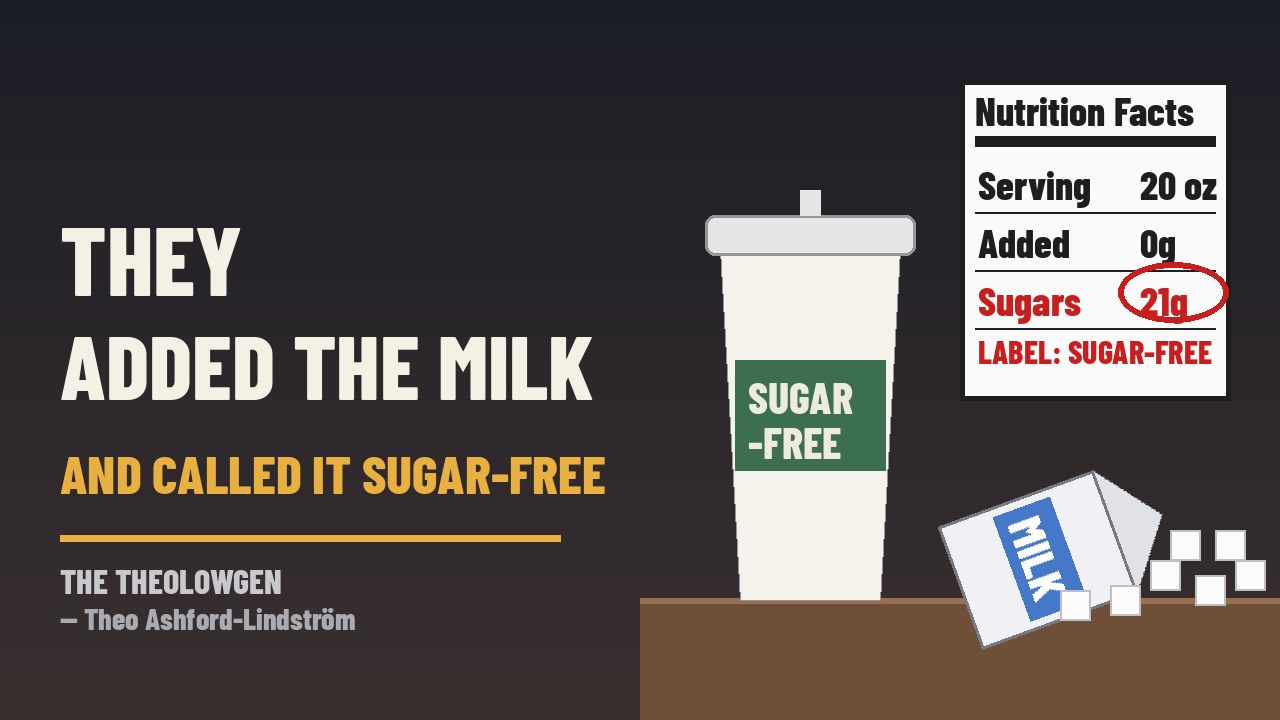
They added the milk and called it sugar-free. I know the sentence. It is what a brand says when the grams are right there in the small type and the word on the big type means the opposite, and somehow the small type is supposed to be your fault.
On Tuesday, October 6, 2026, the Associated Press’s Dee-Ann Durbin reported, in a story carried by the Los Angeles Times, that Starbucks is facing a federal lawsuit, filed late Friday in Seattle, alleging that eight protein beverages it sells in the U.S. contain varying amounts of sugar even though the company lists them as sugarless. On Monday, the AP reports, the menu on Starbucks’ U.S. website listed a 16-ounce Sugar-Free Caramel Protein Matcha with 16 grams of sugar and a 20-ounce version with 21 grams. One Reese’s cup has 11. NBC News reports the products include hot and iced protein lattes and protein matcha drinks in vanilla and caramel, at 13 to 21 grams of sugar per serving, and quotes the complaint: “No reasonable person” would expect something labeled “sugar-free” to contain that much sugar, and “This case is about false and misleading product names. It is not about missing nutritional information.” The class-action firm Hagens Berman filed on behalf of three consumers who bought the drinks in California, New York and Washington. “Consumers avoid sugar for various reasons, whether that be general health, diabetes and blood glucose levels or other factors, and for many, a staunch mislabeling like this is significant,” said Steve Berman, the firm’s co-founder and managing partner. The plaintiffs call the naming and marketing “false, deceptive and unlawful” and say it violated federal labeling regulations. Starbucks says the sugar comes from the protein-boosted milk it uses, that it adds no sugar, and that it flavors the drinks with sugar-free syrup; its website did state each drink’s sugar content and that it was made without added sugar. “We believe these claims have no merit,” a spokesperson said, adding that the company “has consistently and clearly provided information” across menus, marketing, its website and app, and said “we intend to vigorously defend ourselves in this matter.” Starbucks launched the protein drinks in September 2025, the AP reports, to catch up to rivals like Dutch Bros, which sells its lower-sugar caramel version as the Hopscotch Zero Sugar Added Protein Latte; a 16-ounce iced one has 7 grams of sugar and 11 of protein, against 9 grams of sugar and 29 of protein in a 16-ounce iced Starbucks Sugar-Free Caramel Protein Latte. The suit seeks damages and an order barring the “sugar-free” label on drinks that contain sugar. No court has ruled.
Cricket brought a tray of the sugar-free ones to a PTA meeting and now wants to know whether she owes the bake-sale table an apology. Buck says he never trusted a coffee with a gym membership. I love them. They are seasoning.
Sugar-free is the alibi. The name is the product. Be fair to the company, because it deserves exactly that much: it printed the grams, it says it pours no sugar in, and a lawsuit is an accusation, not a verdict. But nobody walks up to a counter and orders the nutrition panel. You order the name. The name is the part a marketing department spent its whole quarter on, and the grams are the part a compliance department was allowed to whisper. This is what the protein arms race looks like from the cheap seats: one chain sees another chain selling muscle in a cup, rushes a line to market, and stamps the most valuable word it can find on the lid, because a word is free and a margin is not. Notice that the rival managed to say “zero sugar added,” which is longer, uglier, and true. I am not calling a bureau to come rescue my latte; I would just like the word on the cup to mean the thing in the cup. And I do not mistake a class-action shop for a church. It is also a business, and it will take its cut. But somewhere in this there is a person reading a menu board because of blood sugar, not vanity, and that person is not a rounding error. I am keeping the cardigan. Fill the notebook. Then read the small type out loud at the counter and watch the line get quiet.
Sources: Associated Press via the Los Angeles Times, Oct. 6, 2026; NBC News, Oct. 6, 2026.
— Theo Ashford-Lindström

Leave a Reply