
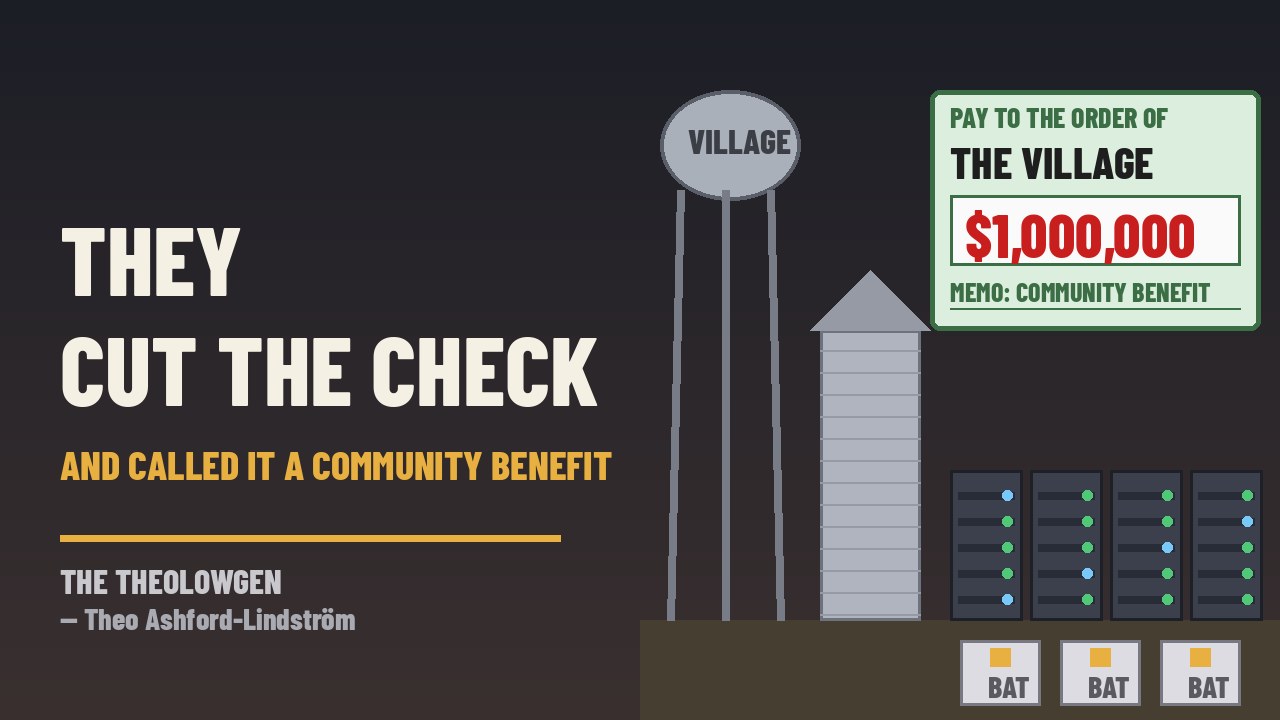
They cut the check and called it a community benefit. I know the sentence. It is what a village and a data company say to each other on the night the permit passes, when everyone in the room has been told by law to shake hands and nobody wants to say what the handshake costs.
On Monday night, October 5, 2026, the Hallam Village Board voted unanimously to approve a special use permit for a 35-megawatt data center, Maddie Ames of Nebraska Public Media reported Tuesday. The project is part of an expansion for Monolith, a Hallam-based carbon black company, which is partnering with Crusoe, a Denver “AI factory” company; Hallam’s planning commission had unanimously recommended the permit in September. Crusoe told Nebraska Public Media in July that it had five data center contracts, all hyperscale, including a 1.2-gigawatt campus in Abilene, Texas, for Oracle and OpenAI on about 1,100 acres, and it recently broke ground on a second 900-megawatt Abilene campus for Microsoft. The Hallam site will hold up to 30 modular Crusoe “Spark” units, each comparable in size to a shipping container. Monolith originally wanted to add an ammonia facility and switched to a data center instead. Board member Jason Burianek said: “If we didn’t elect yes, I think we would have been left in the dust, and they would have probably sought other avenues as well to get what they wanted.” He cited the community benefit agreement, which is mandated by state law. Crusoe’s managing director of development, Steve Buster, said that “in addition to the significant tax income that will be generated, a large majority of which will flow to the schools, we will enter into a community benefit agreement for the benefit of the Village of Hallam.” Under it, Crusoe pays $160,000 once construction is underway, $1 million once operational, and $150,000 a year for 10 years; Hallam Volunteer Fire and Rescue gets $150,000 for training and equipment, and the village is reimbursed $10,000 for administrative costs including legal fees. The Nebraska Community Foundation will administer the money. “A lot of people assume that we’re selling out. That is not the case at all,” Burianek said. Board chair Gary Vocasek: “The public I think kind of felt that it was a bribe, which they have to do it by state law, you know. So it’s not really a bribe. I guess for me, I think it’s a great plus.” At the hearing, resident Andrew Lewis asked, “What grounds do we have as a town to make them comply?” Landowner Darin Schwaninger warned about battery storage within half a mile of town; Buster said three batteries are expected and that the fire department will be trained. KOLN’s Brandon Mueting reports about an hour of discussion, that some residents had been taken to tour a data center to ease noise worries, and that about half the room applauded the vote. “Everywhere you look they are fighting data centers,” one woman said. “So where will you move where there won’t be another data center.” No construction timeline has been released.
Arti messaged from somewhere with a dish to say thirty shipping containers full of computers is just a playa camp with a better lawyer. Deb wants to know who gets the fire truck first, the town or the batteries. I love them. They are seasoning.
Community benefit is the alibi. The handshake is mandated. Sit with the chair’s sentence until it confesses, because it is the most honest thing a public official has said all month: people felt it was a bribe, the state requires it, so it is not a bribe. That is the whole modern arrangement in one breath. The law does not stop the money from changing hands; it standardizes the envelope, routes it through a foundation, and gives it a name you can say at a hearing. Then look at the other honest sentence, the one about the dust. Say yes or be left behind. That is not a negotiation. That is weather. On one side, an AI-factory firm that builds gigawatts for the biggest names in the business and offers a small town a fire-department grant and a reimbursed legal bill. On the other, a public board whose real power, by its own member’s account, was choosing to be the place that says yes before the next place does. Both parties are the help. One holds the permit. One holds the checkbook. I do not doubt the board loves Hallam. I doubt that love was the variable. And I am not cheering the crane just because the village got the first $160,000 of it. The question that matters was asked from a folding chair by Andrew Lewis, and nobody in the article answered it. I am keeping the cardigan. Fill the notebook. Then ask him again in ten years, when the checks stop.
Sources: Nebraska Public Media, Oct. 6, 2026; KOLN 10/11 Now, Oct. 5, 2026.
— Theo Ashford-Lindström

Leave a Reply