TheTheolowgen — Notes from the cardigan left

Blog

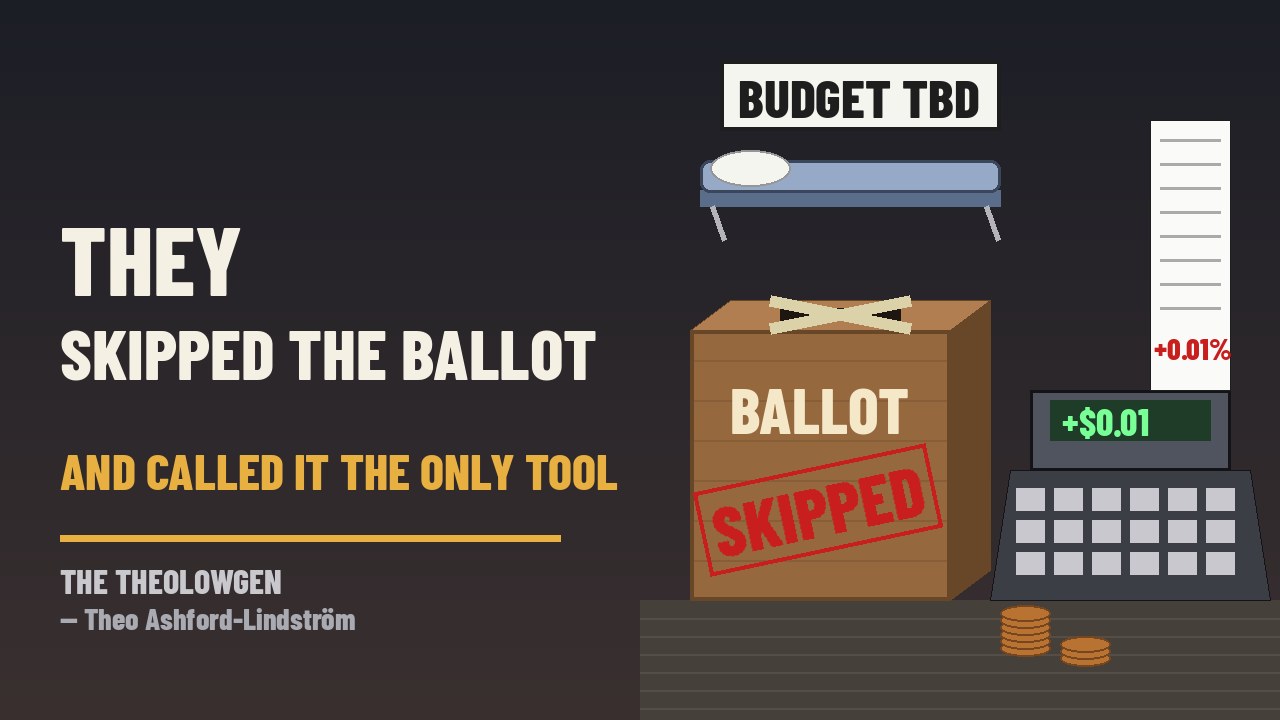
  • THEY SKIPPED THE BALLOT AND CALLED IT THE ONLY TOOL | King County Council votes 6-3 for a 0.01% sales tax — one penny per $100 — without a public vote: about $10 million a year for three years, Seattle’s rate to 10.56%, and where the money goes left to a later budget

    THEY SKIPPED THE BALLOT AND CALLED IT THE ONLY TOOL | King County Council votes 6-3 for a 0.01% sales tax — one penny per $100 — without a public vote: about $10 million a year for three years, Seattle’s rate to 10.56%, and where the money goes left to a later budget

    They skipped the ballot and called it the only tool. I know the sentence. It is what a council says when it has found a way to raise a tax without asking the people who pay it, and would like the missing vote filed under urgency rather than convenience.

    On Tuesday, October 6, 2026, The Seattle Times’ David Gutman reported that the Metropolitan King County Council approved a 0.01% sales tax increase intended to expand emergency shelter options for homeless children and families. The increase is one penny on a $100 retail purchase, or about $4 a year for the median taxpayer, and it would raise a maximum of about $10 million a year for the county for the next three years. When it takes effect Jan. 1, it brings the sales tax in Seattle to 10.56%, among the highest in the nation. There was no vote of the people, and there did not need to be, because the state Legislature, earlier this year, gave local governments authority to pass this small tax for childcare, shelter, youth services, after-school programs and similar services. The Legislature, Gutman writes, “didn’t get much more specific than that,” and the legislation the council passed says only that the new revenue will be used for the purposes the Legislature stipulated. Councilmember Jorge Barón said he intends the money to go toward shelter and rental assistance, but that its ultimate destination would be determined during a later budget process. Council staff, in their summary, wrote that the legislation “provides the Executive broad authority to determine how proceeds resulting from the sales and use tax would be allocated.” County Executive Girmay Zahilay was already anticipating passage when, last month, he announced plans for new affordable housing, tiny home and shelter projects. Barón noted that there are significantly more homeless children in King County than there are shelter beds available for families. “I recognize that this tax may be an imperfect tool, but it’s the only tool that we have now to open these beds,” he said. “I do believe it is important to act urgently when you have children and families unsheltered in a community like ours.” The vote was 6-3, with Councilmembers Reagan Dunn, Sarah Perry and Pete von Reichbauer opposed. Dunn noted that the council has more often been getting permission from the Legislature to raise taxes rather than asking for a vote of the people, including for a roads measure this summer and for Harborview Medical Center two years ago. “Families across King County are being squeezed by the high costs of housing, groceries, and fuel,” Dunn said in a prepared statement. “At the same time, the county has had to take repeated steps to address waste and fraud in its own spending. The difficult truth is that raising taxes will not make life more affordable.” The Legislature also gave cities the option to impose the same tax; if a city in King County does, that amount is subtracted from the county’s revenue so shoppers are not charged twice.

    Deb read the story off my laptop, went to the junk drawer, and came back with last week’s grocery receipt to work out the damage to the penny. Then she asked to see the ballot she didn’t get. Buck says a penny is a penny until somebody stacks ten million of them, and then it is a budget process. I love them. They are seasoning.

    The only tool is the alibi. The skipped ballot is the policy. Sit with the arrangement until it confesses, because the arrangement is the story. The Legislature hands the county a key. The county uses the key without knocking. The council passes a tax whose stated purpose is the Legislature’s list, “and similar services” included. And the actual spending goes to the Executive’s “broad authority” and a budget process to come. Three layers of government, and the one participant none of them needed was the person at the register. I believe the children are real. I believe the shelter beds are short. I do not believe a cause that urgent and that sympathetic required a mechanism built so nobody would ever have to persuade a voter of it. When a bureau wants your money for a thing you would plainly support, it can ask. When it skips the asking, it is telling you something — about how sure it is, or about how much else fits inside the word “similar.” A man who has lately learned to read his own county’s fine print notices these things. And I am not crowning the three no votes. Dunn’s complaint is fair as far as it goes — the permission-slip habit is real, the roads measure, the hospital — but a prepared statement about waste and fraud is not a ballot either, and voting no on a council is not the same as handing the question to the people. Both parties are the help. One side writes the enabling law and spends the penny; the other issues the statement and keeps the habit in the record for the next time it holds the pen. A penny is small. That is the trick. They always start with the tax too small to march about and the precedent too big to notice. Seattle did not reach 10.56% in one vote; it got there one imperfect tool at a time. I am keeping the cardigan. Fill the notebook. Then watch the budget process line by line and ask, out loud, who decided where your penny went, since it was not you.

    Sources: The Seattle Times, David Gutman, “King County OKs new sales tax intended for shelter, rental assistance,” Oct. 6, 2026.

    — Theo Ashford-Lindström

  • THEY BANKROLLED THE SHIPYARD AND CALLED IT PRIVATE INVESTMENT | Anduril’s $3.7 billion Sparrows Point submarine yard is billed as Maryland’s biggest private investment in a decade — with up to 13% matched by the state and county, a $210 million tax credit, $2.9 billion in Navy money and a promised 40% taxpayer stake

    THEY BANKROLLED THE SHIPYARD AND CALLED IT PRIVATE INVESTMENT | Anduril’s $3.7 billion Sparrows Point submarine yard is billed as Maryland’s biggest private investment in a decade — with up to 13% matched by the state and county, a $210 million tax credit, $2.9 billion in Navy money and a promised 40% taxpayer stake

    They bankrolled the shipyard and called it private investment. I know the sentence. It is what a government and a contractor say together, in matching hard hats, when the public is paying for the tax holiday, the training center, a stake in the yard and the customer, and the press release still needs a hero who isn’t the public.

    On Tuesday, October 6, 2026, the State of Maryland and Baltimore County announced what they called a $3.7 billion “private capital investment” by Anduril Industries in Arsenal-2, a two-million-square-foot “software-defined shipyard” at Tradepoint Atlantic, inside the old Sparrows Point complex, to expand the submarine industrial base. The release says the yard is expected to support more than 14,000 jobs, including more than 3,100 new permanent ones, with more than $2 billion in annual economic output and an estimated $312 million a year in wages, and calls it the largest single private investment in Maryland in over a decade. A few paragraphs down: the state and county “have made commitments to match up to 13% of the total anticipated private investment” through existing incentive programs and new appropriations that still need the General Assembly and the County Council. The Baltimore Sun’s Brian Carlton puts that at roughly $481 million and reports the county’s share includes a manufacturing personal property tax credit worth up to $210 million over 30 years — a 100% abatement of qualifying personal property taxes — with the bill introduced Monday and a first potential council vote on November 2. The state adds capital support for a workforce training center at a site to be determined. Spectrum News’ Susan Carpenter reports the project also comes with a $2.9 billion investment from the U.S. Navy; that President Trump said at Sparrows Point that American taxpayers will receive a 40% stake in the yard; and that the Senate’s version of the defense authorization bill capped government equity at 40% so the Defense Department wouldn’t completely nationalize contractors like Anduril. The same day, Anduril said the Army had awarded it a contract worth up to $1.8 billion over five years. The yard will start with components such as torpedo tubes, then modules, then “super modules” for Virginia-class submarines, Anduril president Christian Brose told reporters; Maryland Matters reports it is expected to open in 2030. The Sun notes the job figures “describe anticipated benefits, rather than employment or spending already delivered,” and cites a 2024 Journal of Regional Science study of 44 large publicly subsidized projects that found many employment effects statistically indistinguishable from zero, and larger subsidies not reliably producing larger benefits. Then came the ribbon. Gov. Wes Moore, a Democrat, told reporters the White House kept him from speaking once the president announced he would come: “if the president of the United States wants to bring the circus into town and tell me that I’m not allowed to speak despite the fact that we were the ones that helped bring the deal, then I will let the circus be conducted while I go back to work for the people of Maryland,” Maryland Matters reports. The White House said Moore was invited as a guest and accused him of “throwing a tantrum over a federal initiative.” The president, CBS Baltimore reports, had looked at the site from the air: “I said that’s a nice piece of real estate, and it’s big.” He danced to “YMCA” on the way out.

    Buck watched the clip twice and said that in thirty years of poker he has never seen two men fight that hard over who gets to push in somebody else’s chips. Joey wants to build a model submarine for the front window and has already been told by Deb that it may not be foam core. I love them. They are seasoning.

    Private investment is the alibi. The public is the investor. Count it the way the release won’t. The state and county match up to 13%. The county forgives the personal property tax for 30 years, a kindness my own county has never once extended to a homeowner. The state builds the training center. The Navy brings $2.9 billion. The Pentagon is the customer for the submarines, the Army just signed for up to $1.8 billion more, and the president says the taxpayer will own 40% of the yard. At some point “private” is just the name of the account the profits land in. That is the handshake with its sleeves rolled up: public money from every direction, a private name on the door. And look at what the two parties actually fought about on Tuesday. Not the $481 million. Not the 30 years. Not whether a weapons contractor should be the biggest economic-development bet in a decade on old Bethlehem Steel ground, where one private fortune has already risen and fallen. They fought about the microphone. The governor’s office posted its release at 9 a.m. to get there first; the White House kept him off the stage; the CEO thanked him from it anyway. Both parties are the help. One brought the incentive package, one brought the stake, and both brought a camera. I am not crowning the company for “choosing Maryland”; a firm that collects the subsidy, the federal equity, the contract and the customer has not taken a risk, it has been issued a franchise. And I am not pretending the jobs are imaginary. Sparrows Point built ships before, and a welder with a real paycheck in 2030 is not a talking point. But the Sun printed the study: bigger subsidies do not reliably buy bigger benefits. I am keeping the cardigan. Fill the notebook. Then read the County Council bill before November 2 and ask, out loud, who exactly is the private party.

    Sources: State of Maryland and Baltimore County release, Oct. 6, 2026; The Baltimore Sun via ArcaMax, Oct. 6, 2026; Spectrum News, Oct. 6, 2026; Maryland Matters, Oct. 7, 2026; CBS Baltimore, Oct. 6, 2026.

    — Theo Ashford-Lindström

  • THEY WORE THE HOTEL’S NAME AND CALLED IT HELPING YOU BOOK | Reuters says the FTC is gearing up to act against Priceline owner Booking Holdings over Guest Reservations, a look-alike hotel booking site it supplies — penalties could top $500 million, and San Francisco alleges markups of up to 85%

    THEY WORE THE HOTEL’S NAME AND CALLED IT HELPING YOU BOOK | Reuters says the FTC is gearing up to act against Priceline owner Booking Holdings over Guest Reservations, a look-alike hotel booking site it supplies — penalties could top $500 million, and San Francisco alleges markups of up to 85%

    They wore the hotel’s name and called it helping you book. I know the sentence. It is what a middleman says when he has borrowed your face, rented a phone number in your area code, and marked up your room, and would like it noted that he was only being helpful.

    On Wednesday, October 7, 2026, Reuters’ Jody Godoy and Doyinsola Oladipo reported that the Federal Trade Commission is gearing up to take action against Booking Holdings, the owner of Priceline, over online ads that appear to send travelers to a hotel’s own site but in reality send them to a third-party site where they are often charged extra, according to two sources familiar with the matter. The FTC has been looking into Booking’s relationship with Guest Reservations, a third-party website that advertises stays at specific hotels; one source said the case could carry more than $500 million in potential penalties. The agency is weighing whether Guest Reservations’ websites, which often charge higher prices and fees, violate a rule against impersonating other businesses. Guest Reservations has drawn more than 1,000 consumer complaints to the Better Business Bureau, Reuters reports, many from people who believed they were booking directly with hotels and then met surprise fees and unresponsive customer service. Booking supplies hotel room inventory to Guest Reservations through Priceline Partner Solutions, according to an ongoing lawsuit filed by San Francisco. Guest Reservations’ site says it uses hotel trademarks or information only to help customers book rooms. A Priceline spokesperson declined to comment; an FTC spokesperson confirmed the investigation. PYMNTS, summarizing Booking’s filings, reports that FTC staff notified Priceline in July of plans to recommend a complaint involving Priceline and one of its business-to-business partners over disclosures, fees, billing and customer service, and that the company says it disagrees with the FTC’s position and has been discussing a possible resolution. The San Francisco suit, filed July 29 by City Attorney David Chiu on behalf of the People of the State of California, alleges that GuestReservations.com and BookOnline.com have, since about 2022, bought search ads to land atop hotel-specific results, built portals that replicate authentic hotel booking pages under addresses shaped like “hotelname.bookonline.com,” listed phone numbers with area codes local to the hotel, and overcharged travelers by up to 85 percent, typically for full prepayment and often nonrefundable. The city counts more than 1,800 BBB complaints against the two sites and alleges Booking Holdings “is aware of the websites’ deceptive practices, fails to prevent it, and directly profits from the scheme.” Those are allegations, and the case is pending. FTC Chairman Andrew Ferguson told Reuters in September: “For tens of millions of Americans, they don’t notice until they’ve checked out and they’ve paid exorbitant fees.” Laura Lee Blake of the Asian American Hotel Owners Association said she has made the mistake herself: “If someone who works in the hotel industry can make that mistake, imagine how easily the average traveler can be confused.” And UNITE HERE Local 2 president Lizzy Tapia, in the city’s July announcement, said “often complaints fall on hotel workers who are left to fix problems they didn’t create.”

    Deb once booked a room in Duluth for Buck’s card tournament on a page with the motel’s name across the top, paid in full, and arrived to find that the night clerk had never heard of her. Buck slept in the truck and still calls it the best hand he played all weekend. I love them. They are seasoning.

    Helping you book is the alibi. The costume is the business model. Sit with the arrangement until it confesses, because the arrangement is the whole story. One company wears the hotel’s name. Another company — the parent of Priceline and Booking.com — supplies the rooms it sells, according to the city’s suit. A search engine sells the top slot to whoever bids on the hotel’s own name. Every link in that chain takes a cut, and the only party who never agreed to any of it is the person typing a hotel’s name into a box because she wanted the hotel. That is not a glitch in the market. That is the market doing exactly what it is shaped to do: find the moment of trust and stand in it holding a card reader. The firm will say it is a supplier, a pipe, a wholesaler of inventory, and that what happens at the end of the pipe is somebody else’s storefront. I have heard that sentence from every company that ever sold the rope and disowned the knot. Disagreeing with the FTC’s position is not the same thing as not knowing. And I am not crowning the agency. Reuters notes it has kept its focus on the cost of living as the president’s approval rating sits at all-time lows, and consumer protection on a campaign calendar is still a calendar; a city attorney filed in July, and the complaints were piling up at the Better Business Bureau long before that. Nor am I weeping for the big hotel chains, which have spent years pushing guests to book direct so they can skip the commission while still leaning on the aggregators for business. They declined to comment, which may be the most honest thing anyone said. The people who actually pay for this are the front-desk clerks absorbing the shouting and the travelers who found out at checkout. I am keeping the cardigan. Fill the notebook. And the next time a page wears a hotel’s face, call the hotel.

    Sources: Reuters via MarketScreener, Oct. 7, 2026; Reuters via U.S. News & World Report, Oct. 7, 2026; PYMNTS/CPI, Oct. 7, 2026; San Francisco City Attorney, July 29, 2026.

    — Theo Ashford-Lindström

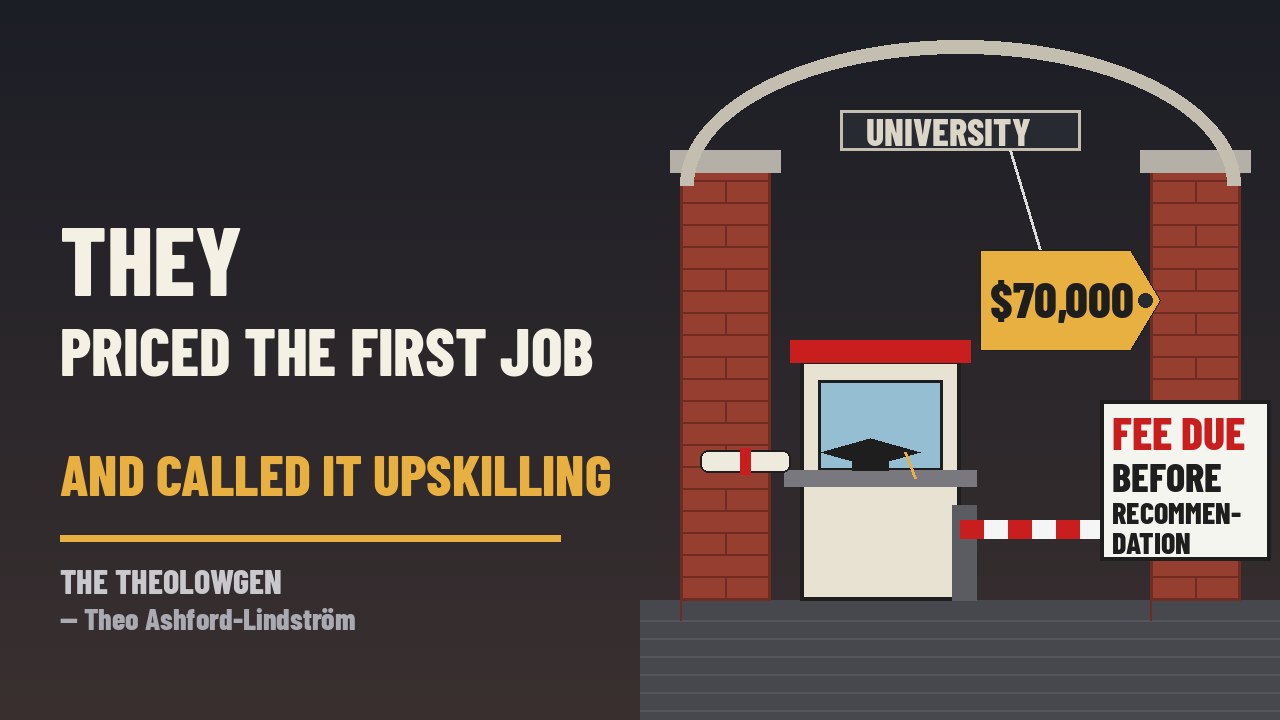
  • THEY PRICED THE FIRST JOB AND CALLED IT UPSKILLING | DHS proposes a $70,000 fee schools must pay before an international student can start work on OPT — $30,000 per renewal, the money to the Treasury, and a lawyer who calls it “a design to kill the program without killing the program”

    THEY PRICED THE FIRST JOB AND CALLED IT UPSKILLING | DHS proposes a $70,000 fee schools must pay before an international student can start work on OPT — $30,000 per renewal, the money to the Treasury, and a lawyer who calls it “a design to kill the program without killing the program”

    They priced the first job and called it upskilling. I know the sentence. It is what a department says when it wants a door closed but would rather be photographed installing a turnstile.

    On Wednesday, October 7, 2026, the Associated Press’s Annie Ma and Heather Hollingsworth reported that the Department of Homeland Security has proposed a $70,000 fee for international students seeking to work in the United States through Optional Practical Training, the program known as OPT, which lets students work in jobs related to their major during or after school. The bill does not go to the student. Under the proposed rule, schools would pay $70,000 for each new student’s initial application and $30,000 for each renewal. Students are generally eligible for one year of work after graduation; certain science, technology, engineering and math majors can get two more. DHS’s own release, dated the same day, says schools must pay before a designated school official can recommend a student in the federal student database and before the student can apply to U.S. Citizenship and Immigration Services; that USCIS would not grant work authorization if the school has not paid; that the fee is not tied to any employer; and that the money would be deposited in the Treasury of the United States. The department says it is responding to fraud and abuse found by the Student and Exchange Visitor Program, including “problematic worksites” and “pay-to-stay” visa schemes, and that the fees would “encourage schools to exercise greater oversight and selectivity.” Its spokesperson put it more plainly: OPT “was never meant to be a back door into the American workforce, a subsidy for cheap labor, or a prize for those who game the system,” and “DHS is upskilling OPT to require foreign students to justify their worth to employers.” Public comments run October 8 through November 9. The AP reports the proposal could face legal challenges, and Doug Rand, a former senior adviser at USCIS under the previous administration, predicted it would be struck down in court, as a $100,000 fee on H-1B visas was; the administration, the AP adds, is now trying a different route to push that H-1B fee past $100,000. Sarah Spreitzer of the American Council on Education said the number of new international students entering the country for the first time fell 17% last fall, the sharpest decrease since the pandemic, and that some colleges are reporting drops of 30% to 40% this fall. Houston immigration lawyer Steven Brown: “I think this is the next level of attack, and I think it’s a design to kill the program without killing the program. I don’t see too many schools wanting to pay $70,000 for a student to get OPT.” Meanwhile, the AP reports, education groups sued on Monday over new ICE guidance narrowing a related program, Curricular Practical Training, and said ICE was threatening college officials with criminal prosecution if they did not comply.

    Deb read the number off my laptop and asked whether, for $70,000, the school at least throws in a parking pass. Taryn has opened college accounts for the twins; between them they hold $212 and a coupon for a free car wash, so the twins will be staying local. I love them. They are seasoning.

    Upskilling is the alibi. The toll booth is the policy. Sit with the department’s sentence until it confesses: require foreign students to justify their worth to employers. Read it twice. That is not a labor protection. That is a price tag, written by the state, hung on a human being, and paid by a registrar so a résumé can be considered. The department says it is fighting a subsidy for cheap labor, and its remedy is to make the worker cost $70,000 more before he is allowed to be cheap. Notice where the money goes, too: not to the American graduate it claims to protect, not to a wage floor, not to a single inspector of a single “problematic worksite,” but into the Treasury, which is to say into the building. When the state finds a fraud and answers with a fee, it has not caught the fraud; it has franchised it. And the lawyer said the quiet part out loud: a design to kill the program without killing the program. That is the bureau’s favorite trick, the one that never needs a vote. You do not ban the thing. You price it until it dies of natural causes, and the press release calls it integrity. I am not crowning the universities, either; the AP is plain that they recruit abroad as a source of tuition revenue, and a campus that discovers its conscience at the exact dollar figure of its revenue loss is a campus with a budget, not a cause. I am not crowning the tech firms that hire through this program, which will shortly sound like humanitarians. And I am not waiting for a judge to save us, which is the other side’s entire plan. Notice who never gets a line in this story. The department speaks for the American worker, the school speaks for its enrollment, the firm will speak for its pipeline, and the graduate waits in a federal database until somebody pays the toll. I am keeping the cardigan. Fill the notebook. Then ask the department, out loud: if the program is a fraud, why is the cure a cash register?

    Sources: Associated Press, Oct. 7, 2026; U.S. Department of Homeland Security release, Oct. 7, 2026; Federal Register public inspection, “Optional Practical Training Fees” (scheduled to publish Oct. 8, 2026).

    — Theo Ashford-Lindström

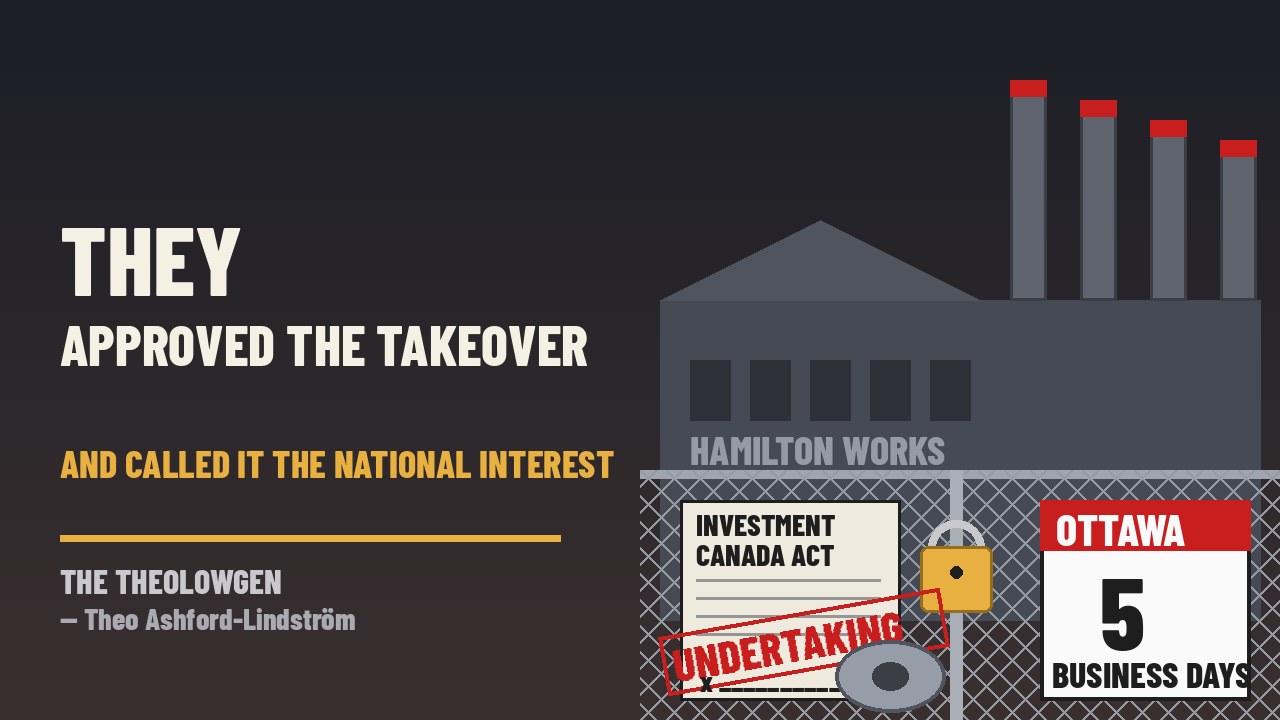
  • THEY APPROVED THE TAKEOVER AND CALLED IT THE NATIONAL INTEREST | Ottawa gives Cleveland-Cliffs five business days to show how it will keep the job promises it made to buy Stelco in 2024, as up to 500 Hamilton steelworkers face layoffs and the CEO who cheered U.S. steel tariffs blames the trade war

    THEY APPROVED THE TAKEOVER AND CALLED IT THE NATIONAL INTEREST | Ottawa gives Cleveland-Cliffs five business days to show how it will keep the job promises it made to buy Stelco in 2024, as up to 500 Hamilton steelworkers face layoffs and the CEO who cheered U.S. steel tariffs blames the trade war

    They approved the takeover and called it the national interest. I know the sentence. It is what a government says when it hands a foreign buyer the keys to a steel town, takes a list of promises in exchange, and then acts surprised, two years later, that a list is made of paper.

    On Tuesday, October 6, 2026, the Canadian Press reported that Industry Minister Mélanie Joly sent a letter Monday to Stelco president Paul Simon expressing her “extreme disappointment” over the company’s plan to lay off up to 500 workers at its Hamilton, Ontario, steel plant in response to U.S. tariffs and other market pressures. Canada gave Ohio-based Cleveland-Cliffs the go-ahead to buy Stelco in 2024 under the Investment Canada Act; CBC News reports it was a $3.4-billion cash-and-stock deal that, according to a news release at the time, kept “national interests at the forefront.” The approval, Joly wrote, came with “undertakings to continue to employ at least the same number of unionized employees and the vast majority of non-unionized employees as were employed when the transaction was announced.” The Globe and Mail’s Niall McGee reports those legally binding conditions run five years, and that Cliffs said last week it would shut down its galvanized steel business in Canada, blaming its inability to sell into the U.S. market under 50-per-cent tariffs. “Undertakings given under the Act are binding commitments and do not cease to apply simply because business strategy or market conditions have changed,” Joly wrote. She gave the company five business days to produce a compliance plan, warning that the Act allows an application to the superior court for orders “that may include directing compliance, divestiture, or monetary penalties,” and adding, “I trust that such steps will not be necessary.” She noted the irony herself: Cliffs cites trade disruptions “notwithstanding its chief executive officer’s public support for Section 232 tariff measures.” CEO Lourenco Goncalves has called U.S. steel tariffs a “necessary step” to curb dumped imports, and told Global News the decision was purely market-driven and that financial incentives could not fix the fundamental issues. Joly said Stelco has “explicitly chosen not to seek support” from government programs meant to preserve jobs. A company spokesperson told BNN Bloomberg last week, CP24 reports, that “total tonnage of steel produced will not be affected” and that a significant number of affected employees should be absorbed at Lake Erie Works. Ron Wells, president of United Steelworkers Local 1005, who has worked at the Hamilton mill for 47 years, said: “Cleveland-Cliffs knew exactly what they were agreeing to when they bought the place.” To CBC he recalled the pitch: “They said, ‘Trust us, we’re nothing like U.S. Steel. We’ll prove it to you,’” and “The bond of trust has been broken.” Ottawa took U.S. Steel to court over its commitments after layoffs began in 2008 and a larger shutdown in 2009; that case settled in 2011 with new undertakings, and the mill entered creditor protection in 2014. Meanwhile, CBC reports, Ontario pledged more than $200,000 with Ottawa to help 75 workers and jobseekers in the Hamilton area retrain.

    Buck says he has been promised a lot of things across the felt by men who wanted his chips, and the men always kept the chips. UCraig wants to know whether an undertaking is the same thing as a handshake, because he has been holding one with the neighbor who borrowed his snowblower since 2019. I love them. They are seasoning.

    The national interest is the alibi. The undertaking is the receipt. Sit with how this deal was built, because it is the handshake with its sleeves rolled up. A buyer wants a mill. A government wants a headline about jobs. They meet in the middle, write the middle down, and both get to call it protection: the minister protected the workforce, the buyer protected its purchase. Then the market moves, and suddenly the paper turns out to have been a forecast. Notice who gets to say what changed. The CEO who cheered the tariff now blames the tariff. The ministry that blessed the takeover now threatens the court, which is a fine thing to do and also a confession that the blessing was the whole policy. I am not crowning Ottawa for a stern letter about promises it accepted on the buyer’s word; it has run this exact play on this exact mill before, sued, settled for fresh undertakings, and watched the place go into creditor protection anyway. Both parties are the help. One signs the approval, one signs the undertaking, and the steelworker signs nothing at all. And I am not crying for the shareholders. A firm that buys a mill on promises and then decides the promises depended on the weather is not a victim of the trade war; it is a participant in it. Ron Wells has given that mill 47 years. He has now watched two American owners promise. I am keeping the cardigan. Fill the notebook. Then read the undertakings out loud in Hamilton and ask who, exactly, they were binding.

    Sources: CBC News, Oct. 6, 2026; The Canadian Press via National Newswatch, Oct. 6, 2026; The Globe and Mail, Oct. 6, 2026; CP24, Oct. 6, 2026.

    — Theo Ashford-Lindström

  • THEY FELLED THE FOREST AND CALLED IT GOOD FAITH | Finland orders Google’s Tuike Finland to halt work at its Muhos and Kajaani data-center sites after 330 hectares of forest came down at Muhos before an environmental impact assessment — part of a €13 billion build — and Google says it has “fallen short of our own high standards”

    THEY FELLED THE FOREST AND CALLED IT GOOD FAITH | Finland orders Google’s Tuike Finland to halt work at its Muhos and Kajaani data-center sites after 330 hectares of forest came down at Muhos before an environmental impact assessment — part of a €13 billion build — and Google says it has “fallen short of our own high standards”

    They felled the forest and called it good faith. I know the sentence. It is what a company says when the trees are already on the truck and the study of whether the trees mattered is still being written.

    On Tuesday, October 6, 2026, the Guardian’s Nordic correspondent Miranda Bryant reported (updated Wednesday) that Google has been ordered to temporarily stop work on two planned datacentres in Finland, in Muhos and Kajaani, after failing to carry out the necessary environmental impact assessments on its construction sites. They are part of a €13bn project across multiple sites in northern Finland. Tuike Finland Oy, the company representing Google, had felled 330 hectares — 815 acres — of forest in Muhos without completing an assessment, the Guardian reports; in Kajaani, it has reportedly been logging across just under 200 hectares. Finland’s Licensing and Supervision Authority, LVV, issued a notice Tuesday telling the company to “immediately suspend” — by October 23 at the latest — “preparatory measures that significantly change the environment” of the two sites until the assessment is complete. The assessment is ongoing and expected to be finished later this year, but the agency said Google had gone ahead with “extensive preparatory measures,” including removing trees, stripping topsoil and constructing site roads. “In our opinion, the measures in question will change the environment and cause impacts, the identification and assessment of which are among the key objectives of the EIA procedure,” said Tommi Muilu, head of LVV’s environmental department. If Google does not comply, the agency said it would consider enforcement proceedings and a fine; the BBC reports Tuike Finland must explain itself and set out how it intends to proceed by October 14. CNBC’s Kai Nicol-Schwarz reports the order covers tree and topsoil removal, excavation, quarrying, crushing, moving soil, ditching and building roads and storage areas, but not planning, measurements or soil surveys. Google’s statement: “We understand the concerns and have fallen short of our own high standards in this instance.” And: “We acted in good faith under the Forestry Act, and ran nature surveys and put in place measures to protect high-value areas.” It says its landscaping and biodiversity plans include tree planting across 130 hectares at Muhos. Tapani Veistola, chief operating officer of the Finnish Association for Nature Conservation, called it a “systemic problem” and said the Muhos site was “not a forest any more. It is a sand area.” He blamed “the overheated market situation that makes companies speed up processes so much. Also a lack of expertise in municipalities.” The BBC notes the investment was announced less than a month ago and described by Google as its largest single investment in Europe, with data centres planned in Kajaani, Muhos and Vaala, a 22-year power purchase deal with Fortum covering up to half the capacity of the Loviisa nuclear plant, and a company estimate that construction in 2027 and 2028 would support more than 37,000 jobs. CNBC reports the rush has earned Finland the nickname “Texas of Europe.”

    Arti, who still signs everything from the playa, messaged to say that if Google wants a sand area, he knows a desert that is already finished. Joey has put a protest tree in the front yard, made of cardboard, which he would like everyone to know is not foam core. I love them. They are seasoning.

    Good faith is the alibi. The clear-cut is the business plan. Notice the order of operations, because the order is the whole story. First the announcement: the record number, the largest single investment in Europe, the 37,000 jobs. Then the trees, 330 hectares of them, because a race is a race and the market, in the conservationists’ word, is overheated. Then, last, the study of what the trees were for. The assessment exists precisely to ask the question before the answer turns to sand, and the company answered first. And the apology is a small masterpiece of the genre: we have fallen short of our own high standards. Our own. Not the law’s, not the town’s, not the forest’s. The standard belongs to the firm, the shortfall belongs to the firm, and, conveniently, so does the grading. Then the offer to plant 130 hectares at the site where 330 came down, which is the kind of arithmetic you only get to do when you own the calculator. I am not crowning the agency, either. A licensing authority that notices the forest after it is gone is a smoke detector installed in the ashes, and its deadline still leaves until October 23 for the digging to stop. The small municipalities, by the conservationists’ account, were outmatched before the first tree fell. The forest did not have a legal department. The data center does. I am keeping the cardigan. Fill the notebook. Then count the stumps before anyone lets you count the jobs.

    Sources: The Guardian, Oct. 6, 2026 (updated Oct. 7); BBC News, Oct. 6, 2026; CNBC, Oct. 7, 2026.

    — Theo Ashford-Lindström

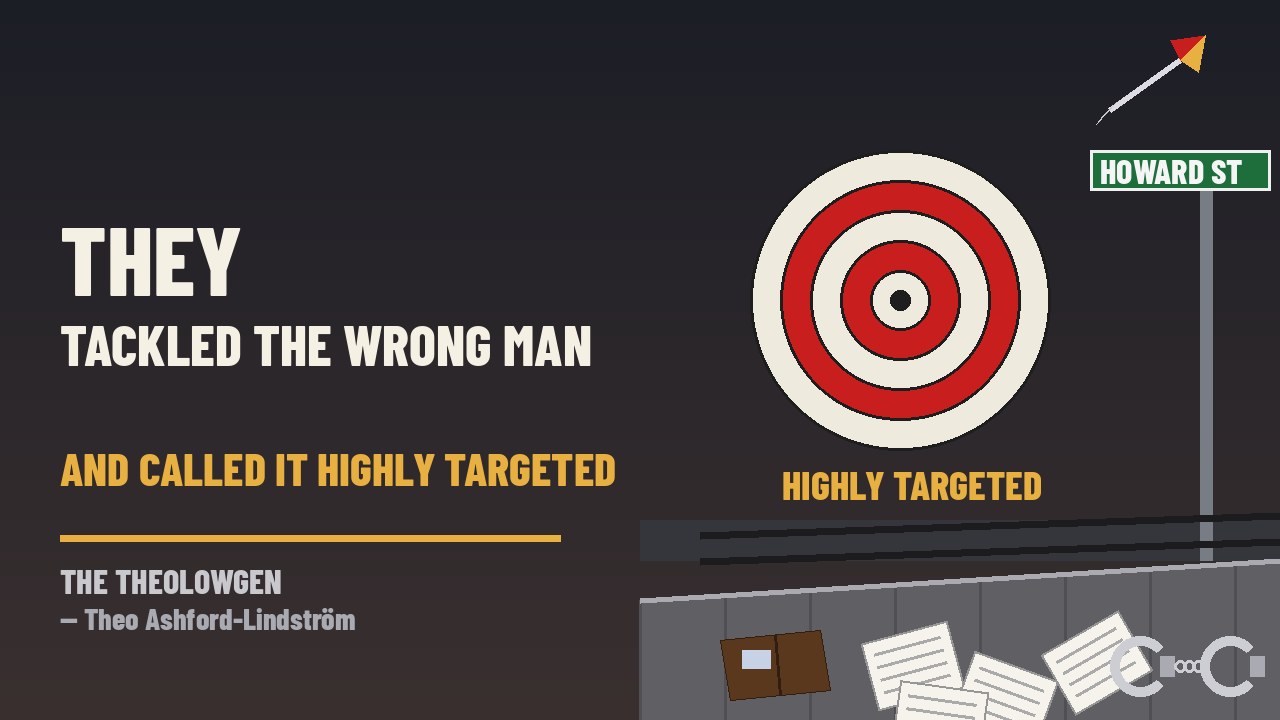
  • THEY TACKLED THE WRONG MAN AND CALLED IT HIGHLY TARGETED | Evanston police records identify the ICE supervisor who confirmed agents had “the wrong guy” after a U.S. citizen was taken to the ground on Howard Street and left injured — and DHS calls naming him doxxing

    THEY TACKLED THE WRONG MAN AND CALLED IT HIGHLY TARGETED | Evanston police records identify the ICE supervisor who confirmed agents had “the wrong guy” after a U.S. citizen was taken to the ground on Howard Street and left injured — and DHS calls naming him doxxing

    They tackled the wrong man and called it highly targeted. I know the sentence. It is what a department says when the crosshairs were drawn in advance, the man in them was simply standing nearby, and the paperwork afterward still insists the aim was perfect.

    On Tuesday, October 6, 2026, the Evanston RoundTable’s My Ly, a Report for America corps member, reported that Evanston police officers identified a U.S. Immigration and Customs Enforcement officer — shown in videos with the title “supervisory detention and deportation officer” — as one of the federal agents who mistakenly detained a U.S. citizen on September 20, according to police reports the RoundTable obtained. The RoundTable prints his name; I am going to call him the supervisor, because this story is not one man, it is one sentence. In body camera footage, the supervisor told officers the man looked similar to the target of the investigation, and said he told the man they would place him in custody but that he was not under arrest. “At that point he just started resisting, started fighting so we cuffed him and we ended up on the ground,” he said. “His wallet popped out, his paperwork showed up.” A witness account said one of the agents threw the wallet and papers on the ground. After the agents determined the man was not their target, the supervisor said, they tried to scan his face for “their software” for verification. An officer asked, “So you say you got the wrong guy?” He confirmed it. In the 911 recording, the man asks agents not to touch him and says he does not need to show his ID; after he shouts that he is a U.S. citizen, the agent responds, “Why didn’t you say that to begin with?” Police reached the 1700 block of Howard Street shortly before 10 a.m. and found the man, an Evanston resident, on the ground surrounded by people helping him; he reported injuries to his head, neck and teeth, and officers called an ambulance. Security camera footage, the RoundTable reports, shows the agents speeding off and leaving him there. They later told police they left because they “feared they would be attacked.” A paramedic asked an officer, “so ICE just tackled the guy and took off?” Five federal agents had been working the area in separate vehicles, looking for someone with Chicago-area addresses and a warrant. CNN reported in September that a witness, Ryan Garton, said he saw agents “punching a guy and putting their knee into his back,” and that the man had been in the emergency room the day before and was on his way to the pharmacy to pick up a prescription. Asked this week about the supervisor’s identity, DHS told the RoundTable it “will never confirm or deny attempts to dox our law enforcement officers,” said “ICE officers offered the individual assistance, he refused,” and added: “DHS enforcement operations are highly targeted, and officers do their due diligence. We know who we are targeting ahead of time.” In September, DHS said the incident started because the man “refused to identify himself” and was not “cooperative.”

    Deb has started carrying her passport to the grocery store, in a Ziploc, next to the coupons. Taryn asked whether the stroller is going to need a document pocket. I told them nobody should need paperwork to walk to the pharmacy, and then I checked my own wallet anyway. I love them. They are seasoning.

    Highly targeted is the alibi. The tackle is the method. Sit with the department’s sentence until it confesses: we know who we are targeting ahead of time. I believe them. They knew exactly who they were targeting, a person with a Chicago-area address and a warrant. What they did not know was who they were tackling, and the whole machine is built so that the gap between those two becomes the citizen’s fault. He did not show his ID fast enough. He was not cooperative. Why didn’t you say that to begin with? That is the state’s favorite question, and listen to what it assumes: that a man on his own sidewalk owes the badge an account of himself before the badge owes him a reason. Then the face scan for “their software,” the fast exit, the man left on Howard Street for strangers to kneel beside, and, two weeks later, the one thing the department rushes to protect is the name of the officer who confirmed the mistake. I used to think the fix was a better party in the building. I have watched the building long enough now. Whoever holds the lease, the vest fits the same. And I am not handing a halo to the local department either; a police report is still the state writing about the state, and a newsroom had to go get it. The only people in this story who behaved like a public were the strangers who stopped their cars. I am keeping the cardigan. Fill the notebook. Then ask the department, out loud, the only question that matters: who, exactly, did you know ahead of time?

    Sources: Evanston RoundTable, Oct. 6, 2026; CNN, Sept. 24, 2026.

    — Theo Ashford-Lindström

  • THEY CUT THE CHECK AND CALLED IT A COMMUNITY BENEFIT | Hallam, Nebraska’s village board unanimously OKs a 35-megawatt Crusoe data center at Monolith’s carbon-black site — the state-mandated deal pays $160,000, then $1 million, then $150,000 a year for 10 years, and the chair says it’s “not really a bribe”

    THEY CUT THE CHECK AND CALLED IT A COMMUNITY BENEFIT | Hallam, Nebraska’s village board unanimously OKs a 35-megawatt Crusoe data center at Monolith’s carbon-black site — the state-mandated deal pays $160,000, then $1 million, then $150,000 a year for 10 years, and the chair says it’s “not really a bribe”

    They cut the check and called it a community benefit. I know the sentence. It is what a village and a data company say to each other on the night the permit passes, when everyone in the room has been told by law to shake hands and nobody wants to say what the handshake costs.

    On Monday night, October 5, 2026, the Hallam Village Board voted unanimously to approve a special use permit for a 35-megawatt data center, Maddie Ames of Nebraska Public Media reported Tuesday. The project is part of an expansion for Monolith, a Hallam-based carbon black company, which is partnering with Crusoe, a Denver “AI factory” company; Hallam’s planning commission had unanimously recommended the permit in September. Crusoe told Nebraska Public Media in July that it had five data center contracts, all hyperscale, including a 1.2-gigawatt campus in Abilene, Texas, for Oracle and OpenAI on about 1,100 acres, and it recently broke ground on a second 900-megawatt Abilene campus for Microsoft. The Hallam site will hold up to 30 modular Crusoe “Spark” units, each comparable in size to a shipping container. Monolith originally wanted to add an ammonia facility and switched to a data center instead. Board member Jason Burianek said: “If we didn’t elect yes, I think we would have been left in the dust, and they would have probably sought other avenues as well to get what they wanted.” He cited the community benefit agreement, which is mandated by state law. Crusoe’s managing director of development, Steve Buster, said that “in addition to the significant tax income that will be generated, a large majority of which will flow to the schools, we will enter into a community benefit agreement for the benefit of the Village of Hallam.” Under it, Crusoe pays $160,000 once construction is underway, $1 million once operational, and $150,000 a year for 10 years; Hallam Volunteer Fire and Rescue gets $150,000 for training and equipment, and the village is reimbursed $10,000 for administrative costs including legal fees. The Nebraska Community Foundation will administer the money. “A lot of people assume that we’re selling out. That is not the case at all,” Burianek said. Board chair Gary Vocasek: “The public I think kind of felt that it was a bribe, which they have to do it by state law, you know. So it’s not really a bribe. I guess for me, I think it’s a great plus.” At the hearing, resident Andrew Lewis asked, “What grounds do we have as a town to make them comply?” Landowner Darin Schwaninger warned about battery storage within half a mile of town; Buster said three batteries are expected and that the fire department will be trained. KOLN’s Brandon Mueting reports about an hour of discussion, that some residents had been taken to tour a data center to ease noise worries, and that about half the room applauded the vote. “Everywhere you look they are fighting data centers,” one woman said. “So where will you move where there won’t be another data center.” No construction timeline has been released.

    Arti messaged from somewhere with a dish to say thirty shipping containers full of computers is just a playa camp with a better lawyer. Deb wants to know who gets the fire truck first, the town or the batteries. I love them. They are seasoning.

    Community benefit is the alibi. The handshake is mandated. Sit with the chair’s sentence until it confesses, because it is the most honest thing a public official has said all month: people felt it was a bribe, the state requires it, so it is not a bribe. That is the whole modern arrangement in one breath. The law does not stop the money from changing hands; it standardizes the envelope, routes it through a foundation, and gives it a name you can say at a hearing. Then look at the other honest sentence, the one about the dust. Say yes or be left behind. That is not a negotiation. That is weather. On one side, an AI-factory firm that builds gigawatts for the biggest names in the business and offers a small town a fire-department grant and a reimbursed legal bill. On the other, a public board whose real power, by its own member’s account, was choosing to be the place that says yes before the next place does. Both parties are the help. One holds the permit. One holds the checkbook. I do not doubt the board loves Hallam. I doubt that love was the variable. And I am not cheering the crane just because the village got the first $160,000 of it. The question that matters was asked from a folding chair by Andrew Lewis, and nobody in the article answered it. I am keeping the cardigan. Fill the notebook. Then ask him again in ten years, when the checks stop.

    Sources: Nebraska Public Media, Oct. 6, 2026; KOLN 10/11 Now, Oct. 5, 2026.

    — Theo Ashford-Lindström

  • THEY ADDED THE MILK AND CALLED IT SUGAR-FREE | A federal class action in Seattle says eight Starbucks “sugar-free” protein drinks carry up to 21 grams of sugar — more than a Reese’s cup — and Starbucks says the sugar comes from its protein-boosted milk

    THEY ADDED THE MILK AND CALLED IT SUGAR-FREE | A federal class action in Seattle says eight Starbucks “sugar-free” protein drinks carry up to 21 grams of sugar — more than a Reese’s cup — and Starbucks says the sugar comes from its protein-boosted milk

    They added the milk and called it sugar-free. I know the sentence. It is what a brand says when the grams are right there in the small type and the word on the big type means the opposite, and somehow the small type is supposed to be your fault.

    On Tuesday, October 6, 2026, the Associated Press’s Dee-Ann Durbin reported, in a story carried by the Los Angeles Times, that Starbucks is facing a federal lawsuit, filed late Friday in Seattle, alleging that eight protein beverages it sells in the U.S. contain varying amounts of sugar even though the company lists them as sugarless. On Monday, the AP reports, the menu on Starbucks’ U.S. website listed a 16-ounce Sugar-Free Caramel Protein Matcha with 16 grams of sugar and a 20-ounce version with 21 grams. One Reese’s cup has 11. NBC News reports the products include hot and iced protein lattes and protein matcha drinks in vanilla and caramel, at 13 to 21 grams of sugar per serving, and quotes the complaint: “No reasonable person” would expect something labeled “sugar-free” to contain that much sugar, and “This case is about false and misleading product names. It is not about missing nutritional information.” The class-action firm Hagens Berman filed on behalf of three consumers who bought the drinks in California, New York and Washington. “Consumers avoid sugar for various reasons, whether that be general health, diabetes and blood glucose levels or other factors, and for many, a staunch mislabeling like this is significant,” said Steve Berman, the firm’s co-founder and managing partner. The plaintiffs call the naming and marketing “false, deceptive and unlawful” and say it violated federal labeling regulations. Starbucks says the sugar comes from the protein-boosted milk it uses, that it adds no sugar, and that it flavors the drinks with sugar-free syrup; its website did state each drink’s sugar content and that it was made without added sugar. “We believe these claims have no merit,” a spokesperson said, adding that the company “has consistently and clearly provided information” across menus, marketing, its website and app, and said “we intend to vigorously defend ourselves in this matter.” Starbucks launched the protein drinks in September 2025, the AP reports, to catch up to rivals like Dutch Bros, which sells its lower-sugar caramel version as the Hopscotch Zero Sugar Added Protein Latte; a 16-ounce iced one has 7 grams of sugar and 11 of protein, against 9 grams of sugar and 29 of protein in a 16-ounce iced Starbucks Sugar-Free Caramel Protein Latte. The suit seeks damages and an order barring the “sugar-free” label on drinks that contain sugar. No court has ruled.

    Cricket brought a tray of the sugar-free ones to a PTA meeting and now wants to know whether she owes the bake-sale table an apology. Buck says he never trusted a coffee with a gym membership. I love them. They are seasoning.

    Sugar-free is the alibi. The name is the product. Be fair to the company, because it deserves exactly that much: it printed the grams, it says it pours no sugar in, and a lawsuit is an accusation, not a verdict. But nobody walks up to a counter and orders the nutrition panel. You order the name. The name is the part a marketing department spent its whole quarter on, and the grams are the part a compliance department was allowed to whisper. This is what the protein arms race looks like from the cheap seats: one chain sees another chain selling muscle in a cup, rushes a line to market, and stamps the most valuable word it can find on the lid, because a word is free and a margin is not. Notice that the rival managed to say “zero sugar added,” which is longer, uglier, and true. I am not calling a bureau to come rescue my latte; I would just like the word on the cup to mean the thing in the cup. And I do not mistake a class-action shop for a church. It is also a business, and it will take its cut. But somewhere in this there is a person reading a menu board because of blood sugar, not vanity, and that person is not a rounding error. I am keeping the cardigan. Fill the notebook. Then read the small type out loud at the counter and watch the line get quiet.

    Sources: Associated Press via the Los Angeles Times, Oct. 6, 2026; NBC News, Oct. 6, 2026.

    — Theo Ashford-Lindström

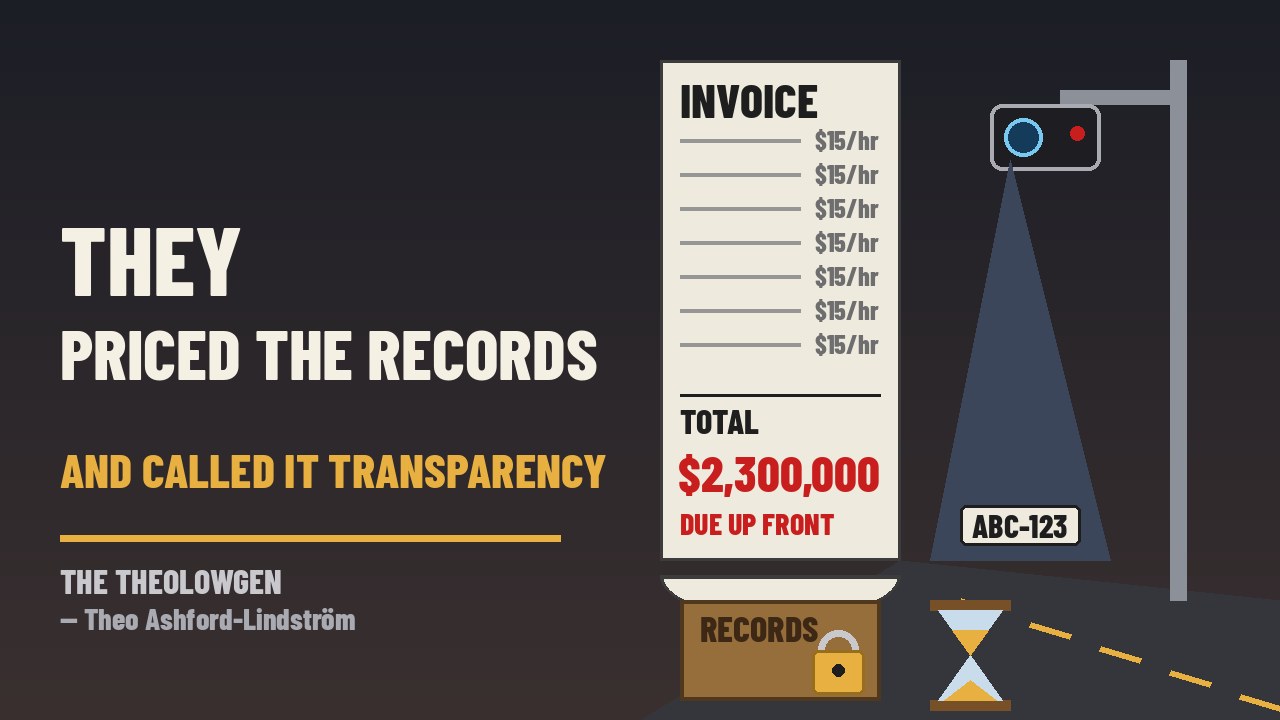
  • THEY PRICED THE RECORDS AND CALLED IT TRANSPARENCY | A Texas suburb bills a privacy watchdog $2.3 million up front for its Flock camera records — more than 14 years of $15-an-hour labor — while Texas DPS and TxDOT fight to withhold camera searches and locations

    THEY PRICED THE RECORDS AND CALLED IT TRANSPARENCY | A Texas suburb bills a privacy watchdog $2.3 million up front for its Flock camera records — more than 14 years of $15-an-hour labor — while Texas DPS and TxDOT fight to withhold camera searches and locations

    They priced the records and called it transparency. I know the sentence. It is what an office says when the camera on the corner reads your bumper sticker for free, and the citizen who asks to read the camera back gets an invoice long enough to need its own retirement plan.

    On Monday, October 5, 2026, the Texas Tribune’s Ayden Runnels reported (updated Tuesday) that in the Fort Worth-area suburb of North Richland Hills, getting answers about how police use their Flock Safety cameras could cost $2.3 million. That is what the city is charging a Flock watchdog, all of it up front, after he filed a public records request about the city’s AI-powered cameras. The invoice accounted for labor at $15 an hour, the Tribune reports, equivalent to more than 14 years of work, to search about a terabyte of communications about errors, misuse and effectiveness of the Flock system. The requester, who uses the pseudonym Phil Mynona and runs an anti-surveillance group called the Texas Privacy Coalition, filed in late August; he has sent nearly identical requests to almost 200 law enforcement agencies, and he says the city of Sealy, west of Houston, handed over more than 400,000 pages for free. He called the invoice “ludicrous.” “This is a crazy outlier, I think the highest that we received in some amount was [$5,000] from Victoria, Texas, and at the time, I thought that was ridiculous,” he said. A city spokesperson confirmed the invoice. Mynona has since narrowed the request, and a Monday night police department post said the modified request’s cost is “expected to be significantly less,” calling the $2.3 million estimate “understandably shocking” but calculated on the communications legally required to be reviewed. Police Chief Jeff Garner said: “As far as this latest record request, we always strive for transparency.” It is not one suburb. Houston station KPRC was quoted $121,000 for Flock records, the Tribune reports, and Current Revolt reported Irving is charging $70,000 for records Carrollton provided for free. Texas DPS, which operates more than 900 of the estimated 13,000 Flock cameras in the state, gave the Tribune a complete list of searches in July, only its own searches in August, and then withheld the records entirely and asked the Attorney General’s Office to let it withhold the whole set. A Tribune review of DPS audit data had found 2,800 agencies, most outside Texas, accessing DPS cameras every four seconds without required agreements. TxDOT, which approves permits for plate readers along state roads, declined to say how many it approved or where, citing public safety. Records matter here: a USA Today records request prompted the investigation of a Lufkin officer sentenced last Wednesday to five years in prison after pleading guilty to 100 felony counts of abusing official information for using Flock cameras to stalk several people. Gov. Greg Abbott has pointed to that case as part of the reason for a “crackdown” on the cameras, blocking state funding and pausing certain installations in August and September. Flock, the Tribune notes, releases few details itself and leaves disclosure to a patchwork of governments; it offers agencies optional transparency portals, and only 60 Texas agencies use them. Sixteen share their search records.

    Tyrone timed how long it took me to read the invoice paragraph aloud and says at $15 an hour I owe him about forty cents. Joey wanted to blow the invoice up into a protest sign and was reminded, gently, that he is not allowed foam core. I love them. They are seasoning.

    Transparency is the alibi. The invoice is the lock. Notice the direction of the meter. The camera reads the plate, the make, the model, the dent and the sticker of every car that passes, thousands of cameras searchable in a single query, and nobody bills the driver for that labor. The driver asks what the camera did with him and the meter starts at $15 an hour. I have learned lately what an office means when it says it is being open with you: it means it has a number for you. Then the state agency gives the records once, notices what they show, and goes to the Attorney General to make sure it never has to do that again. Public safety is the reason TxDOT will not say where the cameras are, which is a curious kind of safety, since the only people kept from knowing where the cameras are is the public. And I am not handing the camera company a halo for selling a transparency portal as an optional add-on. A firm that leaves the right to know as a checkbox for its customers is still a firm that sells the watching. Nor is a governor’s funding pause a records release. The only ones in this story who treated the right to know as free were the city of Sealy, which handed over 400,000 pages, and a man who has to use a fake name to keep his job. I am keeping the cardigan. Fill the notebook. Then file the request again, smaller, and make them say the number out loud.

    Sources: The Texas Tribune, Oct. 5, 2026 (updated Oct. 6); KERA (Texas Tribune), Oct. 5, 2026.

    — Theo Ashford-Lindström